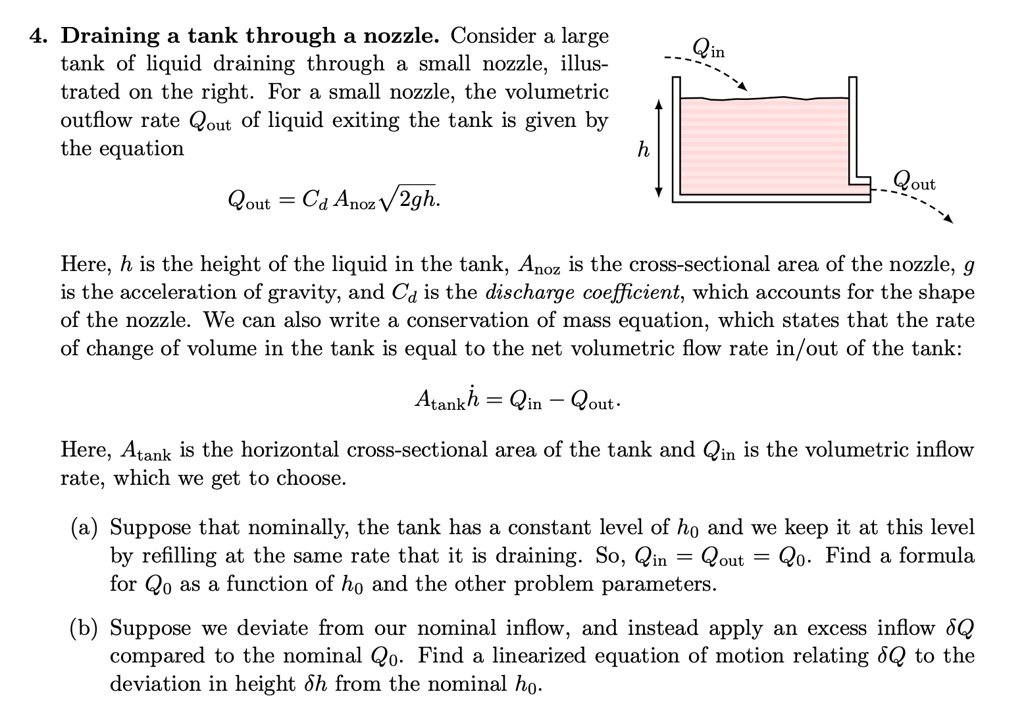
4. Draining a tank through a nozzle. Consider a large
tank of liquid draining through a small nozzle, illus- rated on the right. For a small nozzle, the volumetric
outflow rate $Q_{out}$ of liquid exiting the tank is given by
the equation
$Q_{out} = C_d A_{noz} \sqrt{2gh}$.
Here, $h$ is the height of the liquid in the tank, $A_{noz}$ is the cross-sectional area of the nozzle, $g$
is the acceleration of gravity, and $C_d$ is the discharge coefficient, which accounts for the shape
of the nozzle. We can also write a conservation of mass equation, which states that the rate
of change of volume in the tank is equal to the net volumetric flow rate in/out of the tank:
$A_{tank}\dot{h} = Q_{in} - Q_{out}$.
Here, $A_{tank}$ is the horizontal cross-sectional area of the tank and $Q_{in}$ is the volumetric inflow
rate, which we get to choose.
(a) Suppose that nominally, the tank has a constant level of $h_0$ and we keep it at this level
by refilling at the same rate that it is draining. So, $Q_{in} = Q_{out} = Q_0$. Find a formula
for $Q_0$ as a function of $h_0$ and the other problem parameters.
(b) Suppose we deviate from our nominal inflow, and instead apply an excess inflow $\delta Q$
compared to the nominal $Q_0$. Find a linearized equation of motion relating $\delta Q$ to the
deviation in height $\delta h$ from the nominal $h_0$.