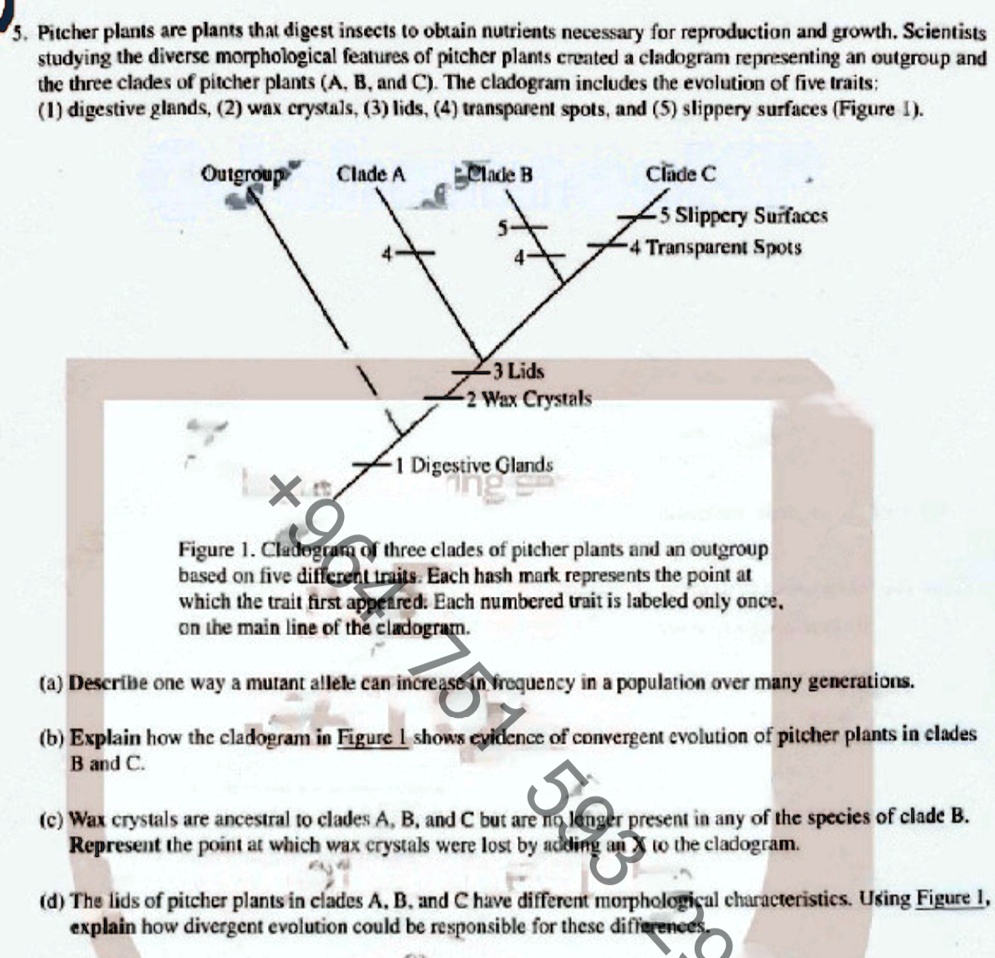
5. Pitcher plants are plants that digest insects to obtain nutrients necessary for reproduction and growth. Scientists
studying the diverse morphological features of pitcher plants created a cladogram representing an outgroup and
the three clades of pitcher plants (A, B, and C). The cladogram includes the evolution of five traits:
(1) digestive glands, (2) wax crystals, (3) lids, (4) transparent spots, and (5) slippery surfaces (Figure 1).
Outgroup
Clade A
Clade B
Clade C
? Slippery Surfaces
-4 Transparent Spots
X
9
-3 Lids
-2 Wax Crystals
1 Digestive Glands
ing
Figure 1. Cladogram of three clades of pitcher plants and an outgroup
based on five different traits. Each hash mark represents the point at
which the trait first appeared. Each numbered trait is labeled only once,
on the main line of the cladogram.
(a) Describe one way a mutant allele can increase in frequency in a population over many generations.
(b) Explain how the cladogram in Figure 1 shows evidence of convergent evolution of pitcher plants in clades
B and C.
(c) Wax crystals are ancestral to clades A, B, and C but are no lenger present in any of the species of clade B.
Represent the point at which wax crystals were lost by adding an X to the cladogram.
(d) The lids of pitcher plants in clades A, B, and C have different morphological characteristics. Using Figure 1,
explain how divergent evolution could be responsible for these differences.