Ace - AI Tutor
Ask Our Educators
Textbooks
My Library
Flashcards
Scribe - AI Notes
Notes & Exams
Download App
renee hart

renee h.

Divider

Questions asked

BEST MATCH

Which of the following would best illustrate what an ERP is? 1) Samantha uses a computerized information system to keep track of all the sales data generated by her bakery. She is considering opening a new bakery on the east side of town. 2) Susan has a system that keeps track of the accounts payable and receivable for her plumbing business. At the end of the year, the system helps her prepare her taxes in just two hours. 3) Mario keeps records of all their business records in a shoe box. Each week they enter all the data into spreadsheets that automatically generate purchase orders based on predetermined inventory reorder points. Production quotas for the coming week are also automatically generated based on customer orders. 4) Alex is a freelance photographer. He keeps records of all expenses and revenues on his cell phone and then e-mails them to himself monthly. The files are stored on his computer and backed up to CD quarterly.

View Answer
divider
BEST MATCH

An adolescent is struggling with peer pressure and making independent decisions. Which of the following nursing interventions would best support development during this stage?Question 8 Answera.Suggest the adolescents parents monitor all their social interactions to prevent poor decision-making.b.Help the adolescent develop problem-solving and decision-making skills to increase independencec.Advise the adolescent to always follow peer behavior to fit in with the groupd.Encourage the adolescent to avoid all peer interactions to reduce the influence of others.

View Answer
divider
BEST MATCH

#6) If 0.80 A of current is passed through a light bulb during 20 hours, how much charge is transferred to this light bulb?

View Answer
divider
BEST MATCH

In HSL color model H=(120) means dark color. Select one: True False

View Answer
divider
BEST MATCH

The velocity profile for a fluid flow over a flat plate is given as $u/U = (3y/5\delta)$ where u is velocity at a distance of \"y\" from the plate and $u = U$ at $y = \delta$, where $\delta$ is the boundary layer thickness. Determine the displacement thickness and the momentum thickness for the above velocity profile.

View Answer
divider
BEST MATCH

what two things happen to the remaining glucose when the amount of glucose available

View Answer
divider
BEST MATCH

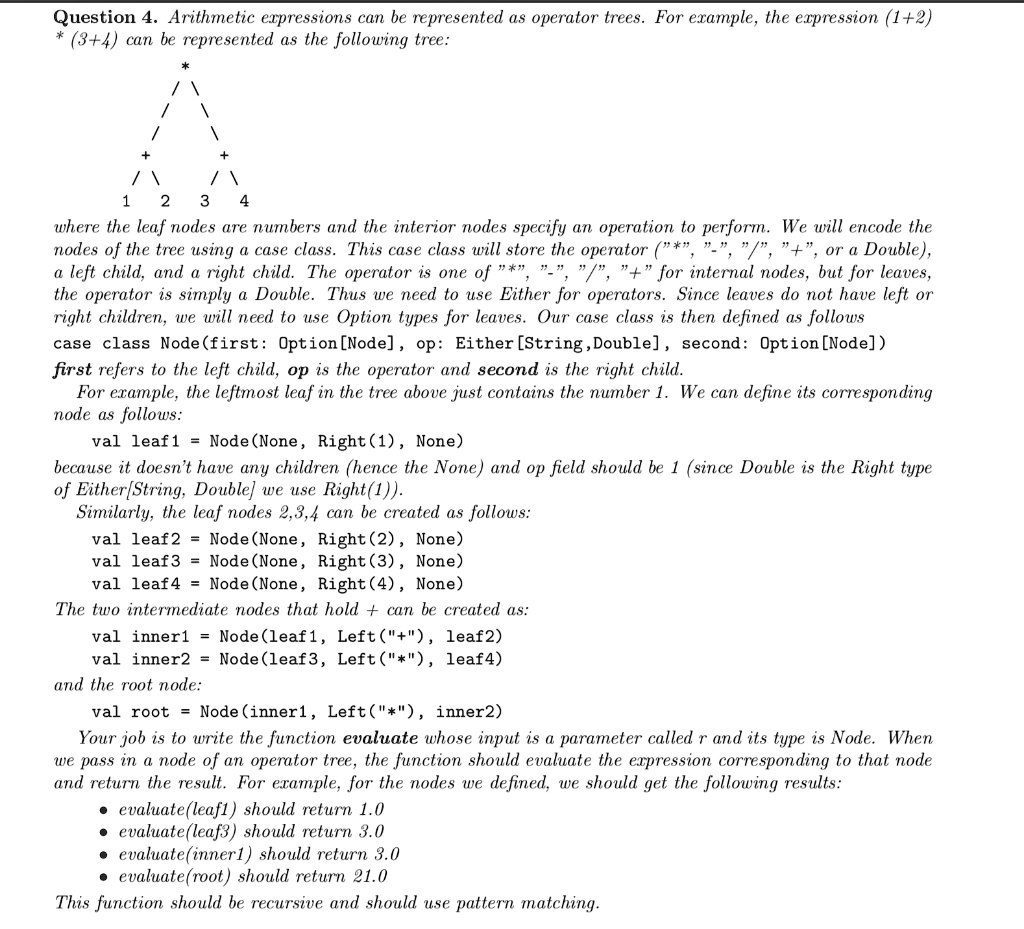
NOTE: Code required in Scala. No other language. Question 4. Arithmetic expressions can be represented as operator trees. For example, the expression 1+2 (3+4) can be represented as the following tree: * / \ / \ / \ + + / \ / \ 1 2 3 4 where the leaf nodes are numbers and the interior nodes specify an operation to perform. We will encode the nodes of the tree using a case class. This case class will store the operator ("*", "-", "/", "+", or a Double), a left child, and a right child. The operator is one of "*", "-", "/", "+" for internal nodes, but for leaves, the operator is simply a Double. Thus we need to use Either for operators. Since leaves do not have left or right children, we will need to use Option types for leaves. Our case class is then defined as follows: case class Node(first: Option[Node], op: Either[String, Double], second: Option[Node]) "first" refers to the left child, "op" is the operator, and "second" is the right child. For example, the leftmost leaf in the tree above just contains the number 1. We can define its corresponding node as follows: val leaf1 = Node(None, Right(1.0), None) because it doesn't have any children (hence the None) and "op" field should be 1.0 (since Double is the Right type of Either[String, Double], we use Right(1.0)). Similarly, the leaf nodes 2, 3, and 4 can be created as follows: val leaf2 = Node(None, Right(2.0), None) val leaf3 = Node(None, Right(3.0), None) val leaf4 = Node(None, Right(4.0), None) The two intermediate nodes that hold "+" can be created as: val inner1 = Node(Some(leaf1), Left("+"), Some(leaf2)) val inner2 = Node(Some(leaf3), Left("*"), Some(leaf4)) and the root node: val root = Node(Some(inner1), Left("*"), Some(inner2)) Your job is to write the function "evaluate" whose input is a parameter called "r" and its type is Node. When we pass in a node of an operator tree, the function should evaluate the expression corresponding to that node and return the result. For example, for the nodes we defined, we should get the following results: evaluate(leaf1) should return 1.0 evaluate(leaf3) should return 3.0 evaluate(inner1) should return 3.0 evaluate(root) should return 21.0 This function should be recursive and should use pattern matching.
View Answer
divider
BEST MATCH

Please solve this problem. CLO 4 Maximum Marks 10 Q3: Henry Company is a marketer of branded foods to retail and foodservice channels. The following table presents Henry's income statements for Year 10, Year 11, and Year 12. Henry Company Income Statement (amounts in millions) Problem 6.18 Year 12 Sales $9,431 Gain on sale of branded product line $465 Cost of goods sold $(5,789) Selling and administrative expenses $(1,882) Interest income $25 Interest expense $(270) Other income (expense) $25 Income before Income Taxes and Cumulative Effect of Accounting Changes $(6,094) Income tax expense $(1,746) Income before Extraordinary Item $27 Extraordinary loss (net of taxes) $(294) Net Income $1,279 Year 11 Sales $8,821 Gain on sale of branded product line $5 Cost of goods sold $(5,884) Selling and administrative expenses $(1,955) Interest income $23 Interest expense $(333) Other income (expense) $1 Income before Income Taxes and Cumulative Effect of Accounting Changes $(5,789) Income tax expense $(1,955) Income before Extraordinary Item $23 Extraordinary loss (net of taxes) $(333) Net Income $673 Year 10 Sales $8,939 Gain on sale of branded product line $465 Cost of goods sold $(5,884) Selling and administrative expenses $(1,955) Interest income $23 Interest expense $(333) Income before Income Taxes and Cumulative Effect of Accounting Changes $(5,884) Income tax expense $(1,955) Income before Extraordinary Item $23 Extraordinary loss (net of taxes) $(333) Net Income $1,463 Notes to the financial statements reveal the following information: 1. Gain on sale of a portion of the branded product line: In Year 10, Henry completed the sale of a portion of one of its branded product lines for $735 million. The transaction resulted in a pretax gain of $464.5 million. The sale did not qualify as a discontinued operation. Henry did not disclose the tax effect of the gain reported in the table above. REQUIRED: a. Discuss whether you would adjust for each of the following items when using earnings to forecast the future profitability of Henry (6 Marks): 1. Gain on sale of a portion of the branded product line. 2. Extraordinary loss. b. Indicate the adjustment you would make to Henry's net income for each item in Requirement a (4 Marks). Solution Q3: III

View Answer
divider
BEST MATCH

A pipe system carries water from a reservoir and discharges it as a free jet at vB = 4 m/s as shown in Fig. 1. The pipe has a 200mm diameter and is a commercial schedule 40 steel pipe. The pipe has a friction factor, f = 0.014. X is a ball type check valve. a. Determine the flow rate of water inside the pipe. b. Calculate the head loss due to pipe friction. c. Calculate minor head loss due to the elbows d. Calculate total head loss in the system e. Calculate height H? A Reservoir H Datum K = 0.05 60 m 20 m 60 m X B 200-mm steel commercial pipe throughout 2-90 elbows K = 0.40 Patm ? = .0113 x 10^-4 m^2/s ? = 999 kg/m^3 Figure 1

View Answer
divider
BEST MATCH

4\newline10\Omega\newline4H\newline+\newlineV(t)\newline-\newline1/6F\newline2H\newline4cos(3t+15^\circ)A\newline150\Omega\newline\mu\newline80\Omega\newline20\Omega\newline512\Omega\newlineDetermine I

View Answer
divider