Ace - AI Tutor
Ask Our Educators
Textbooks
My Library
Flashcards
Scribe - AI Notes
Notes & Exams
Download App
ricardo taylor

ricardo t.

Divider

Questions asked

BEST MATCH

1. Identify the data set's level of measurement. list of 1,222 social security numbers A. ratio B. interval C. nominal D. ordinal

View Answer
divider
BEST MATCH

Use the algebraic method to compute $$ \lim_{x \to 0} \frac{x}{x^2 + 5x} $$

View Answer
divider
BEST MATCH

What is the expected observation if dehydration of KTOF-3 is successful? The crystals will melt The crystals will change color The mass of the crystals will decrease The crystals will gain mass

View Answer
divider
BEST MATCH

\begin{tabular}{|c|c|} \hline atomic mass & \( 107.87 \frac{\mathrm{~g}}{\mathrm{~mol}} \) \\ \hline electronegativity & 1.93 \\ \hline electron affinity & \( 125.6 \frac{\mathrm{~kJ}}{\mathrm{~mol}} \) \\ \hline ionization energy & \( 731.0 \frac{\mathrm{~kJ}}{\mathrm{~mol}} \) \\ \hline heat of fusion & \( 11.3 \frac{\mathrm{~kJ}}{\mathrm{~mol}} \) \\ \hline \end{tabular} You may find additional useful data in the ALEKS Data tab. \begin{tabular}{|c|c|} \hline \begin{tabular}{l} Does the following reaction absorb or release energy? \\ (1) \( \mathrm{Ag}^{+}(g)+e^{-} \rightarrow \mathrm{Ag}(g) \) \end{tabular} & release absorb Can't be decided with the data given. \\ \hline Is it possible to calculate the amount of energy absorbed or released by reaction (1) using only the data above? & \begin{tabular}{l} \( O \) yes \\ O no \end{tabular} \\ \hline If you answered yes to the previous question, enter the amount of energy absorbed or released by reaction (1): & \( \square \mathrm{kJ} / \mathrm{mol} \) \\ \hline \begin{tabular}{l} Does the following reaction absorb or release energy? \\ (2) \( \mathrm{Ag}^{-}(g) \rightarrow \mathrm{Ag}(g)+e^{-} \) \end{tabular} & release absorb Can't be decided with the Sta given. \\ \hline Is it possible to calculate the amount of energy absorbed or released by reaction (2) using only the data above? & \begin{tabular}{l} \( O \) yes \\ O no \end{tabular} \\ \hline If you answered yes to the previous question, enter the amount of energy absorbed or released by reaction (2): & \( \square \mathrm{kJ} / \mathrm{mol} \) \\ \hline \end{tabular}

View Answer
divider
BEST MATCH

A function is given below. Determine the average rate of change of the function between t = 8 and t = 8 + h. f(t)=\sqrt(9t)

View Answer
divider
BEST MATCH

a small left handed girl throes a rock horizontally with the speed of v0 from 25 m tall bridge over a river. the rock lands in the wster 30 m from the base of the bridge. neglect air resistance. write the equations you would use to determine how much time the rock is in the air and speed of the rock when it left her hand

View Answer
divider
BEST MATCH

Caused by elevated levels of antibodies in blood which coat the platelets and interfere with adhesion

View Answer
divider
BEST MATCH

A resident has arthritis. Care includes all of the following except: Oa. Measures to ensure contractures b. Range of motion exercises C. Local heat or cold applications Od. Assistance with activities of daily living

View Answer
divider
BEST MATCH

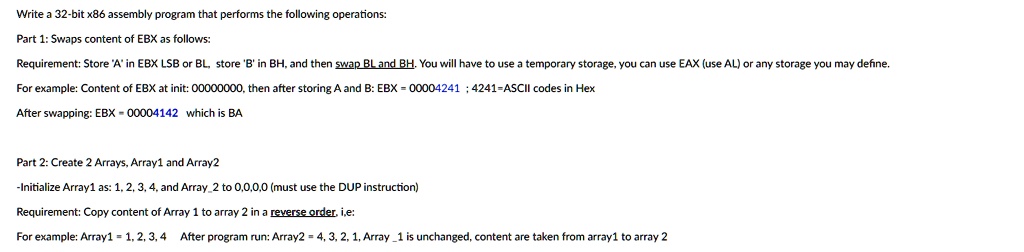
Write a 32-bit x86 assembly program that performs the following operations: Part 1: Swaps content of EBX as follows: Requirement: Store 'A' in EBX LSB or BL, store 'B' in BH, and then swap BL and BH. You will have to use a temporary storage, you can use EAX (use AL) or any storage you may define. For example: Content of EBX at init: 00000000, then after storing A and B: EBX = 00004241; 4241-ASCII codes in Hex After swapping: EBX - 00004142 which is BA Part 2: Create 2 Arrays, Array1 and Array2 -Initialize Array1 as: 1, 2, 3, 4, and Array_2 to 0,0,0,0 (must use the DUP instruction) Requirement: Copy content of Array 1 to array 2 in a reverse order. i,e: For example: Array1 = 1, 2, 3, 4 After program run: Array2 = 4, 3, 2, 1, Array_1 is unchanged, content are taken from array1 to array 2
View Answer
divider
BEST MATCH

[4] Use variation of parameters to find the general solution of each equation. (a) $y'' + 4y' + 4y = \frac{1}{x^2 e^{2x}}$ for $x > 0$ (b) $y'' - 2y' + y = \frac{e^x}{x^2 + 1}$

View Answer
divider