Questions asked
Christopher Dzorkpata
Numerade educator
In a survey, 30 people were asked how much they spent on their child's last birthday gift. The results were roughly bell-shaped with a mean of $41 and standard deviation of $8. Construct a confidence interval at a 80% confidence level. Give your answers to one decimal place. 40 ± 43 Interpret your confidence interval in the context of this problem.
Robin Corrigan
Engineers must consider the breadths of male heads when designing helmets. The company researchers have determined that the population of potential clientele have head breadths that are normally distributed with a mean of 6.4-in and a standard deviation of 1.2-in. In what range would you expect to find the middle 95% of most head breadths? Between [ ] and [ ]. If you were to draw samples of size 34 from this population, in what range would you expect to find the middle 95% of most averages for the breadths of male heads in the sample? Between [ ] and [ ]. Enter your answers as numbers. Your answers should be accurate to 2 decimal places. This problem uses the count-by-thirds empirical rule.
A company produces steel rods. The lengths of the steel rods are normally distributed with a mean of 227.6-cm and a standard deviation of 1.8-cm. For shipment, 20 steel rods are bundled together. Find the probability that the average length of a randomly selected bundle of steel rods is less than 227.9-cm. P(M < 227.9-cm) = 0.7704 Enter your answer as a number accurate to 4 decimal places. Answers obtained using exact z-scores or z-scores rounded to 3 decimal places are accepted.
Breanna Ollech
The number of potholes in any given 1 mile stretch of freeway pavement in Pennsylvania has a bell-shaped distribution. This distribution has a mean of 51 and a standard deviation of 3. Using the empirical rule, what is the approximate percentage of 1-mile long roadways with potholes numbering between 48 and 60? Do not enter the percent symbol. ans = %
Tim Thornhill
Assume Binomial Distribution with n = 12 and p = 0.6. Please show your answers to 4 decimal places. P(X = 6) = P(X ? 6) = P(X < 6) = P(X > 6) = P(X ? 6) =
Benjamin Densmore
A company prices its tornado insurance using the following assumptions: • The probability of a year with tornado(s) is 0.1 . • Each year is independent of any other calendar year. Using the company's assumptions, calculate the probability that there are *fewer* than 4 years with tornadoes in a 21-year period. P(*fewer* than 4 years with tornadoes in a 21-year period) = Express your answer as a decimal accurate to at least 6 decimal places (give every digit your calculator can give you).
Assume Binomial Distribution with n = 12 and p = 0.3. Please show your answers to 4 decimal places. P(X = 4) = P(X ? 4) = P(X < 4) = P(X > 4) = P(X ? 4) =
Qudsiya Anis
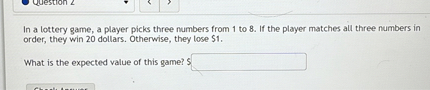
In a lottery game, a player picks three numbers from 1 to 8. If the player matches all three numbers in order, they win 20 dollars. Otherwise, they lose $1. What is the expected value of this game? $
In a lottery game, a player picks three numbers from 1 to 7. If the player matches all three numbers in order, they win 50 dollars. Otherwise, they lose $1. What is the expected value of this game? $
Supposed a certain game is fair and costs $8 if you lose and has a net payoff of $4 if you win. The only possible outcomes of the game are winning and losing. What is the probability of winning?