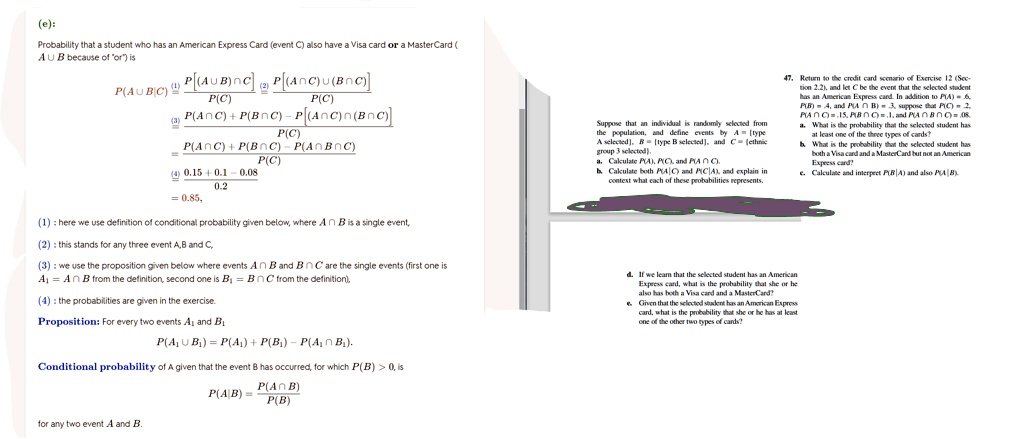
(e):
Probability that a student who has an American Express Card (event C) also have a Visa card or a MasterCard (
Acup B because of "or") is
P(Acup B|C)=^((1))(P[(Acup B)cap C])/(P(C))=^((2))(P[(Acap C)cup (Bcap C)])/(P(C))
=^((3))(P(Acap C)+P(Bcap C)-P[(Acap C)cap (Bcap C)])/(P(C))
=(P(Acap C)+P(Bcap C)-P(Acap Bcap C))/(P(C))
=^((4))(0.15+0.1-0.08)/(0.2)
=0.85,
(1) : here we use definition of conditional probability given below, where Acap B is a single event,
(2) : this stands for any three event A,B and C,
(3) : we use the proposition given below where events Acap B and Bcap C are the single events (first one is
A_(1)=Acap B from the definition, second one is B_(1)=Bcap C from the definition),
(4) : the probabilities are given in the exercise.
Proposition: For every two events A_(1) and B_(1)
P(A_(1)cup B_(1))=P(A_(1))+P(B_(1))-P(A_(1)cap B_(1)).
Conditional probability of A given that the event B has occurred, for which P(B)>0, is
P(A|B)=(P(Acap B))/(P(B))
for any two event A and B.
Suppose that an individual is randomly selected from
the population, and define events by type
A selected
***I NEED HELP WITH E.) I DONT UNDERSTAND THE SOLUTION AND HOW THE FORMULA WAS DERIVIED***
(e): Probability that a student who has an American Express Card (event C) also have a Visa card o a MasterCard ( A U B because of or) is
47, Return to the credit card scenario of Exercise 12 (Sec- tion 2.2), and let C be the event that the selected student has an American Express card. In addition to P(A) = .6, P(B) = .4, and P(A B) = .3, suppose that P(C) = .2, P(A C) = .15, P(B C) = .1, and P(A N B N C) = .08. a. What is the probability that the selected student has at least one of the three types of cards? h. What is the probability that the selected student has both a Visa card and a MasterCard but not an American Express card? e. Calculate and interpret P(|A) and also P(A|).
P(C
P(C)
gP(4nC)+P(BnC)-P[(AnC)n(BnC) P(C) P(AnC)+P(BnC)P(AnBnC) P(C) 0.15 + 0.1 0.08 0.2 0.85,
Suppose that an individual is randomly selected from the population, and define events byA = (type A selected,=type B selected),andC=(ethnic group 3 selected}. a. Calculate P(A), P(C), and P(A C). b, Calculate both P(A|C) and P(C|A), and explain in context what each of these probabilities represents.
(1) : here we use definition of conditional probability given below, where A B is a single event,
(2) : this stands for any three event A,B and C,
(3) : we use the proposition given below where events A B and B C are the single events (first one is A = A .B from the definition, second one is B = B C from the definition),
d.If we learn that the selected student has an American Express card, what is the probability that she or he also has both a Visa card and a MasterCard? e.Given that the selected student has an American Express e d one of the other two types of cards?
(4) : the probabilities are given in the exercise
Proposition: For every two events A and B
P(A U B) = P(A) + P(B) P(A B).
Conditional probability of A given that the event B has occurred, for which P(B) > 0, is
P(AB) P(A|B)= P(B)
for any two event A and B.