The Ricardian Model (2 Countries × 2 Goods)
The world consists of two countries, Home and Foreign. All Foreign quantities and prices are marked
with an asterisk (*). There are only two sectors, Cheese and Wine. All markets are competitive and
Labor is the only factor of production, supplied inelastically. Production is linear, determined by unit
labor requirements. For the data provided below, answer the following questions:
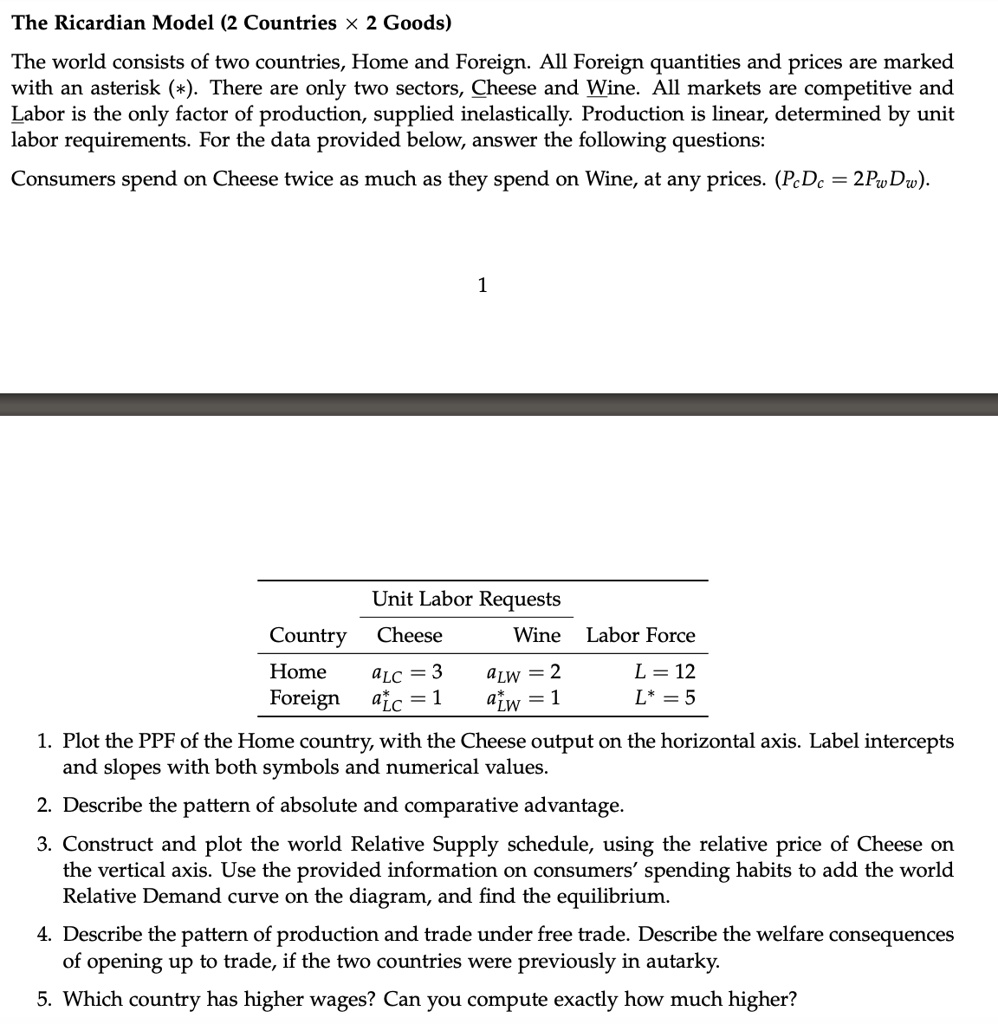
Consumers spend on Cheese twice as much as they spend on Wine, at any prices. ($P_cD_c = 2P_wD_w$).
1
Unit Labor Requests
Country
Cheese
Wine Labor Force
Home
$a_{LC} = 3$
$a_{LW} = 2$
$L = 12$
Foreign
$a^*_{LC} = 1$
$a^*_{LW} = 1$
$L^* = 5$
1. Plot the PPF of the Home country, with the Cheese output on the horizontal axis. Label intercepts
and slopes with both symbols and numerical values.
2. Describe the pattern of absolute and comparative advantage.
3. Construct and plot the world Relative Supply schedule, using the relative price of Cheese on
the vertical axis. Use the provided information on consumers' spending habits to add the world
Relative Demand curve on the diagram, and find the equilibrium.
4. Describe the pattern of production and trade under free trade. Describe the welfare consequences
of opening up to trade, if the two countries were previously in autarky.
5. Which country has higher wages? Can you compute exactly how much higher?