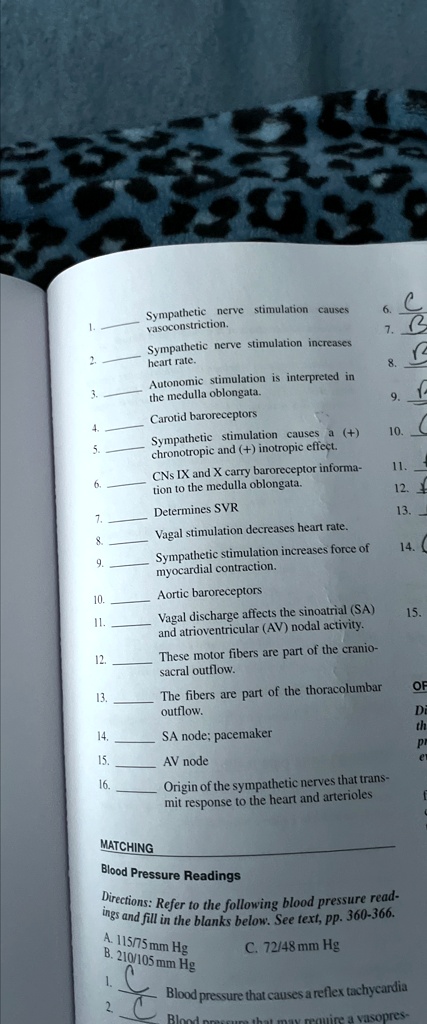
q, Sympathetic nerve stimulation causes vasoconstriction.
q, Sympathetic nerve stimulation increases heart rate.
q, Autonomic stimulation is interpreted in the medulla oblongata.
q, Carotid baroreceptors
q, Sympathetic stimulation causes a (t) chronotropic and ( + ) inotropic effect.
q, CNs IX and X carry baroreceptor information to the medulla oblongata.
q, Determines SVR
q, Vagal stimulation decreases heart rate.
q, Sympathetic stimulation increases force of myocardial contraction.
q, Aortic baroreceptors
q, Vagal discharge affects the sinoatrial (SA) and atrioventricular (AV) nodal activity.
◻ These motor fibers are part of the craniosacral outflow.
◻ The fibers are part of the thoracolumbar outflow.
q, SA node; pacemaker
◻ AV node
q, Origin of the sympathetic nerves that transmit response to the heart and arterioles
MATCHING
q,
Blood Pressure Readings
Directions: Refer to the following blood pressure readings and fill in the blanks below. See text, pp. 360-366.
A. (115)/(75)mmHg
B. (210)/(105)mmHg
C. (72)/(48)mmHg
q, Blood pressure that causes a reflex tachycardia
Sympathetic nerve stimulation causes vasoconstriction. Sympathetic nerve stimulation increases heart rate. Autonomic stimulation is interpreted in the medulla oblongata. Carotid baroreceptors
10
T.
chronotropic and (+) inotropic effect. CNs IX and X carry baroreceptor informa- 11. tion to the medulla oblongata. 12. Determines SVR 13. Vagal stimulation decreases heart rate Sympathetic stimulation increases force of 14. myocardial contraction. Aortic baroreceptors Vagal discharge affects the sinoatrial (SA 15. and atrioventricular (AV nodal activity These motor fibers are part of the cranio- sacral outflow. The fibers are part of the thoracolumbar OF outflow. D th SA node;pacemaker p AV node Origin of the sympathetic nerves that trans- mit response to the heart and arterioles
7.
8.
9.
10.
11.
12.
13.
14.
15.
16.
MATCHING Blood Pressure Readings
A.115/5mm Hg B.210/105mm Hg
C.72/48mm Hg