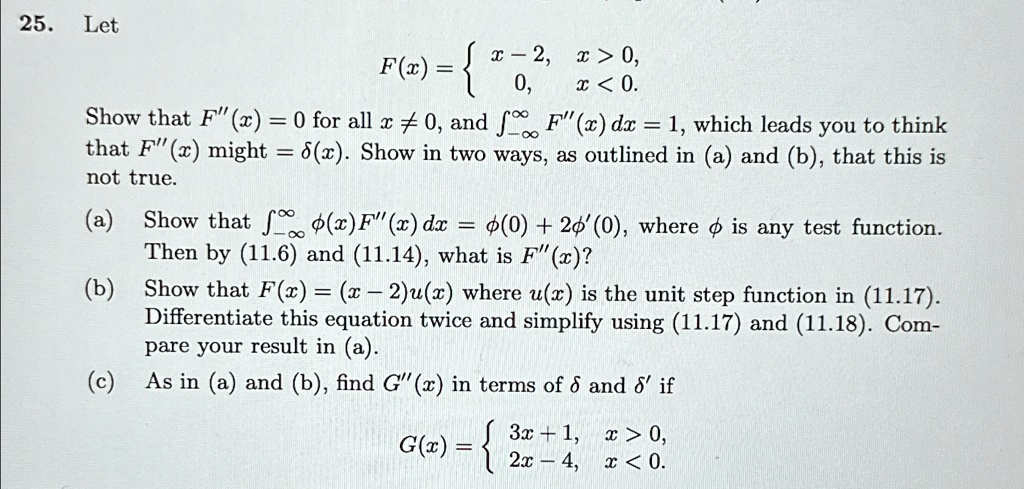
Let
F(x) = { (x-2, x > 0), (0, x < 0) }
Show that F''(x) = 0 for all x ≠ 0, and ∫₋∞ ∞ F''(x)dx = 1, which leads you to think that F''(x) might = δ(x). Show in two ways, as outlined in (a) and (b), that this is not true.
(a) Show that ∫₋∞ ∞ φ(x)F''(x)dx = φ(0) + 2φ'(0), where φ is any test function. Then by (11.6) and (11.14), what is F''(x) ?
(b) Show that F(x) = (x-2)u(x) where u(x) is the unit step function in (11.17). Differentiate this equation twice and simplify using (11.17) and (11.18). Compare your result in (a).
(c) As in (a) and (b), find G''(x) in terms of δ and δ' if
G(x) = { (3x+1, x > 0), (2x-4, x < 0) }