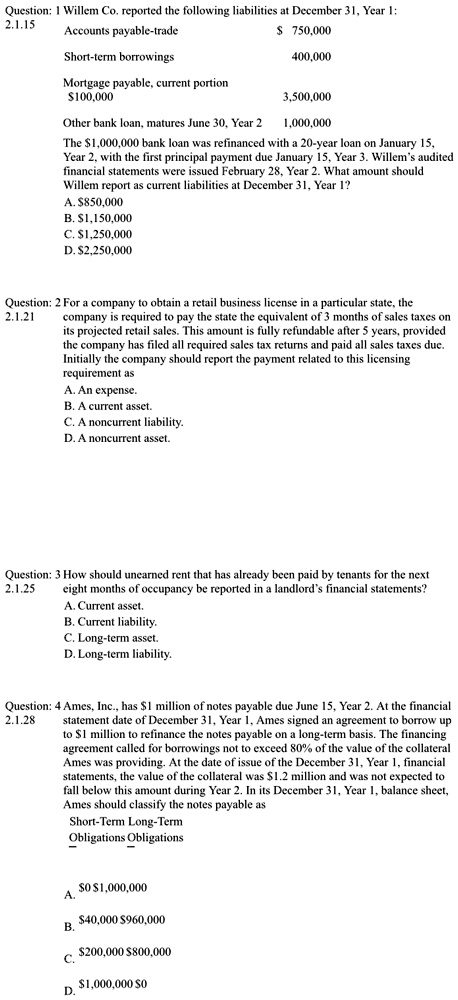
Accounts payable-trade
Short-term borrowings
$750,000
400,000
400,000
Mortgage payable, current portion
$100,000
3,500,000
Other bank loan, matures June 30, Year 2,1,000,000
The $1,000,000 bank loan was refinanced with a 20 -year loan on January 15 ,
Year 2, with the first principal payment due January 15 , Year 3. Willem's audited
financial statements were issued February 28, Year 2. What amount should
Willem report as current liabilities at December 31, Year 1?
A. $850,000
B. $1,150,000
C. $1,250,000
D. $2,250,000
Question: 2 For a company to obtain a retail business license in a particular state, the
2.1.21
company is required to pay the state the equivalent of 3 months of sales taxes on
its projected retail sales. This amount is fully refundable after 5 years, provided
the company has filed all required sales tax returns and paid all sales taxes due.
Initially the company should report the payment related to this licensing
requirement as
A. An expense.
B. A current asset.
C. A noncurrent liability.
D. A noncurrent asset.
Question: 3 How should unearned rent that has already been paid by tenants for the next
2.1.25 eight months of occupancy be reported in a landlord's financial statements?
A. Current asset.
B. Current liability.
C. Long-term asset.
D. Long-term liability.
Question: 4 Ames, Inc., has $1 million of notes payable due June 15, Year 2. At the financial
2.1.28 statement date of December 31, Year 1, Ames signed an agreement to borrow up
to $1 million to refinance the notes payable on a long-term basis. The financing
agreement called for borrowings not to exceed 80% of the value of the collateral
Ames was providing. At the date of issue of the December 31, Year 1, financial
statements, the value of the collateral was $1.2 million and was not expected to
fall below this amount during Year 2. In its December 31, Year 1, balance sheet,
Ames should classify the notes payable as
Short-Term Long-Term
Obligations Obligations
A. $0$1,000,000
B. $40,000$960,000
C. $200,000$800,000
D. $1,000,000$0 What is the correct answers
Question: 1 Willem Co. reported the following liabilities at December 31, Year 1: 2.1.15 Accounts payable-trade $ 750,000
Short-term borrowings
400,000
Mortgage payable, current portion $100,000
3,500,000
Other bank loan, matures June 30, Year 2 1,000,000 The $1,000,000 bank loan was refinanced with a 20-year loan on January 15 Year 2, with the first principal payment due January 15, Year 3. Willems audited financial statements were issued February 28, Year 2. What amount should Willem report as current liabilities at December 31, Year 1? A. $850,000 B. $1,150,000 C. $1,250,000 D. $2,250,000
Question: 2 For a company to obtain a retail business license in a particular state, the 2.1.21 company is required to pay the state the equivalent of 3 months of sales taxes on its projected retail sales. This amount is fully refundable after 5 years, provided the company has filed all required sales tax returns and paid all sales taxes due. Initially the company should report the payment related to this licensing requirement as A. An expense. B. A current asset. C. A noncurrent liability. D. A noncurrent asset.
Question: 3 How should unearned rent that has already been paid by tenants for the next 2.1.25 eight months of occupancy be reported in a landlords financial statements? A. Current asset. B.Current liability. C. Long-term asset. D. Long-term liability.
Ouestion:4 Ames.Inc..has $1 million of notes pavable due June 15.Year 2.At the financial 2.1.28 statement date of December 31, Year 1, Ames signed an agreement to borrow up to $1 million to refinance the notes payable on a long-term basis. The financing agreement called for borrowings not to exceed 80% of the value of the collateral Ames was providing. At the date of issue of the December 31, Year 1, financial statements, the value of the collateral was $1.2 million and was not expected to fall below this amount during Year 2. In its December 31, Year 1, balance sheet, Ames should classify the notes payable as Short-Term Long-Term Obligations Obligations
$0 $1,000,000 A.
$40,000 $960,000 B.