Ace - AI Tutor
Ask Our Educators
Textbooks
My Library
Flashcards
Scribe - AI Notes
Notes & Exams
Download App
Saadet Burcu Tenekecioglu

Saadet Burcu T.

Divider

Questions asked

INSTANT ANSWER

\( d s=\left(r^{2} s^{2}+r^{2}-s^{2}-1\right) d r \)

View Answer
divider
INSTANT ANSWER

2) \( \frac{d y}{d t}=t e^{y+t^{2}} \)

View Answer
divider
INSTANT ANSWER

1) \( \frac{d y}{d x}=\frac{y}{x} \) 2) \( \frac{d y}{d t}=t e^{y+t^{2}} \) 3) \( d s=\left(r^{2} s^{2}+\right. \)

View Answer
divider
ANSWERED

1 Solve the 1) \( \frac{d y}{d x}=\frac{y}{x} \) (answer

View Answer
divider
INSTANT ANSWER

(2) (25 pts.) Express the triple integral \[ \iiint_{V} d V \] in terms of iterated integrals in six different ways. The region \( V \) lies in the first octant and is bounded by the cylinder \( x^{2}+z^{2}=4 \) and the plane \( y=3 \) Find the value of the integral. (Hint: \( d V=d x d y d z=d x d z d y=d y d z d x=d y d x d z=d z d y d x=d z d x d y \).)

View Answer
divider
INSTANT ANSWER

QUESTIONS: (1) ( 25 pts.) Find the shortest distance from origin to the constraints \( z^{2}=x^{2}+y^{2} \) and \( x+y-z+1=0 \).

View Answer
divider
ANSWERED

H M verified

Numerade educator

Is the following statement "If ( f(x, y, z)=x^{2} y^{3}-4 x z ) then the directional derivative of ( f ) in the direction ( vec{v}=langle-1,2,0 angle ) is [ D_{vec{u}} f=frac{1}{sqrt{5}}left(4 z+2 x y^{3}+6 x^{2} y^{2} ight) ] true or false? Select one: True False

View Answer
divider
ANSWERED

Wei Zhang verified

Numerade educator

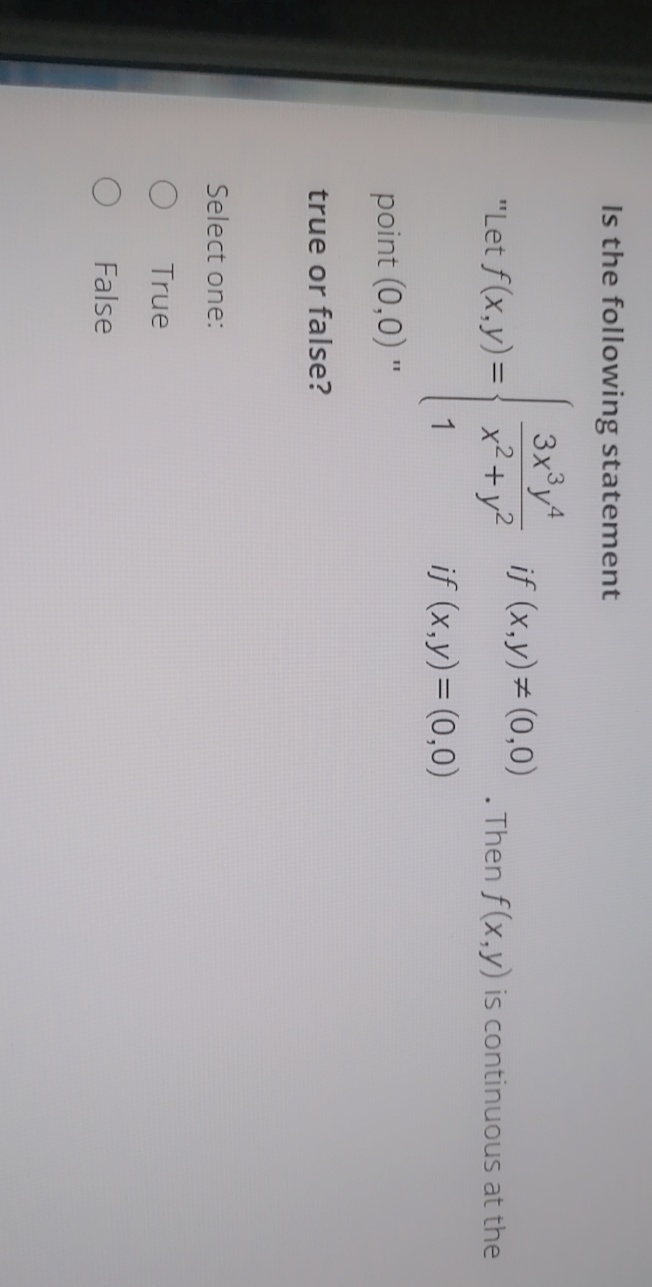
Is the following statement "Let ( f(x, y)=left{egin{array}{ll}frac{3 x^{3} y^{4}}{x^{2}+y^{2}} & ext { if }(x, y) eq(0,0) \ 1 & ext { if }(x, y)=(0,0)end{array} ight. ). Then ( f(x, y) ) is continuous at the point ( (0,0) " ) true or false? Select one: True False
View Answer
divider
ANSWERED

H M verified

Numerade educator

Is the following statement "Equation of the tangent plane to the surface [ e^{z y}+x z^{2}=6 x y^{4} z^{3} ] at the point ( (-1,0,1) ) is [ x+y-2 z=3 ] true or false? Select one: True False

View Answer
divider
ANSWERED

H M verified

Numerade educator

Is the following statement "Since ( lim _{n ightarrow infty}left(frac{frac{1}{n sqrt{n^{6}+3}}}{frac{1}{n^{2}}} ight)=0 ) and ( sum_{n=1}^{infty} frac{1}{n^{2}} ) is convergent, by Limit Comparison Test ( sum_{n=1}^{infty} frac{1}{n sqrt{n^{6}+3}} ) is convergent." true or false? Select one: True False

View Answer
divider