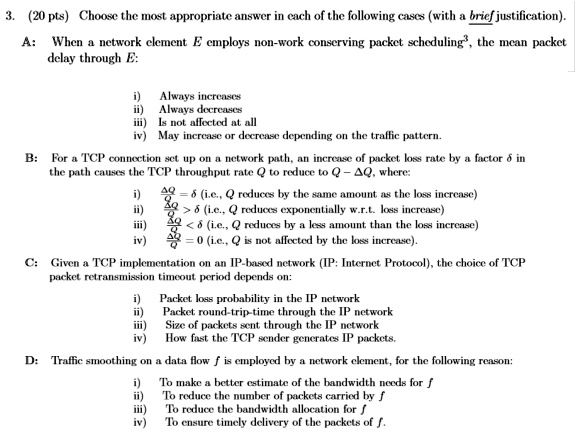
3. (20 pts) Choose the most appropriate answer in each of the following cases (with a brief justification).
A: When a network element E employs non-work conserving packet scheduling³, the mean packet
delay through E:
i) Always increases
ii) Always decreases
iii) Is not affected at all
iv) May increase or decrease depending on the traffic pattern.
B: For a TCP connection set up on a network path, an increase of packet loss rate by a factor $\delta$ in
the path causes the TCP throughput rate Q to reduce to $Q - \Delta Q$, where:
i) $\frac{\Delta Q}{Q} = \delta$ (i.e., Q reduces by the same amount as the loss increase)
ii) $\frac{\Delta Q}{Q} > \delta$ (i.e., Q reduces exponentially w.r.t. loss increase)
iii) $\frac{\Delta Q}{Q} < \delta$ (i.e., Q reduces by a less amount than the loss increase)
iv) $\frac{\Delta Q}{Q} = 0$ (i.e., Q is not affected by the loss increase).
C: Given a TCP implementation on an IP-based network (IP: Internet Protocol), the choice of TCP
packet retransmission timeout period depends on:
i) Packet loss probability in the IP network
ii) Packet round-trip-time through the IP network
iii) Size of packets sent through the IP network
iv) How fast the TCP sender generates IP packets.
D: Traffic smoothing on a data flow f is employed by a network element, for the following reason:
i) To make a better estimate of the bandwidth needs for f
ii) To reduce the number of packets carried by f
iii) To reduce the bandwidth allocation for f
iv) To ensure timely delivery of the packets of f.