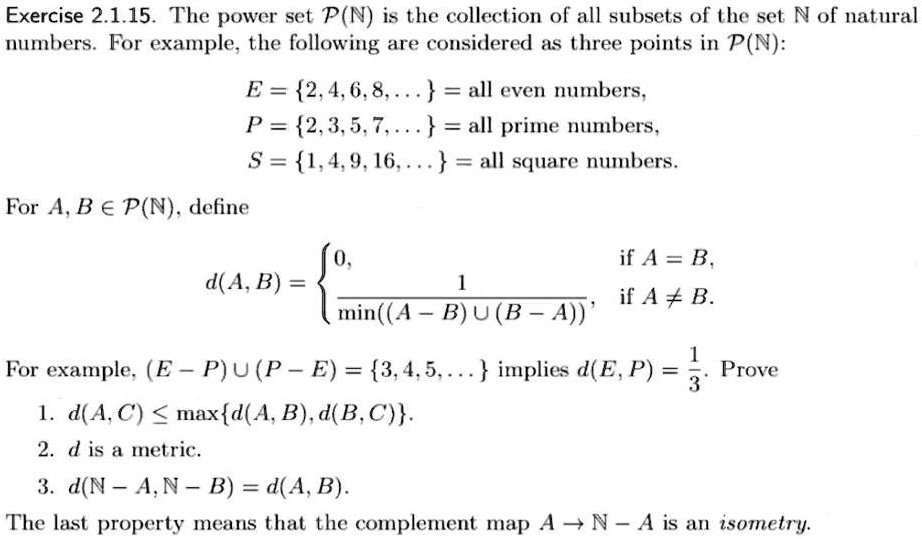
Exercise 2.1.15. The power set $P(N)$ is the collection of all subsets of the set $N$ of natural numbers. For example, the following are considered as three points in $P(N)$:
$E = \{2, 4, 6, 8, ...\} = $ all even numbers,
$P = \{2, 3, 5, 7, ...\} = $ all prime numbers,
$S = \{1, 4, 9, 16, ...\} = $ all square numbers.
For $A, B \in P(N)$, define
$d(A, B) = \begin{cases} 0, & \text{if } A = B, \\\frac{1}{min((A - B) \cup (B - A))}, & \text{if } A \neq B. \end{cases}$
For example, $(E - P) \cup (P - E) = \{3, 4, 5, ...\} $ implies $d(E, P) = \frac{1}{3}$. Prove
1. $d(A, C) \le max\{d(A, B), d(B, C)\}$.
2. $d$ is a metric.
3. $d(N - A, N - B) = d(A, B)$.
The last property means that the complement map $A \to N - A$ is an isometry.