IHP 330 Module Two Worksheet
Complete this worksheet by replacing the bracketed text with the relevant information.
Part 1: Measuring Disease
A causal relationship between cigarette smoking and lung cancer was first suspected in the 1920s based on
clinical observations. To test this apparent association, numerous epidemiologic studies were undertaken
between 1930 and 1960. Two studies were conducted by Richard Doll and Austin Bradford Hill in Great
Britain. The first was a case-control study begun in 1947; it compared the smoking habits of lung cancer
patients with the smoking habits of other patients. The second was a cohort study begun in 1951; it recorded
causes of death among British physicians in relation to smoking habits. This case study deals first with the
case-control study and then with the cohort study.
Data for the case-control study were obtained from hospitalized patients in London and the vicinity over a
four-year period (April 1948-February 1952). Initially, 20 hospitals, and later more, were asked to notify the
investigators of all patients admitted with a new diagnosis of lung cancer. These patients were then
interviewed concerning smoking habits, as were controls selected from patients with other disorders
(primarily nonmalignant) who were hospitalized in the same hospitals at the same time. Data for the cohort
study were obtained from the population of all physicians listed in the British Medical Register who resided
England and Wales as of October 1951. Information about present and past smoking habits was obtained by
using a questionnaire. Information about lung cancer came from death certificates and other mortality data
recorded during the ensuing years.
Over 1700 patients with lung cancer, all under age 75, were eligible for the case-control study. About 15%
these persons were not interviewed because of death, discharge, severity of illness, or inability to speak
English. An additional group of patients were interviewed but later excluded when the initial lung cancer
diagnosis proved to be mistaken. The final study group included 1,465 cases (1,357 males and 108 females
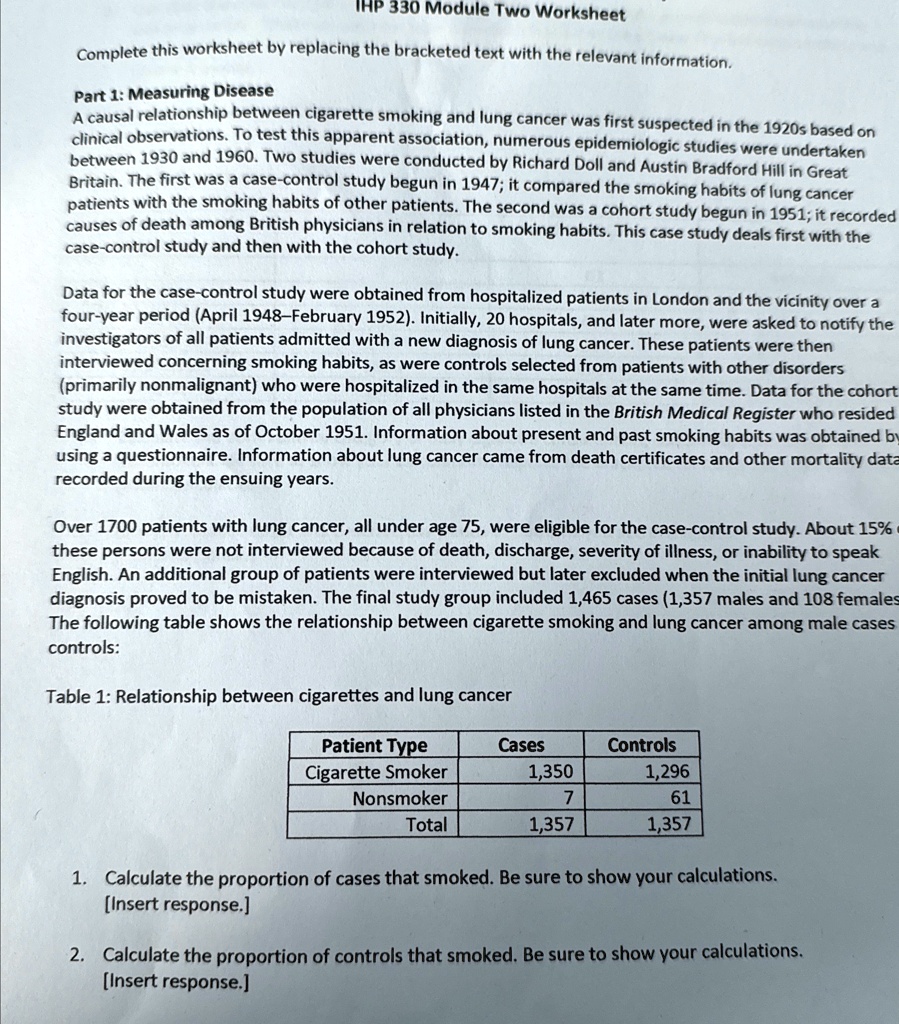
The following table shows the relationship between cigarette smoking and lung cancer among male cases
controls:
Table 1: Relationship between cigarettes and lung cancer
Patient Type
Cases
Controls
Cigarette Smoker
1,350
1,296
Nonsmoker
7
61
Total
1,357
1,357
1. Calculate the proportion of cases that smoked. Be sure to show your calculations.
[Insert response.]
2. Calculate the proportion of controls that smoked. Be sure to show your calculations.
[Insert response.]