Part J
Read about rheumatoid arthritis (RA) on page 537 of your textbook, review supplemental information, and then answer the following question.
Supplemental information: RA is also a chronic systemic autoimmune disease that primarily involves the joints. Damage from RA is facilitated by cytokines, chemokines, and enzymes (e.g., metalloproteases). Peripheral joints like the wrists and metacarpophalangeal are equally
inflamed, leading to gradual destruction of articular structures. This is usually accompanied by systemic symptoms. Plasma cells produce antibodies called rheumatoid factor (RF). Macrophages and lymphocytes produce pro-inflammatory cytokines and chemokines that further promote
inflammation. Diagnosis is based on specific clinical, laboratory (serology for RF), and diagnostic imaging (x-ray, CT, etc.) features. Treatment involves drugs, physical measures, and sometimes surgery. Disease-modifying antirheumatic drugs can be given to help control symptoms
and slow down disease progression. Women are affected at a reate 2-3 times more often than men. RA affects about 1% of the population. Onset of RA can occur at any age. It is most often seen in indivuduals between 35-50 years of age but can be seen during childhood as juvenile
idiopathic arthritis or show up later during old age.
Select all the correct features of RA disease.
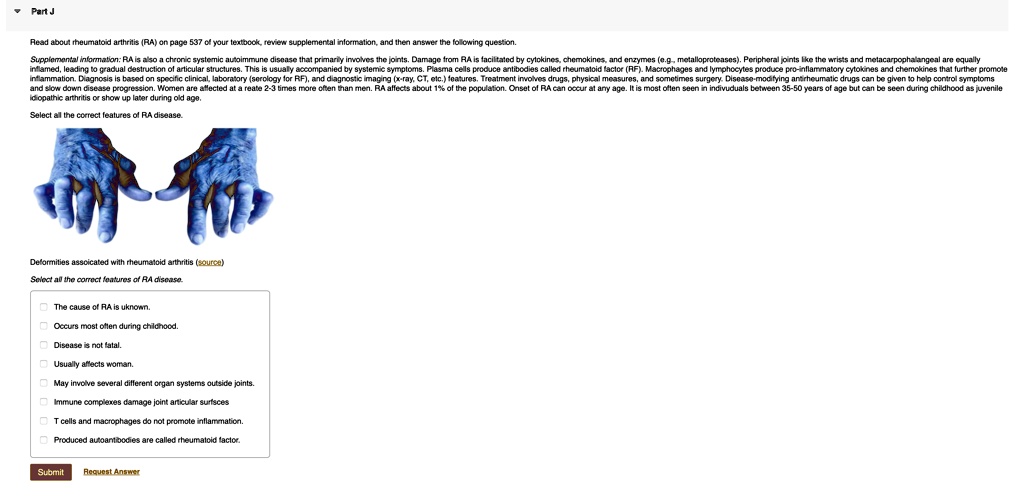
Deformities assoicated with rheumatoid arthritis (source)
Select all the correct features of RA disease.
The cause of RA is uknown.
Occurs most often during childhood.
Disease is not fatal.
Usually affects woman.
May involve several different organ systems outside joints.
Immune complexes damage joint articular surfsces
T cells and macrophages do not promote inflammation.
Produced autoantibodies are called rheumatoid factor.
Submit Request Answer