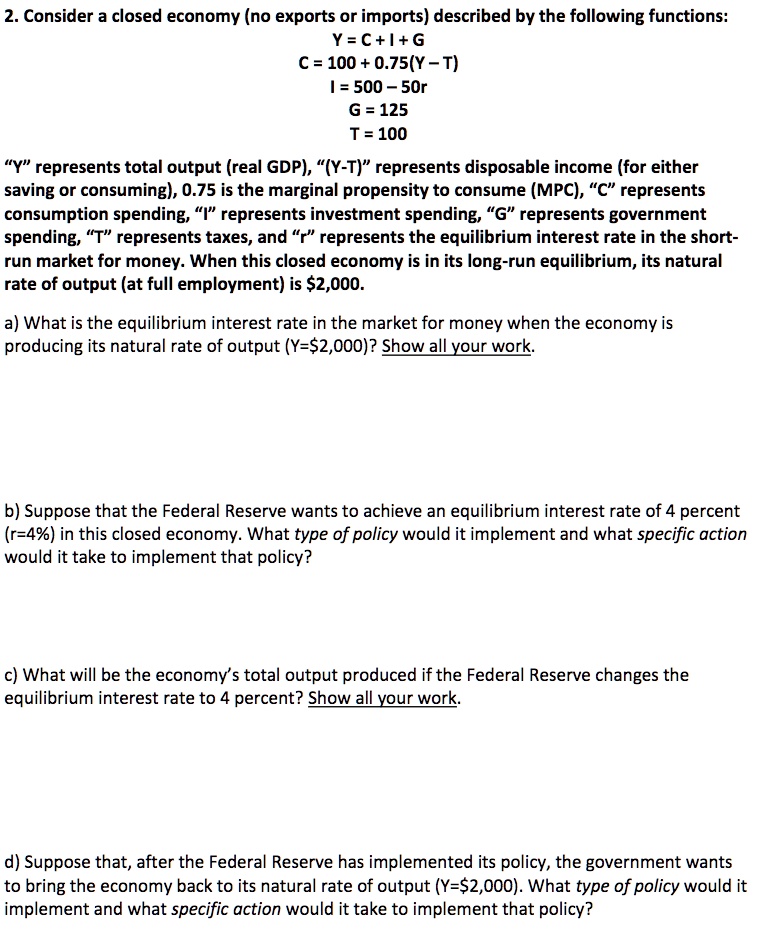
2. Consider a closed economy (no exports or imports) described by the following functions:
Y=C+I+G
C = 100+ 0.75(Y-T)
1 = 500-50r
G = 125
T = 100
"Y" represents total output (real GDP), "(Y-T)" represents disposable income (for either
saving or consuming), 0.75 is the marginal propensity to consume (MPC), "C" represents
consumption spending, "I" represents investment spending, "G" represents government
spending, "T" represents taxes, and "r" represents the equilibrium interest rate in the short-
run market for money. When this closed economy is in its long-run equilibrium, its natural
rate of output (at full employment) is $2,000.
a) What is the equilibrium interest rate in the market for money when the economy is
producing its natural rate of output (Y=$2,000)? Show all your work.
b) Suppose that the Federal Reserve wants to achieve an equilibrium interest rate of 4 percent
(r=4%) in this closed economy. What type of policy would it implement and what specific action
would it take to implement that policy?
c) What will be the economy's total output produced if the Federal Reserve changes the
equilibrium interest rate to 4 percent? Show all your work.
d) Suppose that, after the Federal Reserve has implemented its policy, the government wants
to bring the economy back to its natural rate of output (Y=$2,000). What type of policy would it
implement and what specific action would it take to implement that policy?