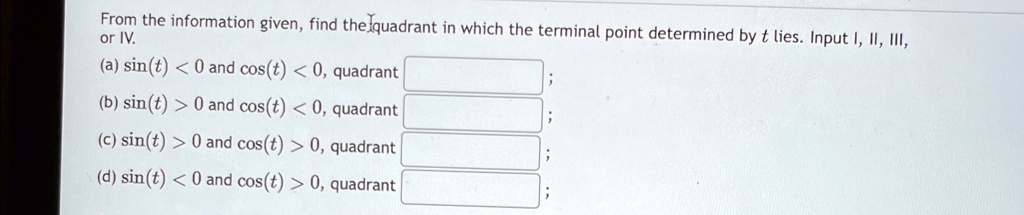
From the information given, find the quadrant in which the terminal point determined by \(t\) lies. Input I, II, III, or IV.
(a) \(\sin(t) < 0\) and \(\cos(t) < 0\), quadrant
(b) \(\sin(t) > 0\) and \(\cos(t) < 0\), quadrant
(c) \(\sin(t) > 0\) and \(\cos(t) > 0\), quadrant
(d) \(\sin(t) < 0\) and \(\cos(t) > 0\), quadrant