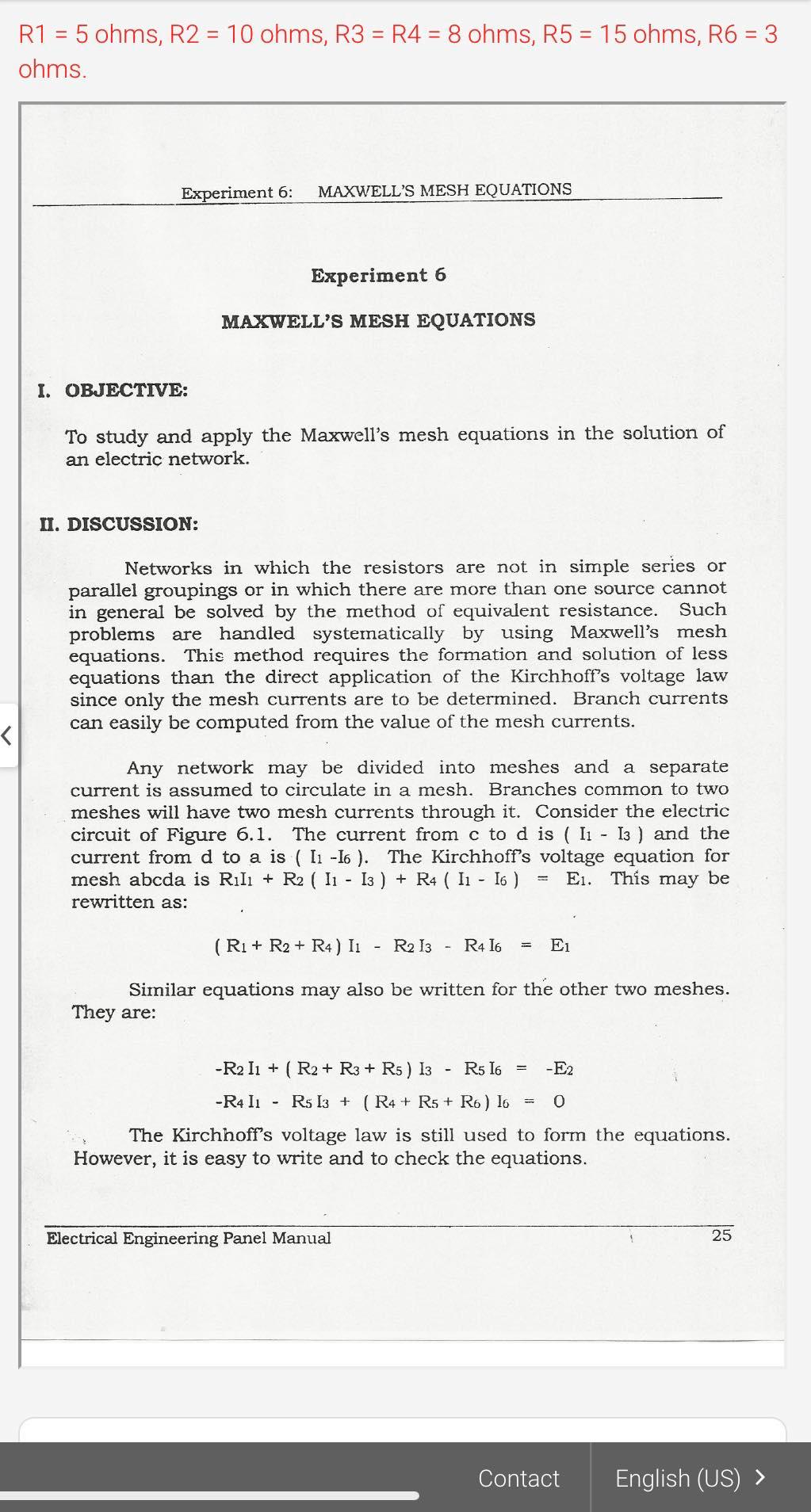
\( \mathrm{R} 1=5 \) ohms, R2 \( =10 \) ohms, R3 = R4 = 8 ohms, R5 = 15 ohms, R6 \( =3 \) ohms.
Experiment 6: MAXWELL'S MESH EQUATIONS
Experiment 6
MAXWELL'S MESH EQUATIONS
I. OBJECTIVE:
To study and apply the Maxwell's mesh equations in the solution of an electric network.
11. DISCUSSION:
Networks in which the resistors are not in simple series or parallel groupings or in which there are more than one source cannot in general be solved by the method of equivalent resistance. Such problems are handled systematically by using Maxwell's mesh equations. This method requires the formation and solution of less equations than the direct application of the Kirchhoff's voltage law since only the mesh currents are to be determined. Branch currents can easily be computed from the value of the mesh currents.
Any network may be divided into meshes and a separate current is assumed to circulate in a mesh. Branches common to two meshes will have two mesh currents through it. Consider the electric circuit of Figure 6.1. The current from \( \mathrm{c} \) to \( \mathrm{d} \) is \( \left(\mathrm{I}_{1}-\mathrm{I}_{3}\right) \) and the current from \( d \) to \( a \) is \( \left(I_{1}-I_{6}\right) \). The Kirchhoff's voltage equation for mesh abcda is \( R_{1} I_{1}+R_{2}\left(I_{1}-I_{3}\right)+R_{4}\left(I_{1}-I_{6}\right)=E_{1} \). This may be rewritten as:
\[
\left(R_{1}+R_{2}+R_{4}\right) I_{1}-R_{2} I_{3}-R_{4} I_{6}=E_{1}
\]
Similar equations may also be written for the other two meshes. They are:
\[
\begin{array}{l}
-R_{2} I_{1}+\left(R_{2}+R_{3}+R_{5}\right) I_{3}-R_{5} I_{6}=-E_{2} \\
-R_{4} I_{1}-R_{5} I_{3}+\left(R_{4}+R_{5}+R_{6}\right) I_{6}=0
\end{array}
\]
The Kirchhoff's voltage law is still used to form the equations. However, it is easy to write and to check the equations.
Electrical Engineering Panel Manual
25