Questions asked
The team can increase cash by paying their long-term debt. A True B False
What is NOT a good way to organize ideas in your writing?
A sample with 4.0x10^15 atoms has an activity of 3.5x10^12 Bq. It has a half life of 600 years. A) how much is the decay constant B) how much time will it take to drop to 1/4 of its original amount
All irregular words are more difficult for students to learn than regular words; therefore, they all require equal amounts of practice. True False
The City of Statesboro is issuing a 30-year bond with a face value of $80,000,000 and a stated annual interest rate of 5 percent. The town will make interest payments twice a year. Calculate the semiannual interest payment. Calculate how much Statesboro will receive from the bond offering under the following conditions: Market interest rates remain unchanged at the time of the offering. Market interest rates increase to 6 percent at the time of the offering.
QUESTION 20 1 POINT A sample of bacteria is decaying according to an exponential decay model. If the sample begins with 900 bacteria, and after 13 minutes there are 540 bacteria, after how many minutes will there be 40 bacteria remaining?
Use algebraic techniques to rewrite $f(x) = \frac{2x^{\frac{17}{4}} - 9x^{\frac{21}{4}} - 6}{\sqrt[4]{x}}$ as a sum of three terms. Then find $f'(x)$.
Differentiate the function. \(y = e^{3x^9}\) \(y'(x) = \)
A double-threaded trapezoidal power screw has a load of 4000 N, a nominal diameter of 24 mm, a mean collar diameter of 35 mm, a thread coefficient of friction of 0.16, and a collar coefficient of friction of 0.12. Determine the following: (a) Pitch diameter of the screw. (b) Screw torque required to raise the load. (c) Maximum thread coefficient of friction allowed to prevent the screw from self-locking if collar friction is eliminated.
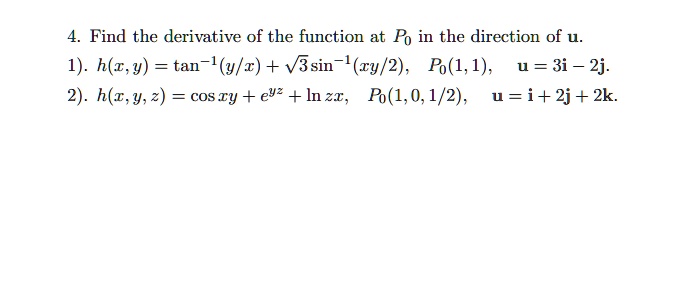
4. Find the derivative of the function at $P_0$ in the direction of u. 1). $h(x, y) = \tan^{-1}(y/x) + \sqrt{3}\sin^{-1}(xy/2)$, $P_0(1,1)$, $u = 3i - 2j$. 2). $h(x, y, z) = \cos xy + e^{yz} + \ln zx$, $P_0(1,0,1/2)$, $u = i + 2j + 2k$.