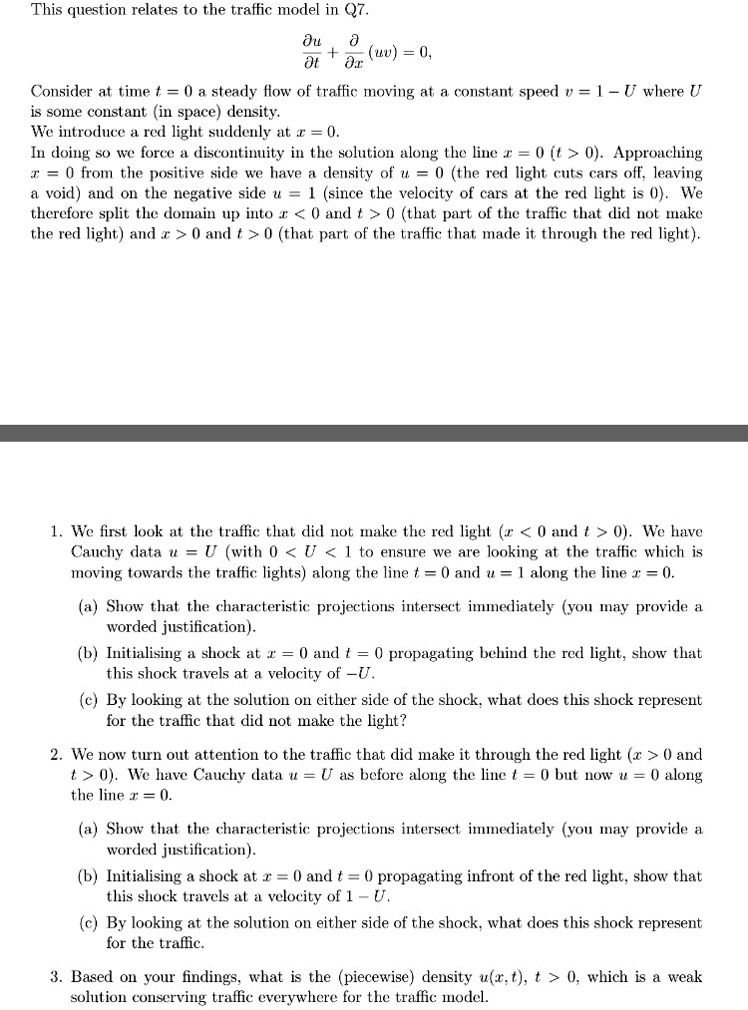
This question relates to the traffic model in Q7.
Ou.O -= 0.030
Consider at time t = 0, a steady flow of traffic moving at a constant speed v = 1 - U, where U is some constant (in space density). We introduce a red light suddenly at t = 0. In doing so, we force a discontinuity in the solution along the line x = 0 (t > 0). Approaching x = 0 from the positive side, we have a density of u = 0. The red light cuts cars off, leaving a void, and on the negative side, u = 1, since the velocity of cars at the red light is 0. We, therefore, split the domain up into x < 0 and t > 0 (that part of the traffic that did not make the red light) and x > 0 and t > 0 (that part of the traffic that made it through the red light).
1. We first look at the traffic that did not make the red light (x < 0 and t > 0). We have Cauchy data u = U with 0 < U < 1 to ensure we are looking at the traffic which is moving towards the traffic lights along the line t = 0 and u = 1 along the line x = 0.
(a) Show that the characteristic projections intersect immediately (you may provide a worded justification).
(b) Initializing a shock at x = 0 and t = 0 propagating behind the red light, show that this shock travels at a velocity of -U.
(c) By looking at the solution on either side of the shock, what does this shock represent for the traffic that did not make the light?
2. We now turn our attention to the traffic that did make it through the red light (x > 0 and t > 0). We have Cauchy data u = U as before along the line t = 0, but now u = 0 along the line x = 0.
(a) Show that the characteristic projections intersect immediately (you may provide a worded justification).
(b) Initializing a shock at x = 0 and t = 0 propagating in front of the red light, show that this shock travels at a velocity of 1 - U.
(c) By looking at the solution on either side of the shock, what does this shock represent for the traffic?
3. Based on your findings, what is the piecewise density u(x, t), t > 0, which is a weak solution conserving traffic everywhere for the traffic model.