A
M
D
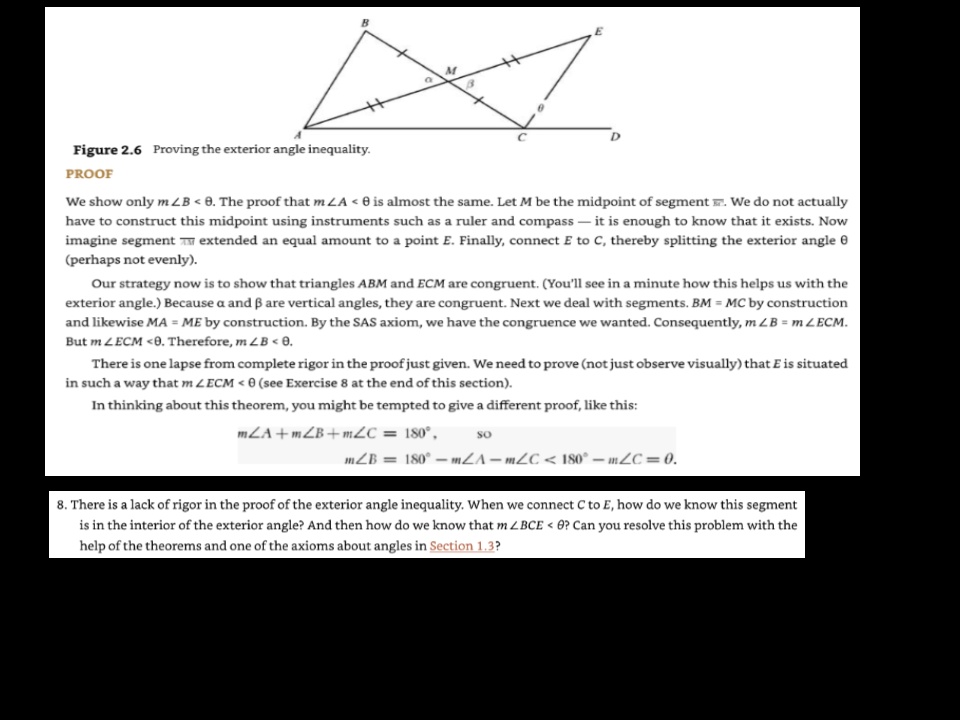
Figure 2.6 Proving the exterior angle inequality.
PROOF
We show only $m\angle B < \theta$. The proof that $m\angle A < \theta$ is almost the same. Let M be the midpoint of segment \overline{\Xi}. We do not actually
have to construct this midpoint using instruments such as a ruler and compass — it is enough to know that it exists. Now
imagine segment $\overline{\Xi}$ extended an equal amount to a point E. Finally, connect E to C, thereby splitting the exterior angle $\theta$
(perhaps not evenly).
Our strategy now is to show that triangles ABM and ECM are congruent. (You'll see in a minute how this helps us with the
exterior angle.) Because $\alpha$ and $\beta$ are vertical angles, they are congruent. Next we deal with segments. BM = MC by construction
and likewise MA = ME by construction. By the SAS axiom, we have the congruence we wanted. Consequently, $m\angle B = m\angle ECM$.
But $m\angle ECM < \theta$. Therefore, $m\angle B < \theta$.
There is one lapse from complete rigor in the proof just given. We need to prove (not just observe visually) that E is situated
in such a way that $m\angle ECM < \theta$ (see Exercise 8 at the end of this section).
In thinking about this theorem, you might be tempted to give a different proof, like this:
$m\angle A + m\angle B + m\angle C = 180^\circ$,
so
$m\angle B = 180^\circ - m\angle A - m\angle C < 180^\circ - m\angle C = \theta$.
8. There is a lack of rigor in the proof of the exterior angle inequality. When we connect C to E, how do we know this segment
is in the interior of the exterior angle? And then how do we know that $m\angle BCE < \theta$? Can you resolve this problem with the
help of the theorems and one of the axioms about angles in Section 1.3?