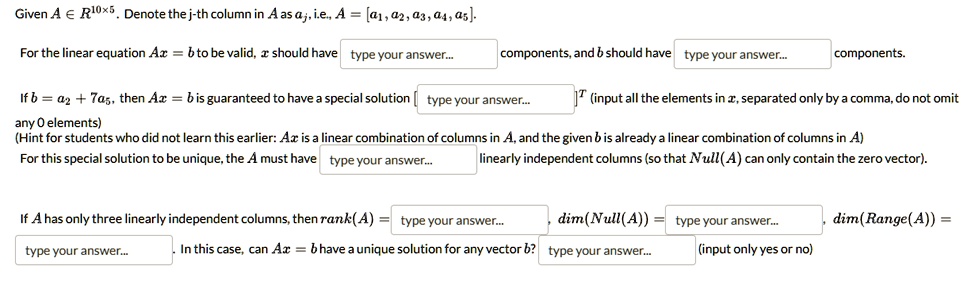
Given A ? R<sup>10×5</sup>. Denote the j-th column in A as a<sub>j</sub>, i.e., A = [a<sub>1</sub>, a<sub>2</sub>, a<sub>3</sub>, a<sub>4</sub>, a<sub>5</sub>].
For the linear equation Ax = b to be valid, x should have type your answer... components, and b should have type your answer... components.
If b = a<sub>2</sub> + 7a<sub>5</sub>, then Ax = b is guaranteed to have a special solution [type your answer...]<sup>T</sup> (input all the elements in x, separated only by a comma, do not omit any 0 elements)
(Hint for students who did not learn this earlier: Ax is a linear combination of columns in A, and the given b is already a linear combination of columns in A)
For this special solution to be unique, the A must have type your answer... linearly independent columns (so that Null(A) can only contain the zero vector).
If A has only three linearly independent columns, then rank(A) = type your answer..., dim(Null(A)) = type your answer..., dim(Range(A)) = type your answer... . In this case, can Ax = b have a unique solution for any vector b? type your answer... (input only yes or no)