Ace - AI Tutor
Ask Our Educators
Textbooks
My Library
Flashcards
Scribe - AI Notes
Notes & Exams
Download App
steve davis

steve d.

Divider

Questions asked

BEST MATCH

This question has Z parts. Each of the 7 parts (Part A - Part G) has a dropdown list of possible answers. Choose the best answer from the dropdown list for EACH part of the question below. A researcher is interested in whether or not there is any association between normal method of transportation taken to work and reported mood at the beginning of a typical Monday morning. He classifies participants into three transportation groups (those who: bike/walk, take public transit or drive) and asks them how they typically feel on a normal Monday morning: happy/excited, angry/irritated, or sleepy. Data from his survey on 200 participants are presented below. Happy/excited Angry/irritated Sleepy TOTAL Bike/walk 22 6 12 40 Public transit 18 6 36 60 Drive 20 18 62 100 TOTAL 60 30 110 200 You would like to test his question of whether or not there is any association between normal method of transportation taken to work and reported mood at the beginning of a typical Monday morning. Calculate a two variable chi-square test using an alpha (a) level of 0.01.

View Answer
divider
BEST MATCH

The strongest chemical bonds are hydrogenbonds. hydrophobicinteractions. covalentbonds. ionic bonds. Van der Waalforces.

View Answer
divider
BEST MATCH

In a certain butterfly population, a recessive mutant gene has an allele frequency of 0.1 and causes the homozygous larvae to have a more attractive coloration but prone to predation by birds. It has been observed that birds consumed 50% of all the attractively colored larvae compared to 10% predation for dull-colored larvae. a. Identify the type of selection. b. What is the frequency of the mutant gene after one generation of predation? c. If panmictic mating happens after predation, what are the expected frequencies of the larval offspring genotypes?

View Answer
divider
BEST MATCH

13.183 A point P moves along the spiral path $r = (0.1)\theta$ ft, where $\theta$ is in radians. The angular position $\theta = 2t$ rad, where t is in seconds, and $r = 0$ at $t = 0$. Determine the magnitudes of the velocity and acceleration of P at $t = 1$ s. Problem 13.183

View Answer
divider
BEST MATCH

Which of the following would most likely be highly price-elastic? Group of answer choices The demand for water The demand for new houses The demand for milk by a household The demand for insulin by a diabetes patient The demand for coal over a period of one month

View Answer
divider
BEST MATCH

One mole of gas A at 300 K is mixed adiabatically with 5 moles of gas A at 400 K to produce 6 moles of gas A at 383.33 K. If $C_P^g/P_A = 7R/2$, calculate the entropy change. Select one: a. 0.1129 R b. 0.1192 R c. 0.9112 R d. 0.2119 R

View Answer
divider
BEST MATCH

solve this I will give you thumbs up the theoretical and simulation result use Matlab for simulation this is the only information teacher gave do what you have to you can use anything provided the proof with the theoretical calculation Design (theoretical calculations) and simulate a 45 kA impulse current generator.

View Answer
divider
BEST MATCH

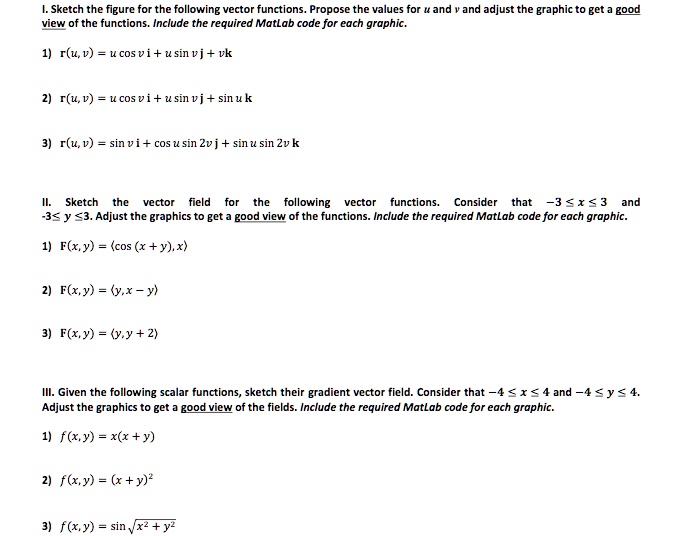
I. Sketch the figure for the following vector functions. Propose the values for u and v and adjust the graphic to get a good view of the functions. Include the required MatLab code for each graphic. 1) r(u, v) = u cos vi+usin vj + vk 2) r(u, v) = u cos vi + usin vj + sinu k 3) r(u, v) = sin vi + cos u sin 2v j + sin u sin 2v k II. Sketch the vector field for the following vector functions. Consider that -3?x?3 and -3? y ?3. Adjust the graphics to get a good view of the functions. Include the required MatLab code for each graphic. 1) F(x, y) = (cos (x + y), x) 2) F(x,y) = (y,x - y) 3) F(x,y) = (y, y + 2) III. Given the following scalar functions, sketch their gradient vector field. Consider that -4 ? x ? 4 and -4 ? y ? 4. Adjust the graphics to get a good view of the fields. Include the required MatLab code for each graphic. 1) f(x, y) = x(x + y) 2) f(x,y) = (x + y)² 3) f(x, y) = sin\sqrt{x^2 + y^2}
View Answer
divider
BEST MATCH

Problem #1 Solve 3 problems, fourth problem is extra credit, but mandatory for Honors class A circuit shown on Figure 1 switches from position A to position B at $t = 0$ sec. Find voltage $V_{out}(t)$ for $t \ge 0$ Using Laplace transforms. Note: Find Initial Conditions in DC. Solve the circuit in Laplace after switching. Find time domain solution using inverse La

View Answer
divider
BEST MATCH

Pr. #10) Using triple integrals, find the volume of the solid contained in the first octant, bounded above and below by the cone $z^2 = \frac{1}{3}(x^2 + y^2)$, and to the side by the sphere $x^2 + y^2 + z^2 = a > 0$.

View Answer
divider