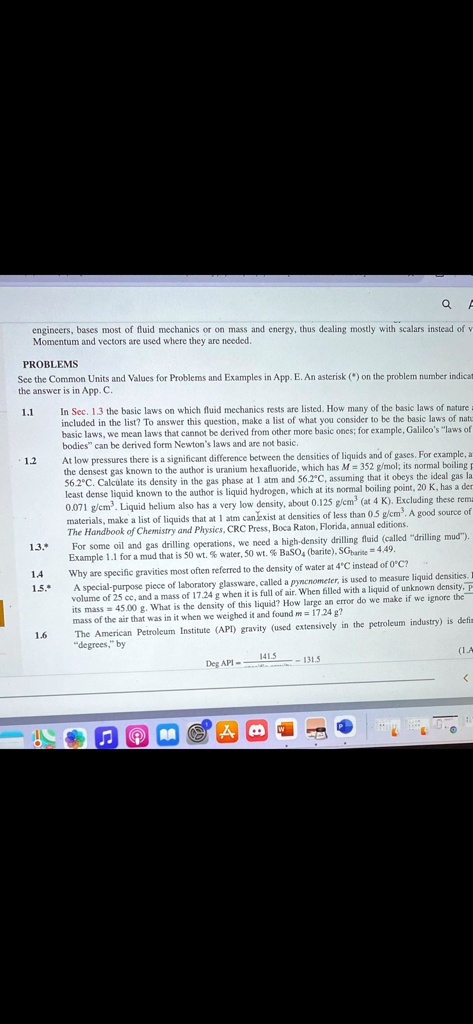
Engineers base most of fluid mechanics on mass and energy, thus dealing mostly with scalars instead of vectors. Momentum and vectors are used where they are needed.
PROBLEMS
See the Common Units and Values for Problems and Examples in App. E. An asterisk (*) on the problem number indicates the answer is in App. C.
1.1 In Sec. 1.3, the basic laws on which fluid mechanics rests are listed. How many of the basic laws of nature are included in the list? To answer this question, make a list of what you consider to be the basic laws of nature. By basic laws, we mean laws that cannot be derived from other more basic ones; for example, Galileo's "laws of bodies" can be derived from Newton's laws and are not basic.
1.2 At low pressures, there is a significant difference between the densities of liquids and gases. For example, the densest gas known to the author is uranium hexafluoride, which has M = 352 g/mol; its normal boiling point is 56.2°C. Calculate its density in the gas phase at 1 atm and 56.2°C, assuming that it obeys the ideal gas law. The least dense liquid known to the author is liquid hydrogen, which at its normal boiling point, 20 K, has a density of 0.071 g/cm^3. Liquid helium also has a very low density, about 0.125 g/cm^3 (at 4 K). Excluding these materials, make a list of liquids that at 1 atm can exist at densities of less than 0.5 g/cm^3. A good source of information is The Handbook of Chemistry and Physics, CRC Press, Boca Raton, Florida, annual editions.
1.3.* For some oil and gas drilling operations, we need a high-density drilling fluid (called "drilling mud"). Example 1.1 provides a mud that is 50 wt. % water, 50 wt. % BaSO4 (barite), SG(barite) = 4.49.
1.4 Why are specific gravities most often referred to the density of water at 4°C instead of 0°C?
1.5.* A special-purpose piece of laboratory glassware, called a pycnometer, is used to measure liquid densities. It has a volume of 25 cc and a mass of 17.24 g when it is full of air. When filled with a liquid of unknown density, P, its mass is 45.00 g. What is the density of this liquid? How large an error do we make if we ignore the mass of the air that was in it when we weighed it and found m = 17.24 g?
1.6 The American Petroleum Institute (API) gravity (used extensively in the petroleum industry) is defined in "degrees" by
Deg API = (141.5)/(-131.5)