Design Problem
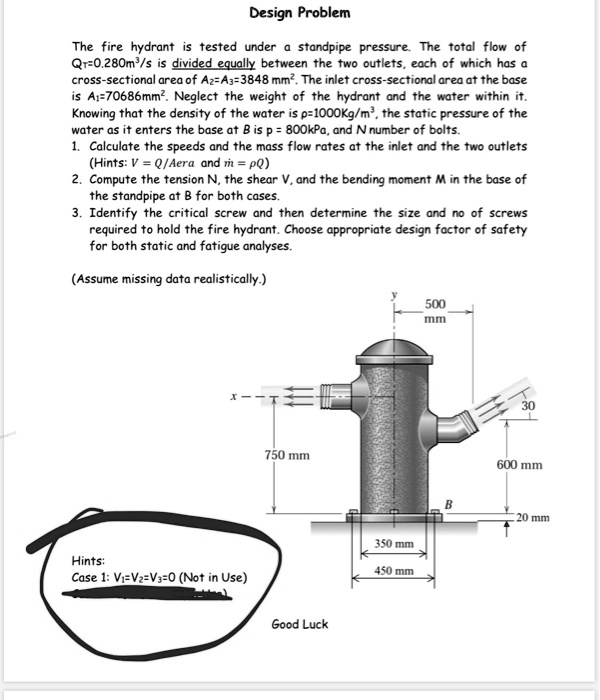
The fire hydrant is tested under a standpipe pressure. The total flow of
QT=0.280m³/s is divided equally between the two outlets, each of which has a
cross-sectional area of A2=A3=3848 mm². The inlet cross-sectional area at the base
is A1=70686mm². Neglect the weight of the hydrant and the water within it.
Knowing that the density of the water is p=1000Kg/m³, the static pressure of the
water as it enters the base at B is p = 800kPa, and N number of bolts.
1. Calculate the speeds and the mass flow rates at the inlet and the two outlets
(Hints: V = Q/Aera and m = pQ)
2. Compute the tension N, the shear V, and the bending moment M in the base of
the standpipe at B for both cases.
3. Identify the critical screw and then determine the size and no of screws
required to hold the fire hydrant. Choose appropriate design factor of safety
for both static and fatigue analyses.
(Assume missing data realistically.)
Hints:
Case 1: V1=V2=V3=0 (Not in Use)