Ace - AI Tutor
Ask Our Educators
Textbooks
My Library
Flashcards
Scribe - AI Notes
Notes & Exams
Download App
timothy gentry

timothy g.

Divider

Questions asked

BEST MATCH

A voltage v0(t) is induced around a loop by a magnetic field B that varies sinusoidally with frequency ω and is perfectly aligned with the loop normal. (a) What is the amplitude of the output voltage if the magnetic field’s frequency of oscillation is doubled? (b) Assume now that the magnetic field vector is tipped by an angle θ with respect to the loop normal while retaining the original oscillation frequency. What is the maximum angle θ such that the magnitude of the output voltage remains at or above 0.6 times the magnitude of v0?

View Answer
divider
BEST MATCH

A bacteriological agar that inhibits the growth of certain types of bacteria is called a ______ agar. selective defined complex differential

View Answer
divider
BEST MATCH

Genetic determinism implies that: Oa. genetic traits are adapted traits Ob. behavior is caused by the interaction of genes and environment Oc. none of the response alternatives are correct Od. genes create environments

View Answer
divider
BEST MATCH

Question 13 (1 point) The blockage of the blood supply to a portion of the brain causes a: Stroke Blackout Heart attack Dizzy spell

View Answer
divider
BEST MATCH

All the following statements are common reasons for an intervention to fail, EXCEPT: Group of answer choices The organization was not ready for change The OD consultant let the client take ownership of the change There were no activities planned to sustain long-term change The intervention proposed was not the best option to solve the problem and/or was poorly designed

View Answer
divider
BEST MATCH

In class, we did not deal with diatomic molecules involving d-orbitals (transition metals). Here we will do so. A homonuclear transition metal dimer can form bonds from d_(z)^(2)(l)=(0)d_(xz) and d_(yz)(l)=(+-1) and d_(xy) and d_(x)^(2)*y^(2)(l)=(+-2) with filling order σ π δ. (Only one of the pairs of wave functions is given for π and δ. You need to use both.) σ, Λ = 0, m_(λ) = 0, ψ ^(+-) = (1)/(sqrt(2))(d_(1z^(2))(1)+-d_(2z^(2))(2)) π, Λ = 1, m_(λ) = +-1, ψ _(xz)^(+-) = (1)/(sqrt(2))(d_(1xz)(1)+-d_(2xz)(2)) δ, Λ = 2, m_(λ) = +-2, ψ _(xy)^(+-) = (1)/(sqrt(2))(d_(1xy)(1)+-d_(2xy)(2)) a. Draw the MO level diagram for d-orbital bonding similar to the p-orbital diagram we did in class. b. Using the inversion operator hat(i), determine the g, u character of each orbital. Include it in your diagram in a). hat(ı)ψ = +-1ψ, g = +1, u = -1 Hint: it is easier to determine these symmetries from orbital images rather than the wave functions. c. Now use the reflection operator through the center of the bond but perpendicular to the internuclear axis to determine the bonding or antibonding character of each orbital. d. Now let's consider an actual molecule (Ti)_(2) with ground state configuration (3s)^(2)(3d)^(2), where the (3s)^(2) orbital is a filled shell you needn't show. i. Fill in an MO diagram for the ground state of (Ti_(2))_(2). ii. Determine the term symbols for the GS and order according to Hund's rules. iii. An excited state of (Ti)_(2) has the d-electron configuration σ(d_(2)^(2))^(2)(π)^(1)(δ)^(1). Determine the allowed terms and order according to Hund's rules. iv. Write the wave functions for the terms in part ii) above. Show that one of them obeys the Pauli Principle.
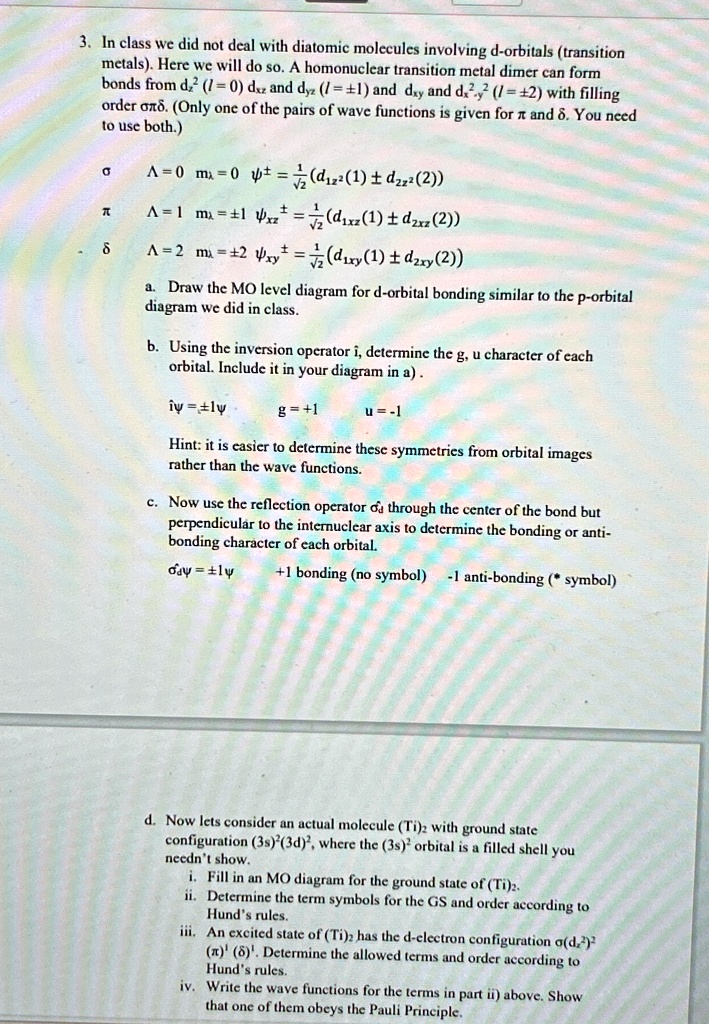
View Answer
divider
BEST MATCH

What can you practice as a nurse to help prevent medication errors

View Answer
divider
BEST MATCH

A charged particle is held at the center of two concentric conducting spherical shells. Figure (a) shows a cross section. Figure (b) gives the net flux $\Phi$ through a Gaussian sphere centered on the particle, as a function of the radius $r$ of the sphere. The scale of the vertical axis is set by $\Phi_s = 4.5 \times 10^5 \text{ N} \cdot \text{m}^2/\text{C}$. What are (a) the charge of the central particle and the net charges of (b) shell A and (c) shell B?

View Answer
divider
BEST MATCH

QUESTION 4 a. Give the general form of Bernoulli's differential equation. b. Describe the method of solution.

View Answer
divider
BEST MATCH

Tek Run Trig'd 1 1 500mV 4.00µs AFG Ramp 50.000kHz 2.0000 Vpp 1.000000µs 5.00GS/s 1M points 1/ 0.00 V

View Answer
divider