Part 2
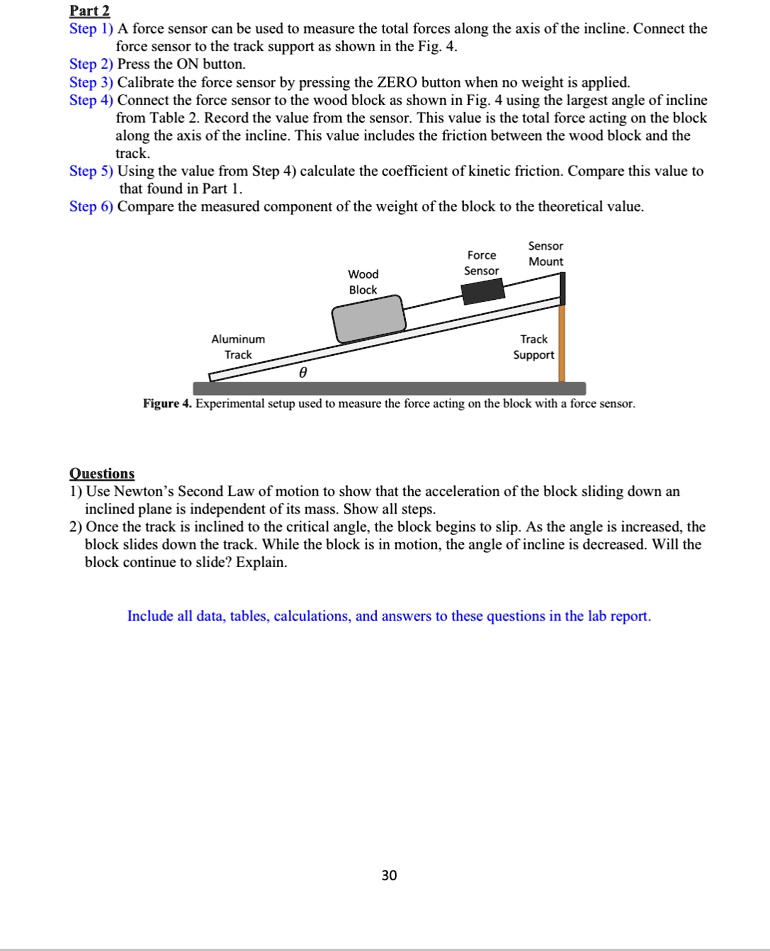
Step 1) A force sensor can be used to measure the total forces along the axis of the incline. Connect the
force sensor to the track support as shown in the Fig. 4.
Step 2) Press the ON button.
Step 3) Calibrate the force sensor by pressing the ZERO button when no weight is applied.
Step 4) Connect the force sensor to the wood block as shown in Fig. 4 using the largest angle of incline
from Table 2. Record the value from the sensor. This value is the total force acting on the block
along the axis of the incline. This value includes the friction between the wood block and the
track.
Step 5) Using the value from Step 4) calculate the coefficient of kinetic friction. Compare this value to
that found in Part 1.
Step 6) Compare the measured component of the weight of the block to the theoretical value.
Aluminum
Track
?
Wood
Block
Force
Sensor
Sensor
Mount
Track
Support
Figure 4. Experimental setup used to measure the force acting on the block with a force sensor.
Questions
1) Use Newton's Second Law of motion to show that the acceleration of the block sliding down an
inclined plane is independent of its mass. Show all steps.
2) Once the track is inclined to the critical angle, the block begins to slip. As the angle is increased, the
block slides down the track. While the block is in motion, the angle of incline is decreased. Will the
block continue to slide? Explain.
Include all data, tables, calculations, and answers to these questions in the lab report.
30