Questions asked
Methylmalonyl CoA mutase is the only enzyme in all the processes we discussed that contains vitamin B12 as its large coenzyme. What is the substrate for this enzyme? (Hint: When did we talk about vitamin B12?) Group of answer choices D-glyceraldehyde 3-phosphate succinyl CoA propionyl CoA trans-Δ2-enoyl CoA trans-Δ3-enoyl CoA
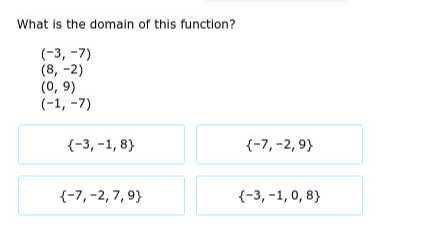
What is the domain of this function? \[ \begin{array}{l} (-3,-7) \\ (8,-2) \\ (0,9) \\ (-1,-7) \end{array} \] \( \{-3,-1,8\} \) \( \{-7,-2,9\} \) \( \{-7,-2,7,9\} \) \( \{-3,-1,0,8\} \)
Are the two equations equivalent? If they are, what operation transforms the first into the second? $x^2 = 9x$ $x = 9$ Select \"Not equivalent.\" if the two equations are not equivalent. Operation:
Solve the quadratic equation: \( 4(x+2)^{2}+21=33 \) \( x \approx 1.46 \) or \( x \approx-5.46 \) \( x \approx-0.27 \) or \( x \approx-3.73 \) \( x \approx-1.46 \) or \( x=5.46 \) \( x \approx 0.27 \) or \( x \approx 3.73 \)
Bilingualism is a categorical variable. Group of answer choices True False
A protein's ________ structure is the overall 3-dimensional shape or conformation of a polypeptide chain. Multiple choice question. secondary quaternary tertiary primary
From the list of substances, identify each as a strong acid, strong base, or neither a strong acid nor a strong base Drag the appropriate items to their respective bins. ? View Available Hint(s) Strong acid HCI HNO$_3$ HF Strong base Reset Help Neither a strong acid nor a strong base CH$_3$COOH CH$_3$NH$_2$ NaCl Ca(OH)$_2$ CH$_3$OH RbOH
b Demonstrate that for every $-1 < x \le 0$ and $n = 0, 1, \dots$, it is true that $e^{nx} - \frac{1}{2}nx^2e^{(n-1)x} \le (1+x)^n \le e^{nx}$. (Hint: Prove first that $1 + x \le e^x$, $1 + x + \frac{1}{2}x^2 \ge e^x$ for all $x \le 0$, and then argue that, provided $|a-1|$ and $|b|$ are small, it is true that $(a-b)^n \ge a^n - na^{n-1}b$.)
f(x) = 10arctan(9x) + 4x^4 - 16 a. Find the derivative of the function. Write the derivative on paper. Do NOT simplify. Use correct notation. b. Find f'(1). Write the EXACT answer on your paper. In D2L, write the answer as a decimal rounded to 3 decimal places. $\frac{d}{dx}(sin^{-1}x) = \frac{1}{\sqrt{1 - x^2}}$ $\frac{d}{dx}(tan^{-1}x) = \frac{1}{1 + x^2}$ $\frac{d}{dx}(sec^{-1}x) = \frac{1}{x\sqrt{x^2 - 1}}$ $\frac{d}{dx}(cos^{-1}x) = \frac{-1}{\sqrt{1 - x^2}}$ $\frac{d}{dx}(cot^{-1}x) = \frac{-1}{1 + x^2}$ $\frac{d}{dx}(csc^{-1}x) = \frac{-1}{x\sqrt{x^2 - 1}}$ Your Answer:
2. Consider a semi-spherical surface defined by $r = 3m$; $0 < \theta < \frac{\pi}{2}$; $0 < \phi < \frac{\pi}{2}$. Determine the electric flux passing through this surface for an electric field $\vec{E} = sec\phi \hat{x} + 5\hat{z}$ (volt/metre). [note that this E field is described using a mixture of Cartesian and Spherical variables!]