Problem 3. (1 point)
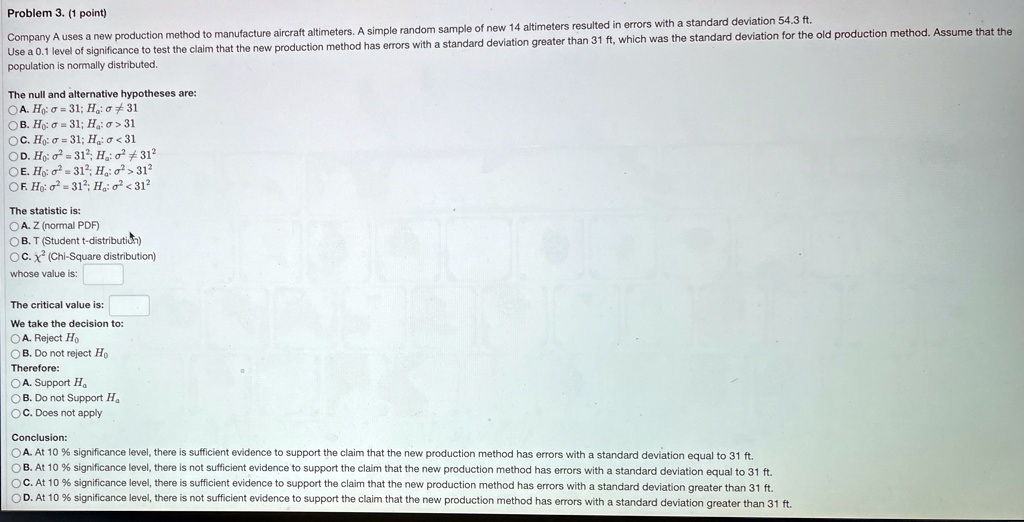
Company A uses a new production method to manufacture aircraft altimeters. A simple random sample of new 14 altimeters resulted in errors with a standard deviation 54.3 ft.
Use a 0.1 level of significance to test the claim that the new production method has errors with a standard deviation greater than 31 ft, which was the standard deviation for the old production method. Assume that the
population is normally distributed.
The null and alternative hypotheses are:
ΟΑ. Ηο: σ = 31; Η: σ≠ 31
Ο Β. Ηο: σ = 31; Ηα: σ> 31
C. Ηο: σ= 31; Η: σ < 31
OD. Ho: 0² = 312; Ηο: σ² ≠ 312
ΟΕ. Ηο: σ² = 312; Η: σ² > 312
F. Ηο: σ² = 312; Ηα: σ² < 312
The statistic is:
A. Z (normal PDF)
OB. T (Student t-distribution)
C. X2 (Chi-Square distribution)
whose value is:
The critical value is:
We take the decision to:
A. Reject Ho
B. Do not reject Ho
Therefore:
A. Support Ho
B. Do not Support Ha
C. Does not apply
Conclusion:
A. At 10% significance level, there is sufficient evidence to support the claim that the new production method has errors with a standard deviation equal to 31 ft.
B. At 10% significance level, there is not sufficient evidence to support the claim that the new production method has errors with a standard deviation equal to 31 ft.
C. At 10% significance level, there is sufficient evidence to support the claim that the new production method has errors with a standard deviation greater than 31 ft.
D. At 10 % significance level, there is not sufficient evidence to support the claim that the new production method has errors with a standard deviation greater than 31 ft.