Ace - AI Tutor
Ask Our Educators
Textbooks
My Library
Flashcards
Scribe - AI Notes
Notes & Exams
Download App
vicente salazar

vicente s.

Divider

Questions asked

BEST MATCH

6 True or False 2 points Etiolation is caused by a lack of blue light True False

View Answer
divider
BEST MATCH

Electrical Engineering Department Question No. 2: [2.5 Marks] Consider the circuit shown in Figure 2.1 below, then apply the Superposition Theorem to find: a. The current $I_2$. b. The voltage drop $V_2$. $R_1 = 330 \Omega$ $E_2 = 10V$ $E_1 = 15V$ $R_2 = 680 \Omega$ $R_3 = 200 \Omega$ Figure 2.1

View Answer
divider
BEST MATCH

. Add a neutron to the nitrogen-14 nucleus. Observe how the mass number changes. Determine which particle(s) is/are counted in the mass number.

View Answer
divider
BEST MATCH

Kate's dog, Chewbarka, loves going on walks. Chewbarka has learned that when Kate grabs the leash, they are going for a walk. Kate starts asking Chewbarka, "Do you want to go for a walk?" before grabbing the leash. Now Chewbarka becomes excited when Kate asks this question, knowing it means they are going for a walk. Chewbarka's excitement in response to Kate's question is an example of: A spontaneous recovery. B stimulus generalization. C higher-order conditioning. D stimulus discrimination.

View Answer
divider
BEST MATCH

Which of the following best distinguishes macroevolution from microevolution? Macroevolution involves large scale processes and patterns over time, while microevolution is changes within a species due to genetic factors. Macroevolution is about rapid evolutionary changes, whereas microevolution involves slower, gradual changes. Microevolution deals with changes in entire ecosystems, while macroevolution focuses on genetic alterations within a population. Microevolution involves large scale transformations in species, whereas macroevolution pertains to minor genetic variations.

View Answer
divider
BEST MATCH

) What happens as a result? Choose ALL that apply. (2 points) a) activate G-protein coupled receptor b) depolarize the presynaptic terminal c) mobilize vesicles from the storage pool d) produce exocytosis of vesicles in the readily releasable pool e) repolarize the presynaptic terminal

View Answer
divider
BEST MATCH

3.2 FIND THE SECOND DERIVATIVE Problem 5: For f(x) = -3x^2 + 4, find f''(x). PLEASE USE DIFFERENCE QUOTIENT EQUATION

View Answer
divider
BEST MATCH

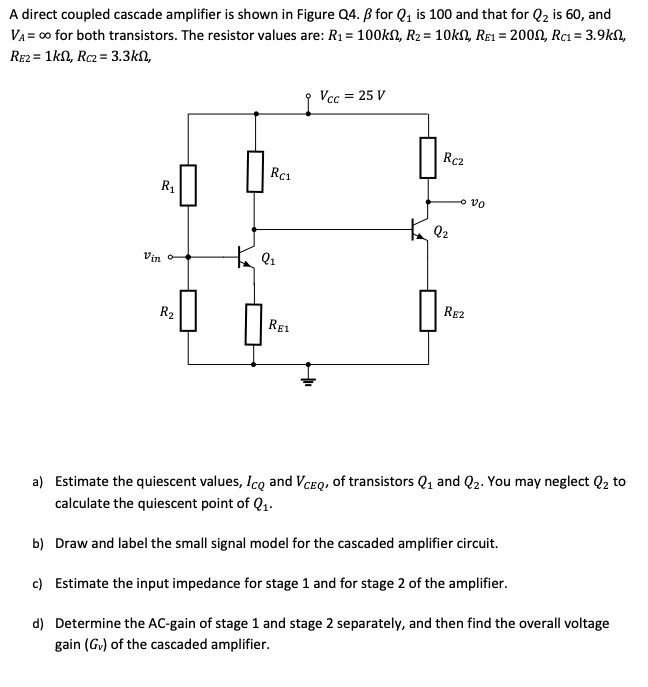
A direct coupled cascade amplifier is shown in Figure Q4. for Q, is 100 and that for Q is 60,and V=o for both transistors.The resistor values are: R=100k,R=10k, RE=200,Rc=3.9k RE2=1k, Rc2= 3.3k Vcc=25V Q2 Vir a)Estimate the quiescent values, Ico and VcEQ, of transistors Q1 and Q. You may neglect Qz to calculate the quiescent point of Q1 b) Draw and label the small signal model for the cascaded amplifier circuit. c) Estimate the input impedance for stage 1 and for stage 2 of the amplifier. d) Determine the AC-gain of stage 1 and stage 2 separately, and then find the overall voltage gain (Gv) of the cascaded amplifier.
View Answer
divider
BEST MATCH

A 15 mL solution of 0.1 M NaOH is being titrated with 0.250 M HBr. What is the solution pH before the titration begins? What is the pH when 5 mL HBr has been added? What is the total solution at the equivalence point? What is the solution pH when 10 mL of HBr has been added? Thanks in advance.

View Answer
divider
BEST MATCH

Question 4 [23] A shaft used for a water pump has a diameter of 50 mm and a length of 0.7 m long and is subjected to a torque of 1200 Nm. If G = 90 GPa. (a) what is the possible maximum shear stress this shaft can possess? With the aid of computation, suggest the angle of twist of this shaft. (10) (b) If the designer decides to make this shaft a hollow type with an internal diameter of 30 mm, what will be the new shear stress and the angle of twist. (13)

View Answer
divider