Ace - AI Tutor
Ask Our Educators
Textbooks
My Library
Flashcards
Scribe - AI Notes
Notes & Exams
Download App
victor burns

victor b.

Divider

Questions asked

BEST MATCH

Select the eqution that best matches A. y=3tan(2x) B. y=-3cot(2x) C. y=3tan((1)/(2)x) D. y=3cot((1)/(2)x) A. $y=3\tan(2x)$ B. $y=-3\cot(2x)$ C. $y=3\tan(\frac{1}{2}x)$ D. $y=3\cot(\frac{1}{2}x)$

View Answer
divider
BEST MATCH

Draw the setup for a Compton Scattering. Indicate , , and . What would be the drawing fora full back-scattering? What is happening to the electron? What is happening to the photon?For the following questions, start from Equation 1:b) What is the scattered photon energy as a function of the photon scattering angle?c) Evaluate the maximum photon energy after a Compton scattering.d) Evaluate the minimum photon energy after a Compton scattering.e) Evaluate the electron kinetic energy as a function of the photon scattering angle.f) Evaluate the maximum electron kinetic energy that makes the Compton edge.g) What is the scattering angle of the electron as a function of the photon scattering angle andenergy?h) In many applications, the energy of gamma rays is not far from the rest energy of an electron.But what happens if the gamma-ray energy is much larger than the electron rest mass energy?(What happens to the energy of the scattered photon? and to the electron scattering angle?)

View Answer
divider
BEST MATCH

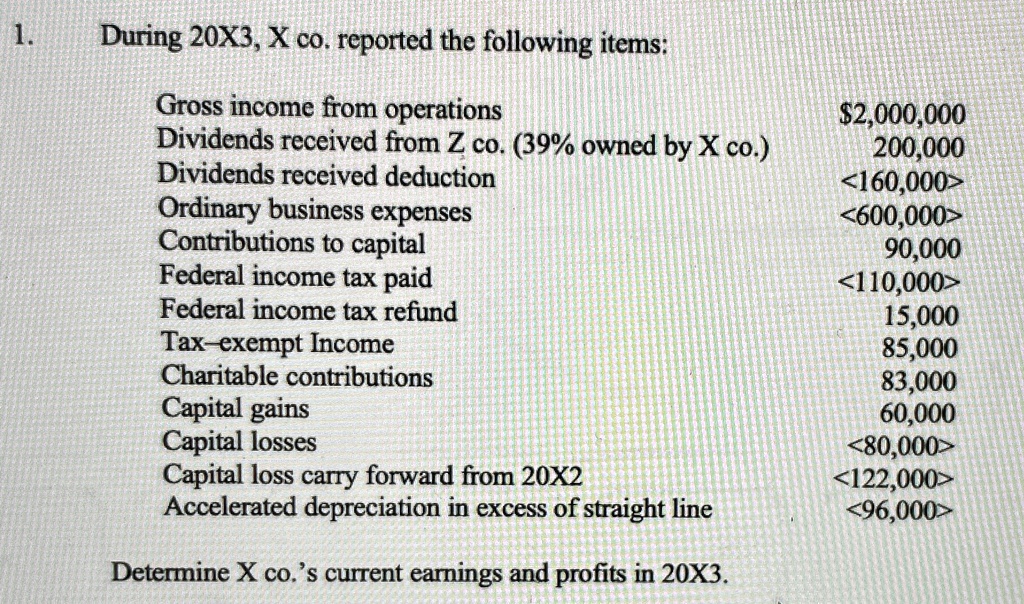
1. During 20X3, X co. reported the following items: Gross income from operations $2,000,000 Dividends received from Z co. (39% owned by X co.) 200,000 Dividends received deduction <160,000> Ordinary business expenses <600,000> Contributions to capital 90,000 Federal income tax paid <110,000> Federal income tax refund 15,000 Tax-exempt Income 85,000 Charitable contributions 83,000 Capital gains 60,000 Capital losses <80,000> Capital loss carry forward from 20X2 <122,000> Accelerated depreciation in excess of straight line <96,000> Determine X co.'s current earnings and profits in 20X3.
View Answer
divider
BEST MATCH

Coupling allows: a. Data to be passed from one module to all other modules. b. Data to be passed from one module to another module. c. Data to be unavailable to other modules. d. Instructions to be available to other modules.

View Answer
divider
BEST MATCH

Determine if the following statement is true or false.\\ The series $\sum_{n=0}^{\infty} \frac{5^n e^{35}}{n!} (x - 7)^n$ is a Taylor series for the function $f(x) = e^{5x}$ at $x = 7$.\\ Select the correct answer below:\\ True\\ False

View Answer
divider
BEST MATCH

D Question 13 1 pts Conceptual Set 1. You design an experiment in which you show one group of participants a video with mild violence and another group of participants a video with no violence. You expect the participants who were shown the video with mild violence to be more aggressive (have higher scores on an aggression questionnaire) than the participants who were shown the video with no violence. Is this a one-talled or two-tailed design? One-tailed Two-tailed Question 14 1 pts Conceptual Set 1. You design an experiment in which you show one group of participants a video with mild violence and another group of participants a video with no violence. You expect the participants who were shown the video with mild violence to be more aggressive (have higher scores on an aggression questionnaire) than the participants who were shown the video with no violence. Select the null hypothesis. Be as specific as you can be given the information presented. • The participants who were shown the video with mild violence will have different levels of aggression than the participants who were shown the video with no violence • The participants who were shown the video with mild violence will not have higher levels of aggression than the participants who were shown the video with no violence • The participants who were shown the video with mild violence will not have different levels of aggression than the participants who were shown the video with no violence • The participants who were shown the video with mild violence will have lower levels of aggression than the participants who were shown the video with no violence Question 15 1 pts Conceptual Set 1. You design an experiment in which you show one group of participants a video with mild violence and another group of participants a video with no violence. You expect the participants who were shown the video with mild violence to be more aggressive (have higher scores on an aggression questionnaire) than the participants who were shown the video with no violence. Select the research hypothesis. Be as specific as you can be given the information presented. • The participants who were shown the video with mild violence will have different levels of aggression than the participants who were shown the video with no violence • The participants who were shown the video with mild violence will have higher levels of aggression than the participants who were shown the video with no violence • The participants who were shown the video with mild violence will not have different levels of aggression than the participants who were shown the video with no violence • The participants who were shown the video with mild violence will not have lower levels of aggression than the participants who were shown the video with no violence Question 16 1 pts Conceptual Set 1. You are studying two different cultures (l.e., Culture A and Culture B) and their child-rearing practices. You expect to see a difference in child-rearing practices as measured by the Child Development Questionnaire (CDQ). Is this a one-tailed or two-tailed design? • One-tailed Two-tailed

View Answer
divider
BEST MATCH

For each of the following matrices A ? Mnxn (F), (i) Determine all the eigenvalues of A. (ii) For each eigenvalue ? of A, find the set of eigenvectors corresponding to ?. (iii) If possible, find a basis for F<sup>n</sup> consisting of eigenvectors of A. (iv) If successful in finding such a basis, determine an invertible matrix Q and a diagonal matrix D such that Q<sup>-1</sup>AQ = D. 258 (a) A = \begin{pmatrix} 1 & 2\\ 3 & 2 \end{pmatrix} for F = R (b) A = \begin{pmatrix} 0 & -2 & -3\\ -1 & 1 & -1\\ 2 & 2 & 5 \end{pmatrix} for F = R (c) A = \begin{pmatrix} i & 1\\ 2 & -i \end{pmatrix} for F = C (d) A = \begin{pmatrix} 2 & 0 & -1\\ 4 & 1 & -4\\ 2 & 0 & -1 \end{pmatrix} for F = R

View Answer
divider
BEST MATCH

Create a 5-step strategy that individuals or parents can implement to maximize resilience and competence at the stage that you chose.

View Answer
divider
BEST MATCH

Question 1 1 pts Here is a brief description of a variable from one of our data sets. Indicate whether the variable measures an explicit attitude or an implicit attitude from participants. Marriage-Rights: Do you think marriage between same-sex partners should be valid? 1=Should be valid; 2=Should not be valid; 3=No opinion This variable measures an explicit attitude. This variable measures an implicit attitude. Neither. This variable does not measure an attitude.

View Answer
divider
BEST MATCH

-3 = -\left|c + 4\right| + 2

View Answer
divider