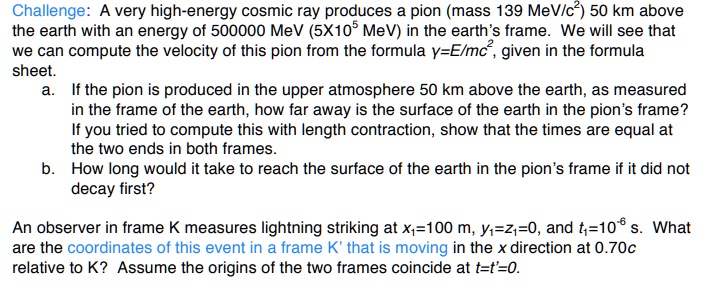
Challenge: A very high-energy cosmic ray produces a pion (mass 139 MeV/c²) 50 km above the earth with an energy of 500000 MeV (5X10<sup>5</sup> MeV) in the earth's frame. We will see that we can compute the velocity of this pion from the formula \(\gamma = E/mc^2\), given in the formula sheet.
a. If the pion is produced in the upper atmosphere 50 km above the earth, as measured in the frame of the earth, how far away is the surface of the earth in the pion's frame? If you tried to compute this with length contraction, show that the times are equal at the two ends in both frames.
b. How long would it take to reach the surface of the earth in the pion's frame if it did not decay first?
An observer in frame K measures lightning striking at x<sub>1</sub>=100 m, y<sub>1</sub>=z<sub>1</sub>=0, and t<sub>1</sub>=10<sup>-6</sup> s. What are the coordinates of this event in a frame K' that is moving in the x direction at 0.70c relative to K? Assume the origins of the two frames coincide at t=t'=0.