Ace - AI Tutor
Ask Our Educators
Textbooks
My Library
Flashcards
Scribe - AI Notes
Notes & Exams
Download App
william hancock

william h.

Divider

Questions asked

BEST MATCH

As part of the encoding process, the sender of a message must blank

View Answer
divider
BEST MATCH

Which of the following produces a positive peak in a DEPT-135 spectrum? O CH4 O quaternary carbon atoms (C with no protons). O CH3 O CH2

View Answer
divider
BEST MATCH

Let $X_1, X_2, ..., X_5$ be a random sample from the Poisson distribution with mean $\lambda$, and suppose that we wish to test $H_0: \lambda = 1$ against $H_1: \lambda > 1$. Determine a critical region of the form $C = \{x_1, x_2, ..., x_n: \bar{x} \geq c\}$ such that the significance level is at most 0.05 and the power is at least 0.90 when $\lambda = 3$.

View Answer
divider
BEST MATCH

\( 5 \)

View Answer
divider
BEST MATCH

Select all of the following statements that are true for a cylindrical copper wire with uniform cross-sectional area. The resistance of the wire is directly proportional to its cross-sectional area. The resistance of the wire is directly proportional to its length. The resistance of the wire is inversely proportional to its cross-sectional area. The resistance of the wire is inversely proportional to its length.

View Answer
divider
BEST MATCH

One of the reasons the aggregate supply curve slopes up in the short run is because some firms overestimate their gains when the price level rises. Group of answer choices True False

View Answer
divider
BEST MATCH

Problem 1: Sultan Haboos University Department of Electrical & Computer Engineering College of Engineering ECCE3142 Signals and Systems --- Homework Fall 2023 Sketch the following continuous-time signals: a) \(x(t) = u(t+1) - 2u(t-1) + u(t-3)\) b) \(x(t) = (t+1)u(t+1) - tu(t) - u(t-2)\) c) \(x(t) = 2(t-1)u(t-1) - 2(t-2)u(t-2) + 2(t-3)u(t-3)\) Problem 2: Find constants \(a_1, a_2,\) and \(a_3\) so that the solution to the difference equation \(a_1y[n-1] + a_2y[n] - a_3y[n+1] = \delta[n]\) is equal to the signal \(y[n],\) where, \(y[n] = \begin{cases} 3^n & n < 0\\ 2^{-n} & n \ge 0 \end{cases}\) Problem 3: Determine if the following signal is periodic; if so, find the fundamental period. where. \(x(t) = cos((a + 1)2\pi(t + 4)) + 2sin((b + 1)5\pi t + 30)\) a is the remainder when your student ID is divided by 3. b is the remainder when your student ID is divided by 2. Problem 4: The signal \(x(t)\) is shown in the figure below: Draw the following signals: a) \(x(-3(t-1))\) b) \(x(\frac{t}{3} + 2)\) Problem 5: A system with input \(x(t)\) and output \(y(t)\) can be described by: \(\omega(t) = y(t) + x(t)\) \(y(t) = x(t) - \omega(t)\) Determine the transfer function of the system \(H(s)\). More precisely, also determine numerical values for the constants \(c_1, c_2,\) and the poles \(p_1,\) and \(p_2\). Determine the impulse response \(h(t)\) of the system. What would be \(y(t)\) if \(x(t) = \delta(t) - \delta(t-t)?\) Also plot \(y(t)\) in this case for \(-\infty \le t \le \infty\) clearly labelling both axes and important values.

View Answer
divider
BEST MATCH

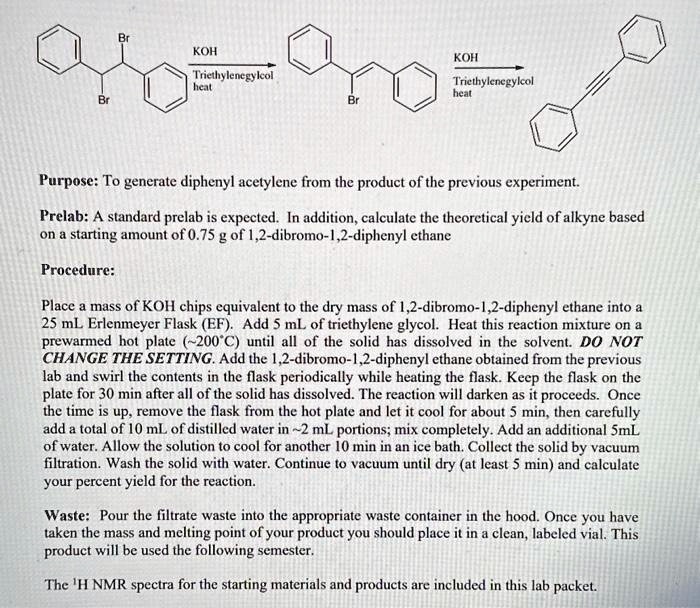
Br KOH Triethylenegylcol heat KOH Triethylenegylcol heat Br Br Purpose: To generate diphenyl acetylene from the product of the previous experiment. Prelab: A standard prelab is expected. In addition, calculate the theoretical yield of alkyne based on a starting amount of 0.75 g of 1,2-dibromo-1,2-diphenyl ethane Procedure: Place a mass of KOH chips equivalent to the dry mass of 1,2-dibromo-1,2-diphenyl ethane into a 25 mL Erlenmeyer Flask (EF). Add 5 mL of triethylene glycol. Heat this reaction mixture on a prewarmed hot plate (~200°C) until all of the solid has dissolved in the solvent. DO NOT CHANGE THE SETTING. Add the 1,2-dibromo-1,2-diphenyl ethane obtained from the previous lab and swirl the contents in the flask periodically while heating the flask. Keep the flask on the plate for 30 min after all of the solid has dissolved. The reaction will darken as it proceeds. Once the time is up, remove the flask from the hot plate and let it cool for about 5 min, then carefully add a total of 10 mL of distilled water in ~2 mL portions; mix completely. Add an additional 5mL of water. Allow the solution to cool for another 10 min in an ice bath. Collect the solid by vacuum filtration. Wash the solid with water. Continue to vacuum until dry (at least 5 min) and calculate your percent yield for the reaction. Waste: Pour the filtrate waste into the appropriate waste container in the hood. Once you have taken the mass and melting point of your product you should place it in a clean, labeled vial. This product will be used the following semester. The 'H NMR spectra for the starting materials and products are included in this lab packet.
View Answer
divider
BEST MATCH

Part A - Boyle's Law Enter only numbers into the yellow boxes below (do not type units). Do NOT change the values in the wh Box Width Pressure from Pressure (nm) Gauge (atm) Volume (nm³) (atm) 10.0 11.7 1000 11.7 5.0 8.4 500 8.4 6.0 7.0 600 7 7.0 6.0 700 6 8.0 5.2 800 5.2 9.0 4.7 900 4.7 11.0 3.8 1100 3.8 12.0 3.5 1200 3.5 13.0 3.2 1300 3.2 14.0 3.0 1400 3 15.0 2.8 1500 2.8 Temperature 300 K # pumps of gas Boyle's Law 14 12 10 8 6 4 2 0 y = 3450.2$x^{-0.958}$ 500 1000 1500 2000 Volume (nm³)

View Answer
divider
BEST MATCH

$\qquad V_s \\ \qquad R_1 \\ \qquad R_2 \\ \qquad R_3 \\ \qquad R_0 \\ \qquad V_o$

View Answer
divider