Ace - AI Tutor
Ask Our Educators
Textbooks
My Library
Flashcards
Scribe - AI Notes
Notes & Exams
Download App
william santos

william s.

Divider

Questions asked

BEST MATCH

Which one of the choices should the paramedic beware of when a restrained person who is exhibiting signs of hyperactivity delirium suddenly becomes tranquil?

View Answer
divider
BEST MATCH

Read the following excerpt from the abstract of a research article. We identified seven companies that had implemented flexible working hours in the past year. To understand employees' satisfaction with the new working hours, a survey questionnaire was administered on a random selected Monday to the first 100 employees that start their working day, making a total sample size of 700. The questions in the survey were derived from the ESM-12, a validated 12-item employee satisfaction questionnaire, and were answered anonymously. It was found that 83 percent of the employees are satisfied to very satisfied with the flexible working hours and 63 percent reported that the flexible working hours had substantially improved their work–life balance. Could there be methodological bias that may have affected the results? Yes, selection bias. Yes, social desirability bias. Yes, halo effect. No, there is no clear indication of methodological bias.

View Answer
divider
BEST MATCH

7 Part 4 of 6 Required information CP9-1 (Algo) Computing Acquisition Cost and Recording Depreciation under Three Alternative Methods [LO 9-2, LO 9-3] [The following information applies to the questions displayed below] At the beginning of the year, Tulip Corporation bought machinery, shelving, and a forklift. The machinery initially cost $26,800 but had to be overhauled (at a cost of $1,440) before it could be installed (at a cost of $720) and finally put into use. The machinery's total life was estimated as 40,000 hours, with an estimated residual value of $1,000. The machinery was actually used 5,000 hours in year 1 and 7,000 hours in year 2. Repair costs were $380 in each year. The shelving cost $9,450 and was expected to last 5 years, with a residual value of $630. The forklift cost $12,150 and was expected to last six years, with a residual value of $2,060. CP9-1 (Algo) Part 4 4. Compute year 2 straight-line depreciation expense for the shelving and give the journal entry to record it. Complete this question by entering your answers in the tabs below. Req 4A Req 4B Compute year 2 straight-line depreciation expense for the shelving. Year 2 straight-line depreciation expense < Req 4A Req 4B > Check my work

View Answer
divider
BEST MATCH

How much work (in J) is involved in a chemical reaction if the volume decreases from 5.30 to 1.10 L against a constant pressure of 0.836 atm? Express your answer to three significant figures and include the appropriate units. ? View Available Hint(s) w = -3.56 J Submit Previous Answers Incorrect; Try Again; 6 attempts remaining

View Answer
divider
BEST MATCH

R Vin1 R1 Vin2 R9 R4 V1 V2 R5 R6 R7 R8 V4 V3 RL R2 The circuit above has the circuit values listed in the table below: R1 R2 R3 R4 R5 R6 R7 R8 RL Vin1 Vin2 1 k? 2 k? 100 ? 1 k? 200 ? 300 ? 100 ? 500 ? 10 k? 0.6 V -0.3 V a) Determine the voltage V1 The circuit above has the circuit values listed in the table below: R1 R2 R3 R4 R5 R6 R7 R8 RL Vin1 Vin2 1 k? 2 k? 100 ? 1 k? 200 ? 300 ? 100 ? 500 ? 10 k? 0.6 V -0.3 V a) Determine the voltage V1 b) Determine the voltage V2 c) Determine the voltage V3 d) Determine the voltage V4 e) Determine the magnitude of the current in $R_L$ in mA

View Answer
divider
BEST MATCH

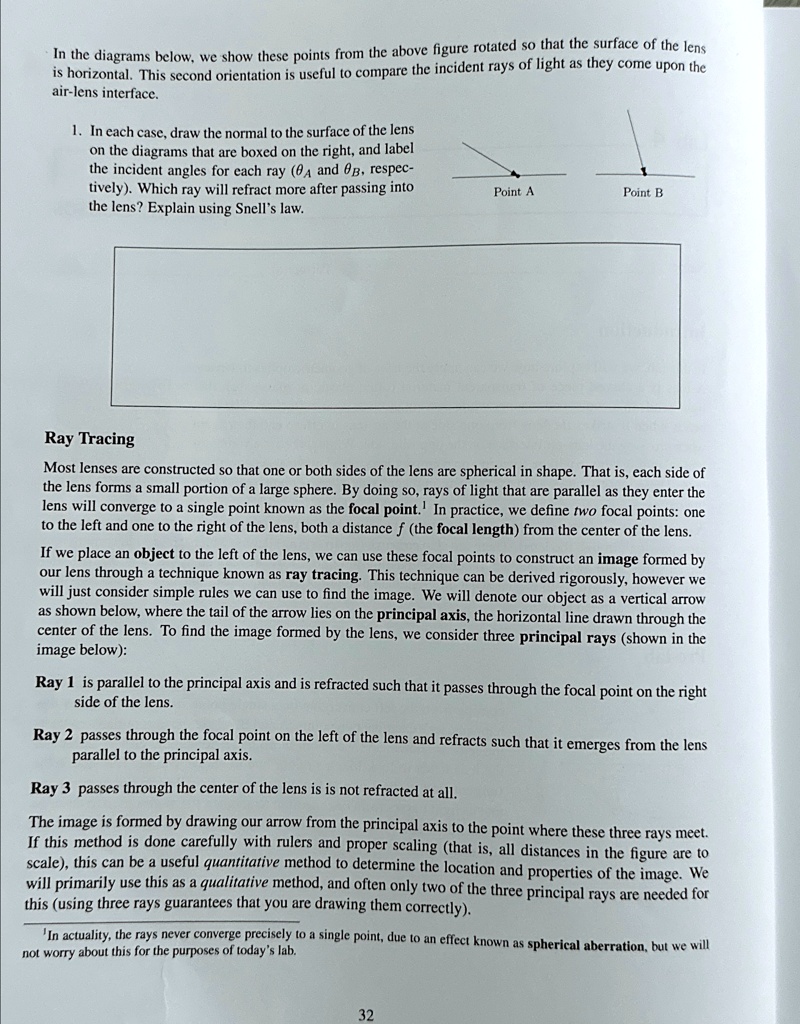
In the diagrams below, we show these points from the above figure rotated so that the surface of the lens is horizontal. This second orientation is useful to compare the incident rays of light as they come upon the air-lens interface. In each case, draw the normal to the surface of the lens on the diagrams that are boxed on the right, and label the incident angles for each ray and heta _(B), respectively). Which ray will refract more after passing into the lens? Explain using Snell's law. Ray Tracing Most lenses are constructed so that one or both sides of the lens are spherical in shape. That is, each side of the lens forms a small portion of a large sphere. By doing so, rays of light that are parallel as they enter the lens will converge to a single point known as the focal point. ^(1) In practice, we define two focal points: one to the left and one to the right of the lens, both a distance f (the focal length) from the center of the lens. If we place an object to the left of the lens, we can use these focal points to construct an image formed by our lens through a technique known as ray tracing. This technique can be derived rigorously, however we will just consider simple rules we can use to find the image. We will denote our object as a vertical arrow as shown below, where the tail of the arrow lies on the principal axis, the horizontal line drawn through the center of the lens. To find the image formed by the lens, we consider three principal rays (shown in the image below): Ray 1 is parallel to the principal axis and is refracted such that it passes through the focal point on the right side of the lens. Ray 2 passes through the focal point on the left of the lens and refracts such that it emerges from the lens parallel to the principal axis. Ray 3 passes through the center of the lens is is not refracted at all. The image is formed by drawing our arrow from the principal axis to the point where these three rays meet. If this method is done carefully with rulers and proper scaling (that is, all distances in the figure are to scale), this can be a useful quantitative method to determine the location and properties of the image. We will primarily use this as a qualitative method, and often only two of the three principal rays are needed for this (using three rays guarantees that you are drawing them correctly). 'In actuality, the rays never converge precisely to a single point, due to an effect known as spherical aberration, but we will not worry about this for the purposes of today's lab. 32 air-lens interface. 1. In each case,draw the normal to the surface of the lens on the diagrams that are boxed on the right, and label the incident angles for each ray A and , respec- tively. Which ray will refract more after passing into the lens? Explain using Snell's law. Point A Point B Ray Tracing Most lenses are constructed so that one or both sides of the lens are spherical in shape. That is,each side of the lens forms a small portion of a large sphere. By doing so,rays of light that are parallel as they enter the lens will converge to a single point known as the focal point. In practice, we define two focal points: one to the left and one to the right of the lens, both a distance f (the focal length from the center of the lens. If we place an object to the left of the lens, we can use these focal points to construct an image formed by our lens through a technique known as ray tracing. This technique can be derived rigorously, however we will just consider simple rules we can use to find the image. We will denote our object as a vertical arrow as shown below, where the tail of the arrow lies on the principal axis, the horizontal line drawn through the center of the lens. To find the image formed by the lens, we consider three principal rays (shown in the image below): Ray 1 is parallel to the principal axis and is refracted such that it passes through the focal point on the right side of the lens. Ray 2 passes through the focal point on the left of the lens and refracts such that it emerges from the lens parallel to the principal axis Ray 3 passes through the center of the lens is is not refracted at all. not worry about this for the purposes of today's lab. 32
View Answer
divider
BEST MATCH

When Joe says that it's important for Theo Chocolate to "create lasting change" in people's lives and the environment, he is referring to which of the following areas of managerial ethics? The employee to the firm The firm to other economic agents The firm to the employee

View Answer
divider
BEST MATCH

Instructions: 1) Create your own version of the structural organization in the human body. 2) Must include: chemical - cellular - tissue - organ - organ system - organism.

View Answer
divider
BEST MATCH

12- The hydrogenation of 2-butyne-1,4-diol to butenediol is to be carried out in a slurry reactor using a palladium-based catalyst. The initial concentration of diol is 2.5 kmol/m³. Pure hydrogen is bubbled through the reactor at a pressure of 35 atm and 35° C. The Henry's constant at these conditions is 3 x 10<sup>4</sup> \frac{kmol}{m<sup>3</sup> \cdot atm} The reaction rate constant is 0.048 \frac{m<sup>3</sup>}{kg \cdot kmol \cdot s}. The catalyst loading is 0.1 kg/m³ with a particle size of 0.01 cm and the catalyst density of 1500 kg/m³. a) Show the rate expression can be expressed as first order in hydrogen even though the reaction is second order. b) Calculate the percent of the overall resistance contributed by each of the transport steps.. Effective diffusivity: $D_e = 10^{-9} m^2/s$ for H<sub>2</sub> in organics. k<sub>ab</sub> = 0.3 s<sup>-1</sup> k<sub>c</sub> = 0.005 cm/s for H<sub>2</sub> in organics

View Answer
divider
BEST MATCH

Program IV: The Tuition Part Write a program that prompts the user to enter the number of courses taken by a student. The program reads the code and the credit of each course, uses the \texttt{switch} statement to calculate, and print the tuition fees the student has to pay. Each course code includes 7 digits the leftmost two digits indicates the course college. The tuition is calculated by multiplying college fees by the number of credits. The following table indicates the fee of every college: College code Fee per 1 credit 11 700 12 950 13 600 14 1200 15 800 The program should check if the code is a valid code. See given sample of input/output: Sample input/output:

View Answer
divider