Ace - AI Tutor
Ask Our Educators
Textbooks
My Library
Flashcards
Scribe - AI Notes
Notes & Exams
Download App
Ydjsjsj Sjsksmm

Ydjsjsj S.

Divider

Viewed Questions

Find the frequency-domain impedance. $\mathbf{Z},$ as shown in Fig. P8.8.

Find the frequency-domain impedance. $\mathbf{Z},$ as shown in Fig. P8.8.

Basic Engineering Circuit Analysis

Questions asked

INSTANT ANSWER

! Required information NOTE: This is a multi-part question. Once an answer is submitted, you will be unable to return to this part. A gear reduction system consists of three gears \( A, B \), and \( C \). Gear \( A \) rotates clockwise with a constant angular velocity \( \omega_{A} \) \( =700 \mathrm{rpm} \). Determine the angular velocities of gears \( B \) and \( C \).

View Answer
divider
INSTANT ANSWER

Find the frequency-domain impedance Z, as shown in Fig. P8.10. \[ (Z R=8 \Omega, Z L=j 2 \Omega, Z C=-j 4 \Omega) \] Figure P8. 10 \( 8.94 \angle 26.57^{\circ} \) \( 17.89 \angle 63.43^{\circ} \) \( 6.32 \angle-18.43^{\circ} \) \( 30.59 \angle-78.69^{\circ} \)

View Answer
divider
ANSWERED

Scott Stetson verified

Numerade educator

Find the frequency-domain impedance Z, as shown in Fig. P8.8. ( (W=1 Omega, L=j 10 Omega) ) Figure P8.8 ( 0.9 angle 2.55^{circ} ) ( 1 angle 5.71^{circ} ) ( 2.83 angle 17^{circ} ) ( 3.9 angle 6^{circ} )

View Answer
divider
INSTANT ANSWER

Calculate current across the capacitor shown in Fig. P8.6 if the voltage input is \[ v 1(t)=30 \cos \left(296 t-60^{\circ}\right) V \] Figure P8.6 For a current \( i(t)=\mathbf{C} \boldsymbol{\operatorname { c o s }}(\mathbf{w t}+\mathbf{P}) \), enter the value of the phase angle \( (\mathbf{P}) \). (be sure that your answer is between -180 deg to 180 deg.) Notes on entering solution: - Enter your solution in degrees - Have your current in cosine format - Do not include units in your answer - ex. \( 5^{\circ} \) is entered as 5

View Answer
divider
ANSWERED

Keondre Parker verified

Numerade educator

Determine by how much phase angle v1(t) leads i1(t), where v1(t)=4 sin (377t+27°) V i1(t)=0.05 cos (377t-24°) A Notes on entering solution: * Enter your solution with respect to "v leads i by" * Enter your solution in degree * Do not include units in your answer * Make sure your final answer is between -180deg and 180deg * ex. 5° is entered as 5

View Answer
divider
ANSWERED

Keondre Parker verified

Numerade educator

Given the following voltage and current: i(t)=5 sin (377t-33°) A u(t)=10 cos (377t+53°) V Determine the phase relationship between i(t) and u(t). Notes on entering solution: * Enter your solution with respect to "V leads i by" * Enter your solution in degree * Do not include units in your answer * ex. 5° is entered as 5

View Answer
divider
ANSWERED

Keondre Parker verified

Numerade educator

Determine the relative phase relationship of the two waves v1(t)=10 cos (377t-58°) V v2(t)=10 cos (377t+119°) V Notes on entering solution: - Enter your solution with respect to "v2(t) leads v1(t) by" - Enter your solution in degrees - Do not include units in your answer - ex. 5° is entered as 5

View Answer
divider
ANSWERED

Eduard Sanchez verified

Numerade educator

Given i(t)=5 cos (411t-120°) A, determine the frequency of the current. Notes on entering solution: - Enter your solution in hertz(Hz) - Enter your solution to the nearest hundredth (2 decimal places) - Do not include units in your answer - ex. 5Hz is entered as 5.00

View Answer
divider
ANSWERED

Eduard Sanchez verified

Numerade educator

Given i(t)=5 cos (10.1t-120°) A, determine the period of the current. Notes on entering solution: * Enter your solution in seconds(s) * Enter your solution to the nearest hundredth of a second (2 decimal places) * Do not include units in your answer * ex. 5sec is entered as 5.00

View Answer
divider
ANSWERED

Melissa Munoz verified

Numerade educator

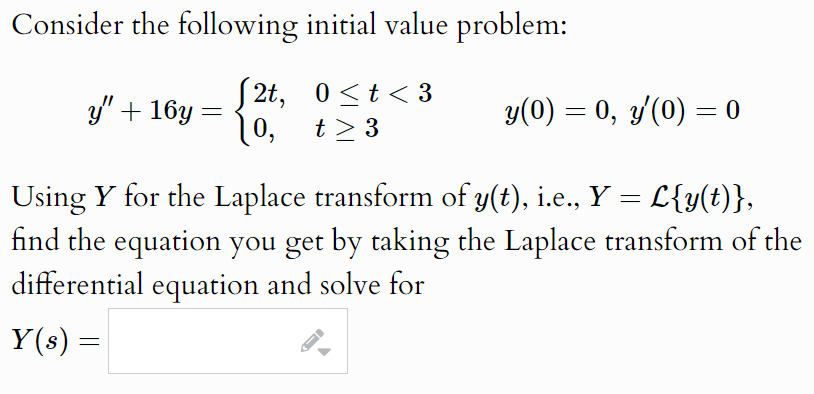
Consider the following initial value problem: [ y^{prime prime}+16 y=left{egin{array}{ll} 2 t, & 0 leq t<3 \ 0, & t geq 3 end{array} quad y(0)=0, y^{prime}(0)=0 ight. ] Using ( Y ) for the Laplace transform of ( y(t) ), i.e., ( Y=mathcal{L}{y(t)} ), find the equation you get by taking the Laplace transform of the differential equation and solve for [ Y(s)= ]
View Answer
divider