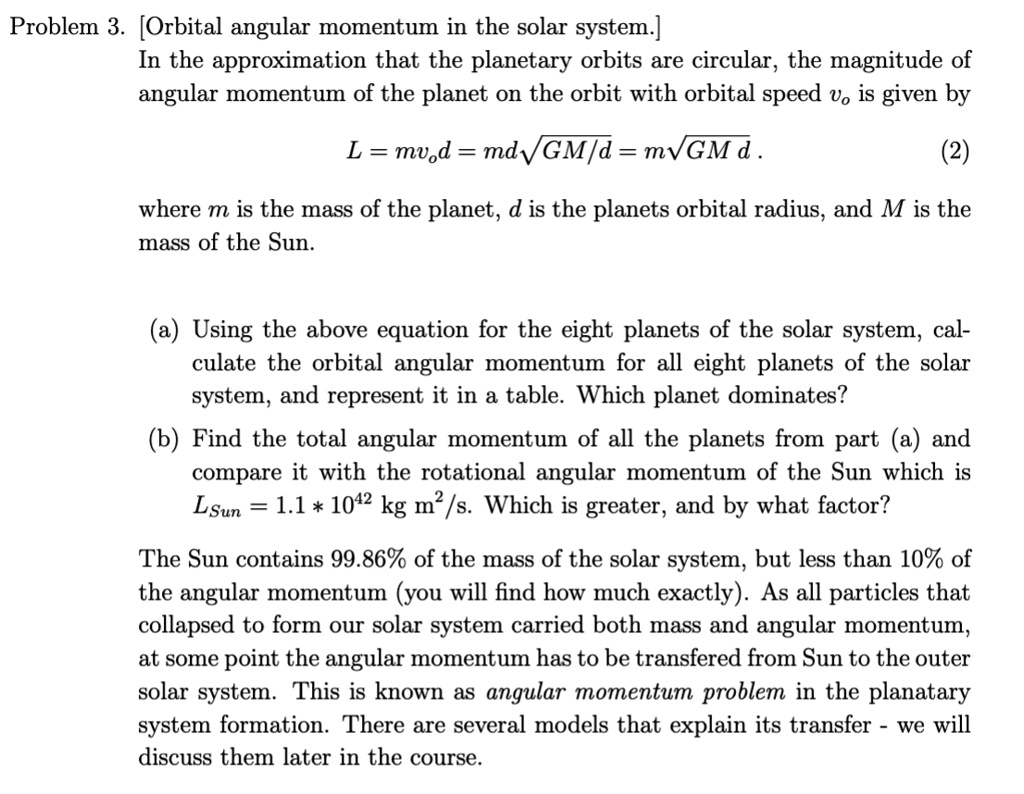
Problem 3. [Orbital angular momentum in the solar system.]
In the approximation that the planetary orbits are circular, the magnitude of angular momentum of the planet on the orbit with orbital speed vo is given by
L = mvod = mdpGM/d = m√GM d . (2)
where m is the mass of the planet, d is the planet's orbital radius, and M is the mass of the Sun.
(a) Using the above equation for the eight planets of the solar system, calculate the orbital angular momentum for all eight planets of the solar system, and represent it in a table. Which planet dominates?
(b) Find the total angular momentum of all the planets from part (a) and compare it with the rotational angular momentum of the Sun which is LSun = 1.1 ∗ 1042 kg m2/s. Which is greater, and by what factor?
The Sun contains 99.86% of the mass of the solar system, but less than 10% of the angular momentum (you will find how much exactly). As all particles that collapsed to form our solar system carried both mass and angular momentum, at some point the angular momentum has to be transferred from Sun to the outer solar system. This is known as angular momentum problem in the planetary system formation. There are several models that explain its transfer - we will discuss them later in the course.