Ace - AI Tutor
Ask Our Educators
Textbooks
My Library
Flashcards
Scribe - AI Notes
Notes & Exams
Download App
Lumi scene

Lumi s.

Divider

Viewed Questions

A recipe calls for $\frac{1}{2} \mathrm{lb}$ of flour for 1 batch. How many batches can be made with each of the following amounts?
a. $1 \mathrm{lb}$
b. $\frac{3}{4} \mathrm{lb}$
c. $\frac{1}{4} \mathrm{lb}$

A recipe calls for $\frac{1}{2} \mathrm{lb}$ of flour for 1 batch. How many batches can be made with each of the following amounts? a. $1 \mathrm{lb}$ b. $\frac{3}{4} \mathrm{lb}$ c. $\frac{1}{4} \mathrm{lb}$

Grade 6 Mathematics: Open Up Resources, Common Core State Standards Edition

Dividing Fractions

What Fraction of a Group?

A roast turkey is taken from an oven when its temperature has reached $ 185^{\circ}F $ and is placed on a table in a room where the temperature is $ 75^{\circ}F $. The graph shows how the temperature of the turkey decreases and eventually approaches room temperature. By measuring the slope of the tangent, estimate the rate of change of the temperature after an hour.

A roast turkey is taken from an oven when its temperature has reached $ 185^{\circ}F $ and is placed on a table in a room where the temperature is $ 75^{\circ}F $. The graph shows how the temperature of the turkey decreases and eventually approaches room temperature. By measuring the slope of the tangent, estimate the rate of change of the temperature after an hour.

Calculus: Early Transcendentals

Limits and Derivatives

Derivatives and Rates of Change

A hot-air balloon stays aloft because hot air at atmospheric pressure is less dense than cooler air at the same pressure. If the volume of the balloon is 500.0 m$^3$ and the surrounding air is at 15.0$^\circ$C, what must the temperature of the air in the balloon be for it to lift a total load of 290 kg (in addition to the mass of the hot air)? The density of air at 15.0$^\circ$C and atmospheric pressure is 1.23 kg/m$^3$.

A hot-air balloon stays aloft because hot air at atmospheric pressure is less dense than cooler air at the same pressure. If the volume of the balloon is 500.0 m$^3$ and the surrounding air is at 15.0$^\circ$C, what must the temperature of the air in the balloon be for it to lift a total load of 290 kg (in addition to the mass of the hot air)? The density of air at 15.0$^\circ$C and atmospheric pressure is 1.23 kg/m$^3$.

University Physics with Modern Physics

Questions asked

INSTANT ANSWER

1. Molybdenum \( (Z=42) \) consists of seven naturally occurring isotopes. Mass spectrum of molybdenum \( (z=42) \) i. State the number of neutrons in an atom of \( { }^{95} \mathrm{Mo} .= \) ii. State the number of electrons in \( { }^{98} \mathrm{Mo}^{3+} \). \( = \) iii. Determine the relative atomic mass of molybdenum from its mass spectrum. 2. The IB data booklet gives the relative atomic mass of chlorine as 35.45 . Chlorine contains two isotopes, \( { }^{35} \mathrm{Cl} \) and \( { }^{37} \mathrm{Cl} \), in the approximate ratio of \( 3: 1 \). i. Determine the molar molecular mass of \( \mathrm{Cl}_{2} \) if the ratio of \( 3: 1 \) is correct. ii. Determine the exact values of \( X \) and \( \boldsymbol{Y} \) for the isotopic abundance of \( { }^{35} \mathrm{Cl} \) and \( { }^{37} \mathrm{Cl} \) respectively.

View Answer
divider
INSTANT ANSWER

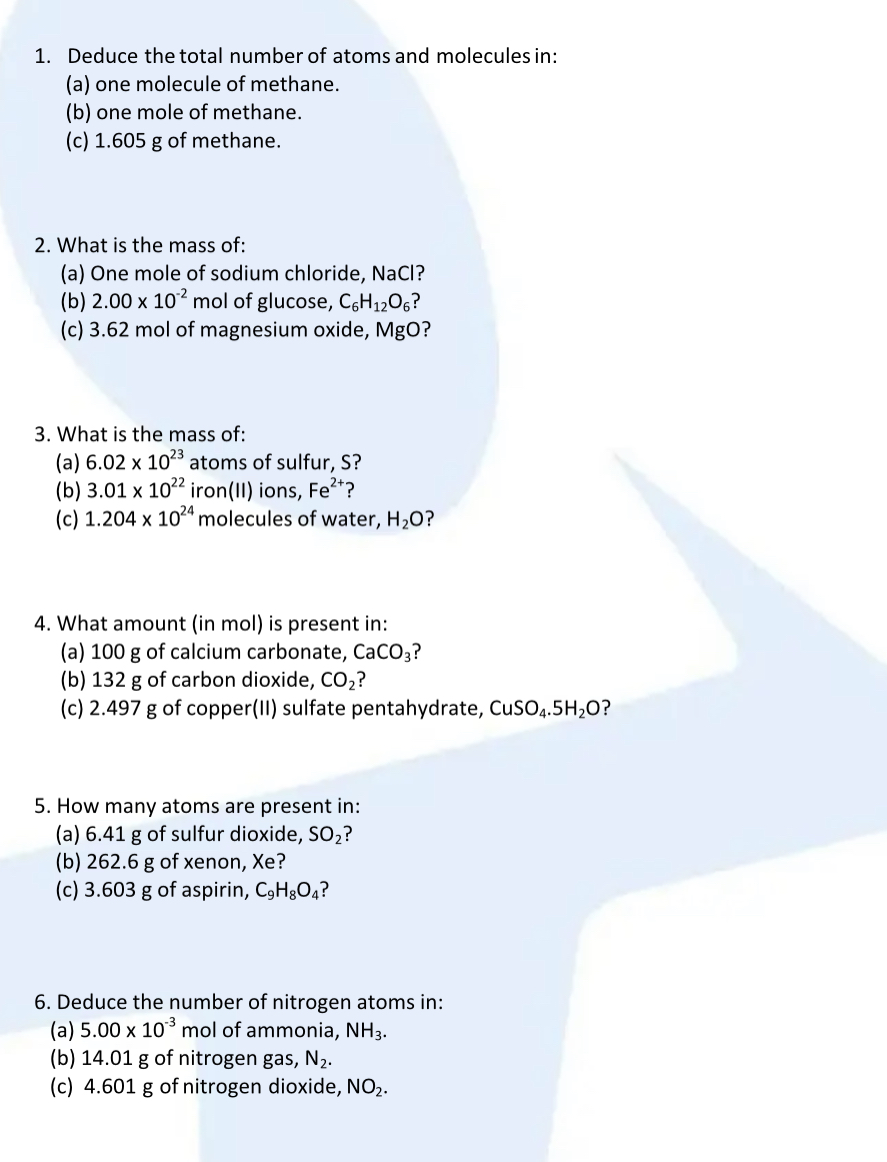
1. Deduce the total number of atoms and molecules in: (a) one molecule of methane. (b) one mole of methane. (c) \( 1.605 \mathrm{~g} \) of methane. 2. What is the mass of: (a) One mole of sodium chloride, \( \mathrm{NaCl} \) ? (b) \( 2.00 \times 10^{-2} \mathrm{~mol} \) of glucose, \( \mathrm{C}_{6} \mathrm{H}_{12} \mathrm{O}_{6} \) ? (c) \( 3.62 \mathrm{~mol} \) of magnesium oxide, \( \mathrm{MgO} \) ? 3. What is the mass of: (a) \( 6.02 \times 10^{23} \) atoms of sulfur, S? (b) \( 3.01 \times 10^{22} \) iron(II) ions, \( \mathrm{Fe}^{2+} \) ? (c) \( 1.204 \times 10^{24} \) molecules of water, \( \mathrm{H}_{2} \mathrm{O} \) ? 4. What amount (in \( \mathrm{mol} \) ) is present in: (a) \( 100 \mathrm{~g} \) of calcium carbonate, \( \mathrm{CaCO}_{3} \) ? (b) \( 132 \mathrm{~g} \) of carbon dioxide, \( \mathrm{CO}_{2} \) ? (c) \( 2.497 \mathrm{~g} \) of copper(II) sulfate pentahydrate, \( \mathrm{CuSO}_{4} \cdot 5 \mathrm{H}_{2} \mathrm{O} \) ? 5. How many atoms are present in: (a) \( 6.41 \mathrm{~g} \) of sulfur dioxide, \( \mathrm{SO}_{2} \) ? (b) \( 262.6 \mathrm{~g} \) of xenon, \( \mathrm{Xe} \) ? (c) \( 3.603 \mathrm{~g} \) of aspirin, \( \mathrm{C}_{9} \mathrm{H}_{8} \mathrm{O}_{4} \) ? 6. Deduce the number of nitrogen atoms in: (a) \( 5.00 \times 10^{-3} \mathrm{~mol} \) of ammonia, \( \mathrm{NH}_{3} \). (b) \( 14.01 \mathrm{~g} \) of nitrogen gas, \( \mathrm{N}_{2} \). (c) \( 4.601 \mathrm{~g} \) of nitrogen dioxide, \( \mathrm{NO}_{2} \).
View Answer
divider
INSTANT ANSWER

1. Deduce the total number of atoms and molecules in: (a) one molecule of methane. (b) one mole of methane. (c) \( 1.605 \mathrm{~g} \) of methane. 2. What is the mass of: (a) One mole of sodium chloride, \( \mathrm{NaCl} \) ? (b) \( 2.00 \times 10^{-2} \mathrm{~mol} \) of glucose, \( \mathrm{C}_{6} \mathrm{H}_{12} \mathrm{O}_{6} \) ? (c) \( 3.62 \mathrm{~mol} \) of magnesium oxide, \( \mathrm{MgO} \) ? 3. What is the mass of: (a) \( 6.02 \times 10^{23} \) atoms of sulfur, S? (b) \( 3.01 \times 10^{22} \) iron(II) ions, \( \mathrm{Fe}^{2+} \) ? (c) \( 1.204 \times 10^{24} \) molecules of water, \( \mathrm{H}_{2} \mathrm{O} \) ? 4. What amount (in \( \mathrm{mol} \) ) is present in: (a) \( 100 \mathrm{~g} \) of calcium carbonate, \( \mathrm{CaCO}_{3} \) ? (b) \( 132 \mathrm{~g} \) of carbon dioxide, \( \mathrm{CO}_{2} \) ? (c) \( 2.497 \mathrm{~g} \) of copper(II) sulfate pentahydrate, \( \mathrm{CuSO}_{4} \cdot 5 \mathrm{H}_{2} \mathrm{O} \) ? 5. How many atoms are present in: (a) \( 6.41 \mathrm{~g} \) of sulfur dioxide, \( \mathrm{SO}_{2} \) ? (b) \( 262.6 \mathrm{~g} \) of xenon, \( \mathrm{Xe} \) ? (c) \( 3.603 \mathrm{~g} \) of aspirin, \( \mathrm{C}_{9} \mathrm{H}_{8} \mathrm{O}_{4} \) ? 6. Deduce the number of nitrogen atoms in: (a) \( 5.00 \times 10^{-3} \mathrm{~mol} \) of ammonia, \( \mathrm{NH}_{3} \). (b) \( 14.01 \mathrm{~g} \) of nitrogen gas, \( \mathrm{N}_{2} \). (c) \( 4.601 \mathrm{~g} \) of nitrogen dioxide, \( \mathrm{NO}_{2} \).

View Answer
divider
INSTANT ANSWER

120 competitors enter an elimination race for charity. Runners set off from the same start running as many laps of the course as possible. Their total distance is tracked and the competitor who runs the furthest over a 6-hour period is the winner. The distances runners achieved are recorded in the table below: \begin{tabular}{|c|c|} \hline Distance \( a \) (miles) & Frequency \( f \) \\ \hline \( 25 \leq d<30 \) & 8 \\ \hline \( 30 \leq d<35 \) & 10 \\ \hline \( 35 \leq d<40 \) & 32 \\ \hline \( 40 \leq d<45 \) & 54 \\ \hline \( 45 \leq d<50 \) & 10 \\ \hline \( 50 \leq d<55 \) & 6 \\ \hline \end{tabular} On the grid below, draw a cumulative frequency graph for the information in the table. Use your graph to find an estimate for the median and interquartile range.

View Answer
divider
ANSWERED

Jeremy Higgins verified

Numerade educator

3. A naturally occurring sample of chromium contains the following relative amounts of four different isotopes. Relative mass of isotope | Relative amount of isotope --- | --- 50.000 | 4.345 52.000 | 83.789 53.000 | 9.501 54.000 | 2.365 Determine the relative atomic mass of chromium to two decimal places. 4. The relative atomic mass of bromine is 79.91. Determine the relative percentage abundance of its two isotopes 79Br and 81Br to two decimal places.

View Answer
divider
ANSWERED

Tanvi Garg verified

Numerade educator

1. Working sequentially from left to right identify all the missing components in each row to complete the following table. | Symbol of isotope | Number of protons | Number of electrons | Number of neutrons | Atomic number | Mass number | | :---: | :---: | :---: | :---: | :---: | :---: | | $^9_4 ext{Be}$ | | | | | | | | 7 | 7 | 7 | | | | F | | 10 | | | 19 | | | | 27 | | 29 | 64 | | $ ext{Br}^-$ | | | 44 | | | 2. Two isotopes used in medicine are $^{125} ext{I}$ and $^{131} ext{I}$. The atomic number of iodine is 53. i. State how they would differ in: (a) the number of neutrons contained in the nucleus of each isotope. (b) their physical properties (c) their chemical properties ii. Suggest why people living near the nuclear power plant in Fukushima, which was damaged in the earthquake that hit Japan in March 2011, were given iodine tablets.

View Answer
divider
ANSWERED

Jennifer Hudspeth verified

Numerade educator

In the space below, construct a genetic diagram to predict the ratios of eye colour in male and female offspring of a white-eyed male fly and a heterozygous red-eyed female fly.

View Answer
divider
INSTANT ANSWER

1 The formula of a polymer is shown. State the type of polymerisation used to make this polymer. [1] [Total: 1]

View Answer
divider
INSTANT ANSWER

Give the name of the process that is used to separate the products of hydrolysis of long chain carbohydrates. [1] [Total: 1] Describe one pollution problem caused by non-biodegradable plastics. [1] [Total: 1] But-1-ene is an unbranched molecule. Name the unbranched isomer of but-1-ene. [1] [Total: 1]

View Answer
divider
INSTANT ANSWER

Give the name of the process that is used to separate the products of hydrolysis of long chain carbohydrates. [1] [Total: 1] Describe one pollution problem caused by non-biodegradable plastics. [1] [Total: 1] But-1-ene is an unbranched molecule. Name the unbranched isomer of but-1-ene. [1] [Total: 1]

View Answer
divider