Experienced in Mathematics different topics including: Calculus, Differential Equations, Algebra, Geometry, Pre-calculus, and statistics. Also, I have 3+ years of experience in the field of tutoring and worked with a lot of students and helped answering their concerns and questions.
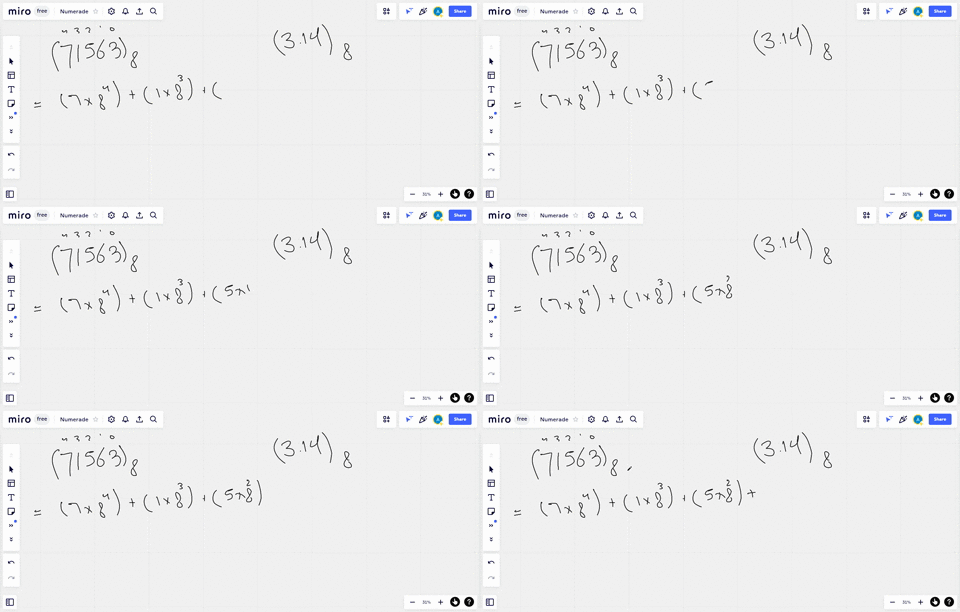
Convert the following base- 8 numbers to base 10: 71,563 and3.14
The derivative of $f(x)=1 /\left(1-3 x^{2}\right)$ is given by$$\frac{6 x}{\left(1-3 x^{2}\right)^{2}}$$Do you expect to have difficulties evaluating this function at $x=0.577 ?$ Try it using 3 - and 4 -digit arithmetic with chopping.
Calculate the random access memory (RAM) in megabytes necessary to store a multidimensional array that is $20 \times 40 \times 120$ This array is double precision, and each value requires a 64 -bit word. Recall that a 64 -bit word $=8$ bytes and 1 kilobyte $=2^{10}$ bytes. Assume that the index starts at 1
Explain how the formula for differentiating the natural exponential function is a special case of the formula for differentiating exponential functions of the form $e^{k x}$. Then explain why it is a special case of the formula for differentiating functions of the form $b^{x}$.
Explain how the formula for differentiating the natural logarithm function is a special case of the formula for differentiating logarithmic functions of the form $\log _{h} x$.
The three blocks, m1 = 2.9kg, m2 = 4 kg andm3 = 7.7 kg lie on a frictionless surface.Determine the magnitude of the force exerted on block 3 by block 2if F = 14 N.
If you are given odds 5 to 6 in favor of winning a bet , what isthe probability of winning the bet?
A pulley has a radius of 0.16 meters. A rope that is wrappedaround the pulley is pulled 2 meters. What angle does the pulleyturn? (Assume the rope does not slip.)
A credit card offers a borrowing rate of 18%, compounded daily.What is the effective rate?
The figure below shows two boxes connected to each other by a light rope that passes over a pulley with negligible friction. The box of mass m1 = 10.0 kg hangs vertically while the box of mass m2 = 5.30 kg lies on an inclined surface with negligible friction. The surface is inclined at an angle θ of 39.0°. What is the magnitude of the acceleration of the 5.30 kg box (in m/s^2)? What is the tension in the rope (in N)?
When running, we bend our knee before swinging our leg forward.Why does bending the knee make running more economical? Explainusing two equations.