Akash M

Numerade Educator

Biography

Numerade educator passionate about unlocking the wonders of math, guiding students through the beauty of numbers and equations with clarity and enthusiasm.

Education

Akash has not yet added their education credentials.

Educator Statistics

Numerade tutor for 3 years
38895 Students Helped

Topics Covered

Exploring Probability Topics: From Basics to Advanced Strategies
Computer Science Overview
Discover the Power of Introduction: Your Guide to Making a Lasting Impression
How Markets Work: Understanding the Dynamics of Supply and Demand
Balancing Markets and Welfare: Striving for Equilibrium
Explore Deeper: Topics for Further Study
Unlocking the Power of Functions: Boost Your Programming Skills
Understanding Firm Behavior and Industry Organization
Understanding Continuous Random Variables: Key Concepts
History of Psychology
Psychological Research: Approaches and Methods
Ethics of Psychological Research
Unlocking Insights: Macroeconomic Data Analysis
Introduction
How Markets Work
Markets and Welfare
The Long-Term Impact of the Real Economy: Insights and Analysis
Understanding the Impact of Money and Prices in the Long Run
Understanding Short-Term Economic Fluctuations
Psychological Research: Analysis of Findings
Linear Regression & Correlation: Analyzing Data Relationships
Unlock the Power of Vectors: Discover Their Limitless Possibilities
Mastering Matrices: An Introduction to the Fundamentals
Introduction to Combinatorics & Probability: Understanding the Basics
Field of Psychology
Arrays
Loops
Treatment of Mental Health: Past and Present
Types of Treatments
Treatment Therapies and Modalities
Principles of Perception
Data Types and Variables
Errors and Design Environment

Akash's Textbook Answer Videos

02:16
Principles of Economics

The many identical residents of Whoville love drinking Zlurp. Each resident has the following willingness to pay for the tasty refreshment:
a. The cost of producing Zlurp is \$1.50, and the competitive suppliers sell it at this price. (The supply curve is horizontal.) How many bottles will each Whovillian consume? What is each
person's consumer surplus?
b. Producing Zlurp creates pollution. Each bottle has an external cost of \$1. Taking this additional cost into account, what is total surplus per person in the allocation you described in part (a)?
c. Cindy Lou Who, one of the residents of Whoville, decides on her own to reduce her consumption of Zlurp by one bottle. What happens to Cindy's welfare (her consumer surplus minus the cost of
pollution she experiences)? How does Cindy's decision affect total surplus in Whoville?
d. Mayor Grinch imposes a \$1 tax on Zlurp. What is consumption per person now? Calculate consumer surplus, the external cost, government revenue, and total surplus per person.
e. Based on your calculations, would you support the mayor's policy? Why or why not?

Chapter 10: Externalities
Akash M
02:33
Principles of Economics

Explain each of the following statements using supply-and-demand diagrams.
a. "When a cold snap hits Florida, the price of orange juice rises in supermarkets throughout
the country."
b. "When the weather turns warm in New England every summer, the price of hotel rooms in Caribbean resorts plummets."
c. "When a war breaks out in the Middle East, the price of gasoline rises and the price of a used
Cadillac falls."

Chapter 4: The Market Forces of Supply and Demand
Akash M
01:52
Introductory Econometrics

Use the data in BWGHT to answer this question.
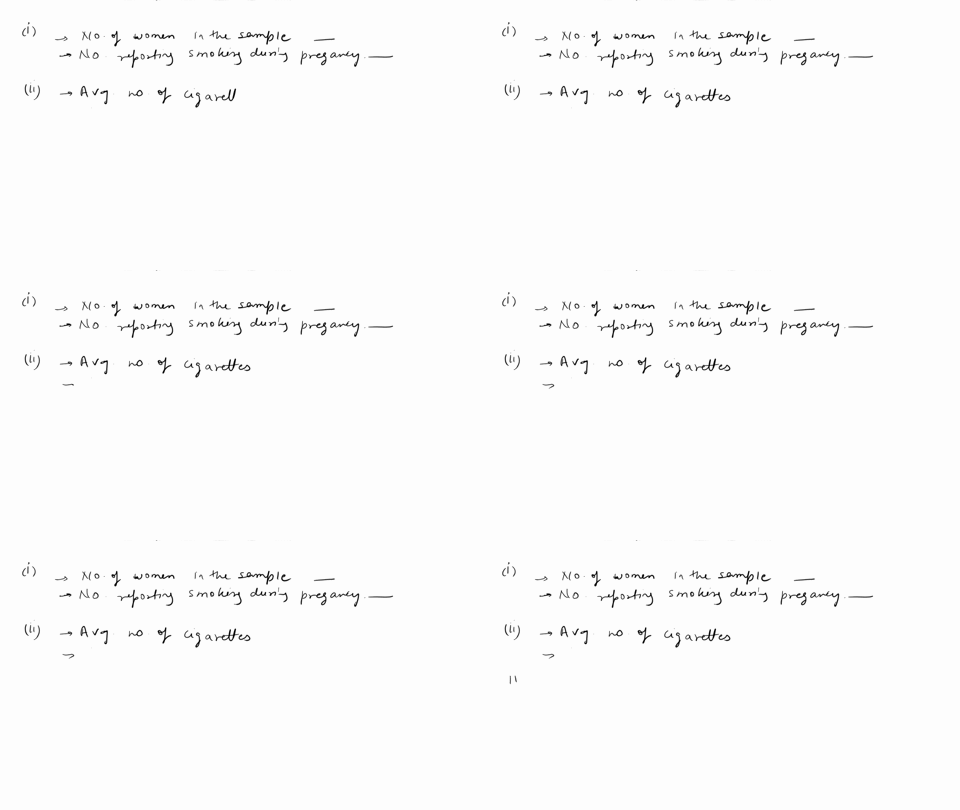
(i) How many women are in the sample, and how many report smoking during pregnancy?
(ii) What is the average number of cigarettes smoked per day? Is the average a good measure of the
"typical" woman in this case? Explain.
(iii) Among women who smoked during pregnancy, what is the average number of cigarettes
smoked per day? How does this compare with your answer from part (ii), and why?
(iv) Find the average of fatheduc in the sample. Why are only 1,192 observations used to compute
this average?
(v) Report the average family income and its standard deviation in dollars.

Chapter 1: The Nature of Econometrics and Economic Data
Akash M
02:43
Introductory Econometrics

Use the data in KIELMC, only for the year $1981,$ to answer the following questions. The data are for
houses that sold during 1981 in North Andover, Massachusetts 1981 was the year construction began on a local garbage incinerator.
(i) To study the effects of the incinerator location on housing price, consider the simple regression
model
log $(price)=\beta_{0}+\beta_{1} \log (d i s t)+u$
where price is housing price in dollars and dist is distance from the house to the incinerator measured in feet. Interpreting this equation causally, what sign do you expect for $\beta_{1}$ if the presence of the incinerator depresses housing prices? Estimate this equation and interpret the results.
(ii) To the simple regression model in part (i), add the variables log( (intst), log(area), log(land), rooms, baths, and age, where intst is distance from the home to the interstate, area is square footage of the house, land is the lot size in square feet, rooms is total number of rooms, bath is number of bathrooms, and age is age of the house in years. Now, what do you conclude about the effects of the incinerator? Explain why (i) and (ii) give conflicting results.
(iii) Add [log( intst) $]^{2}$ to the model from part (ii). Now what happens? What do you conclude about the importance of functional form?
(iv) Is the square of log(dist) significant when you add it to the model from part (iii)?

Chapter 6: Multiple Regression Analysis: Further Issues
Akash M
03:08
Introductory Econometrics

There has been much interest in whether the presence of 401$(\mathrm{k})$ pension plans, available to many U.S. workers, increases net savings. The data set 401 $\mathrm{KSUBS}$ contains information on net financial assets (netta), family income (inc), a binary variable for eligibility in a 401$(\mathrm{k})$ plan (e40lk), and several other
variables.
(i) What fraction of the families in the sample are eligible for participation in a 401$(\mathrm{k})$ plan?
(ii) Estimate a linear probability model explaining 401$(\mathrm{k})$ eligibility in terms of income, age, and gender. Include income and age in quadratic form, and report the results in the usual form.
(iii) Would you say that 401$(\mathrm{k})$ eligibility is independent of income and age? What about gender? Explain.
(iv) Obtain the fitted values from the linear probability model estimated in part (ii). Are any fitted
values negative or greater than one?
(v) Using the fitted values $\widehat{e 401 k_{i}}$ from part (iv), $\widehat{e 401 k_{i}}$ $=1$ if $\widehat{e 401 k_{i}}$ $\geq .5$ and $\widehat{e 401 k_{i}}$ $=0$ if $\widehat{e 401 k_{i}}$ $<.5 .$ Out of $9,275$ families, how many are predicted to be eligible for a 401$(\mathrm{k})$ plan?
(vi) For the $5,638$ families not eligible for a 401(k), what percentage of these are predicted not to have a $401(\mathrm{k}),$ using the predictor $\widehat{e 401 k_{i}}$ For the $3,637$ families eligible for a 401$(\mathrm{k})$ plan, what percentage are predicted to have one? (It is helpful if your econometrics package has a "tabulate" command.)
(vii) The overall percent correctly predicted is about 64.9$\% .$ Do you think this is a complete description of how well the model does, given your answers in part (vi)?
(viii) Add the variable pira as an explanatory variable to the linear probability model. Other things
equal, if a family has someone with an individual retirement account, how much higher is the
estimated probability that the family is eligible for a 401(k) plan? Is it statistically different
from zero at the 10$\%$ level?

Chapter 7: Multiple Regression Analysis with Qualitative Information: Binary (or Dummy) Variables
Akash M
02:45
Introductory Econometrics

Use the data in AIRFARE for this exercise. We are interested in estimating the model
$\begin{aligned} \log \left(\text { fare }_{i t}\right)=& \eta_{t}+\beta_{1} \text { concen }_{i t}+\beta_{2} \log \left(d i s t_{i}\right)+\beta_{3}\left[\log \left(d i s t_{i}\right)\right]^{2} \\ &+a_{i}+u_{i t}, t=1, \ldots, 4 \end{aligned}$
where $\eta_{t}$ means that we allow for different year intercepts.
(i) Estimate the above equation by pooled OLS, being sure to include year dummies. If
\Deltaconcen $=.10,$ what is the estimated percentage increase in fare?
(ii) What is the usual OLS 95 $\%$ confidence interval for $\beta_{1} ?$ Why is it probably not reliable? If you have access to a statistical package that computes fully robust standard errors, find the fully
robust 95$\%$ CI for $\beta_{1} .$ Compare it to the usual CI and comment.
(iii) Describe what is happening with the quadratic in log(dist). In particular, for what value of dist does the relationship between log(fare) and dist become positive? [Hint: Figure out the turning point
value for log(dist), and then exponentiate. Is the turning point outside the range of the data?
(iv) Now estimate the equation using random effects. How does the estimate of $\beta_{1}$ change?
(v) Now estimate the equation using fixed effects. What is the FE estimate of $\beta_{1} ?$ . Why is it fairly similar to the RE estimate? (Hint: What is $\hat{\theta}$ for RE estimation?)
(vi) Name two characteristics of a route (other than distance between stops) that are captured by $a_{i}$ Might these be correlated with concen $_{i t}$ ?
(vii) Are you convinced that higher concentration on a route increases airfares? What is your best estimate?

Chapter 14: Advanced Panel Data Methods
Akash M
1 2 3 4 5 ... 32

Akash's Quick Ask Videos

01:28
Microeconomics

Phil has been accepted into a 2 year Radiology Technician Program at school. He has been awarded a $9000 unsubsidized 10 year federal loan at 4.29%. He knows he has the option of beginning repayment of the loan in 2.5 years. He also knows that during this non-payment time, interest will accrure at 4.9%.
how much interest will Phil accrue during the 2.5 year non payment period?

Akash M
04:00
Psychology

You should present a cogent argument based on your critical analysis of the questions posed, using appropriate psychological terminology. It is not enough to answer a question by merely listing facts.

David is a sophomore in high school and is studying for his United States history exam, in which he must recall all of the battles in the American Revolutionary War. At first, he begins by just trying to group all of the facts associated with each battle into his memory. When he realizes he is forgetting some battles, he begins repeatedly associating the events that occurred in each battle with the place where the battle occurred. He finds he remembers the battles more readily this way, but he is still having a hard time remembering all the facts associated with each battle. Because he continues to think this is the best way to approach learning, he continues to study in this manner. After several bad grades, he realizes that his studying technique is not working, so he asks a friend who is doing better at remembering everything how she is studying. She said she is making up stories about each battle and how each battle is connected with other battles. David tries this method and finds it was much more effective for him.

Explain how each of the following concepts relates to this scenario. Metacognition; Method of loci; Deep processing; Rehearsal; Elaboration; Chunking; Mental set

Akash M
03:08
Macroeconomics

54) Consider two economies, A and B. Economy A has a marginal propensity to consume of 0.9, a net tax rate of 0.2 and a marginal propensity to import of 0.2. Economy B has a marginal propensity to consume of 0.7, a net tax rate of 0.2 and a marginal propensity to import of 0.2. Suppose there is an increase in autonomous investment of $5 billion in each of these economies. Which of the following statements is true?

Select one:
a. The simple multiplier is larger in Economy A.
b. The AD curve shifts farther to the left in Economy B than Economy A.
c. The AD curve shifts farther to the right in Economy A than Economy B.
d. The AD curve shifts to the left the same amount in both economies.
e. The AD curve shifts to the right the same amount in both economies.

Akash M
03:54
Macroeconomics

need help making sure what I have is right and what the other blanks are

Akash M
08:09
Macroeconomics

Suppose the government reduces taxes by $20 billion, that there is no crowding out, and that the
marginal propensity to consume is 3?4.
a. What is the initial effect of the tax reduction on aggregate demand?
b. What additional effects follow this initial effect? What is the total effect of the tax cut on
aggregate demand?
c. How does the total effect of this $20 billion tax cut compare to the total effect of a $20 billion
increase in government purchases? Why?
d. Based on your answer to part (c), can you think of a way in which the government can
increase aggregate demand without changing the government’s budget deficit?

Akash M
04:35
Macroeconomics

An article discusses the market for autographs by Mickey Mantle, the superstar center fielder for the New York Yankees during the 1950 s and 1960 s: "At card shows, golf outings, charity dinners, Mr. Mantle signed his name over and over." One expert on sport autographs is quoted as saying, "He was a real good signer.... He is not rare." Yet the article quotes another expert as saying, "Mr. Mantle's autograph ranks No. 3 of most-popular autographs, behind Babe Ruth and Muhammad Ali." A baseball signed by Mantle is likely to sell for the relatively high price of $ 250 to $ 400 . By contrast, baseballs signed by Whitey Ford, a teammate of Mantle's on the Yankees, typically sell for less than $150. Use one graph to show both the demand and supply for autographs by Whitey Ford and the demand and supply for autographs by Mickey Mantle. Show how it is possible for the price of Mantle's autographs to be higher than the price of Ford's autographs, even though the supply of Mantle autographs is larger than the supply of Ford autographs.

Akash M
1 2 3 4 5 ... 4294