Allea Cauilan

California State University - Northridge
Adjunct Instructor

Biography

I teach a non-major introductory course in biotechnology, focusing on technical skills. I also tutor for AP biology, AP chemistry, algebra 1, and geometry. Courses are taught online via zoom, pre-recorded lectures, etc.

Education

BS Microbiology, Cell and Molecular Biology (double major)
California State University - Northridge
MS Biology
California State University - Northridge
MA Bioinformatics - MicroMasters through edX
University of Maryland - University College

Educator Statistics

Numerade tutor for 6 years
55 Students Helped

Topics Covered

Mastering Chemical Reactions and Stoichiometry for Optimal Results
Aqueous Equilibria: Understanding the Balance of Solutions
Effective Solutions for Your Business Needs

Allea's Textbook Answer Videos

11:21
World of Chemistry

Identify each of the following unbalanced reaction equations as belonging to one or more of the following categories: precipitation, acid–base, or oxidation–reduction.
a. $\mathrm{K}_{2} \mathrm{SO}_{4}(a q)+\mathrm{Ba}\left(\mathrm{NO}_{3}\right)_{2}(a q) \rightarrow$ $\mathrm{BaSO}_{4}(s)+\mathrm{KNO}_{3}(a q)$
b. $\mathrm{HCl}(a q)+\mathrm{Zn}(s) \rightarrow \mathrm{H}_{2}(g)+\mathrm{ZnCl}_{2}(a q)$
c. $\mathrm{HCl}(a q)+\mathrm{AgNO}_{3}(a q) \rightarrow$
$\mathrm{HNO}_{3}(a q)+\mathrm{AgCl}(s)$
d. HCl $(a q)+\mathrm{KOH}(a q) \rightarrow \mathrm{H}_{2} \mathrm{O}(l)+\mathrm{KCl}(a q)$
e. $\mathrm{Zn}(s)+\mathrm{CuSO}_{4}(a q) \rightarrow \mathrm{ZnSO}_{4}(a q)+\mathrm{Cu}(s)$
f. $\mathrm{NaH}_{2} \mathrm{PO}_{4}(a q)+\mathrm{NaOH}(a q) \rightarrow$
$\mathrm{Na}_{3} \mathrm{PO}_{4}(a q)+\mathrm{H}_{2} \mathrm{O}(l)$
g. $\mathrm{Ca}(\mathrm{OH})_{2}(a q)+\mathrm{H}_{2} \mathrm{SO}_{4}(a q) \rightarrow$
$\quad \mathrm{CaSO}_{4}(s)+\mathrm{H}_{2} \mathrm{O}(l)$
h. $\mathrm{ZnCl}_{2}(a q)+\mathrm{Mg}(s) \rightarrow \mathrm{Zn}(s)+\mathrm{MgCl}_{2}(a q)$
i. $\mathrm{BaCl}_{2}(a q)+\mathrm{H}_{2} \mathrm{SO}_{4}(a q) \rightarrow$
$\mathrm{BaSO}_{4}(s)+\mathrm{HCl}(a q)$

Chapter 8: Reactions in Aqueous Solutions
Section 3: Classifying Reactions
Allea Cauilan
05:25
Chemistry The Science in Context

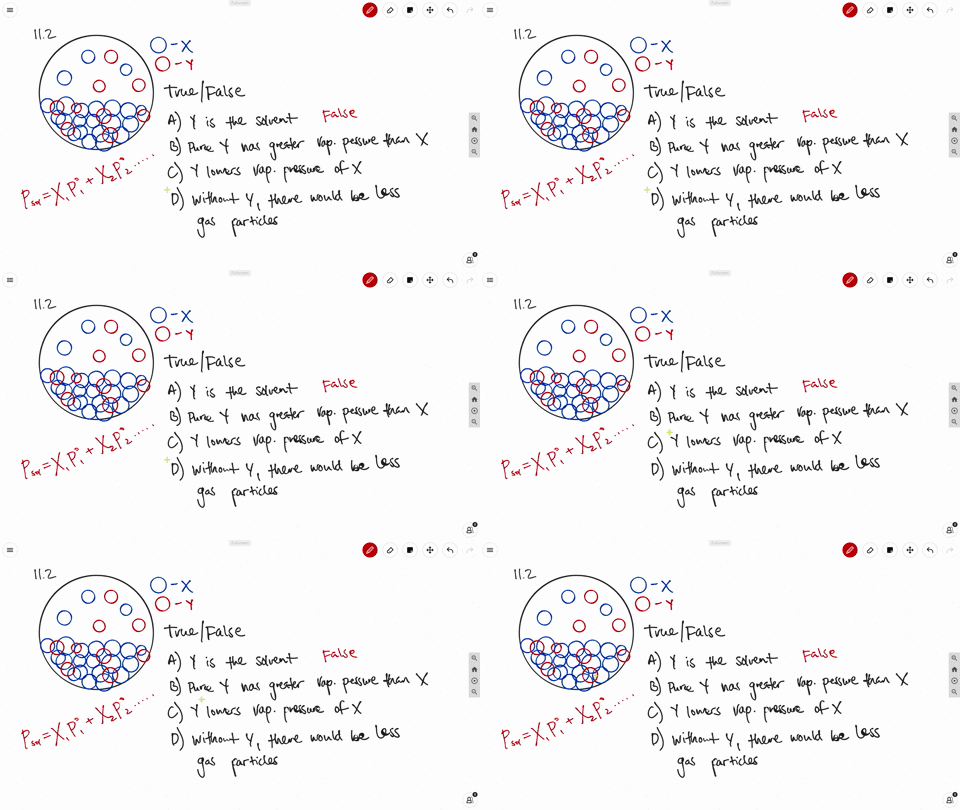
Figure $\mathrm{P} 11.2$ shows a particle-level vicw of a scaled container partially filled with a solution of two miscible liquids: X (blue spheres) and $Y$ (red spheres). Which of the following statements about substances $\mathrm{X}$ and $\mathrm{Y}$ are true?
a. Y is the solvent in this solution.
b. Pure $Y$ has a higher vapor pressure than pure X.
c. The presence of $Y$ in the solution lowers the vapor pressure of $\mathrm{X}$.
d. If $Y$ were not present, there would be fewer total particles in the gas above the liquid solution.

Chapter 11: Solutions: Properties and Behavior
Allea Cauilan
04:20
Chemistry The Science in Context

The graph in Figure P11.4 describes the volume of distillate collected during the fractional distillation of a liquid. Answer the following questions about the process: (a) Is the sample a pure liquid or a mixture? (b) If it is a mixture:
(i) how many components are in the mixture? (ii) What are the relative ratios of the volumes in the mixture? (iii) What are their approximate boiling points?

Chapter 11: Solutions: Properties and Behavior
Allea Cauilan
02:34
Chemistry The Science in Context

The arrow in Figure P11.6 indicates the direction of solvent flow through a semipermeable membrane in equipment designed to measure osmotic pressure. Which solution, A or B, is more concentrated? Explain your answer.

Chapter 11: Solutions: Properties and Behavior
Allea Cauilan
06:34
Chemistry The Science in Context

Use representations [A] through [I] in Figure P11.8 to answer questions a-f about the formation of an aqueous solution of potassium chloride from potassium $[\mathrm{K}(s),$ purple spheres] and chlorine $\left[\mathrm{Cl}_{2}(g),$ green spheres]. \right.
a. Which process depicts the formation of a compound from its elements?
b. Which processes require the breaking of bonds?
c. Which processes depict transfer of electrons?
d. Which representation illustrates ion-dipole interactions?
e. Which processes require the input of energy to overcome intermolecular forces?
F. Which processes are exothermic?

Chapter 11: Solutions: Properties and Behavior
Allea Cauilan
04:43
Chemistry The Science in Context

Indicate the substance that contains the smallest cation.
(a) $\mathrm{BaCl}_{2} ;$ (b) $\mathrm{Al}_{2} \mathrm{O}_{3} ;$ (c) $\mathrm{Mg}_{3} \mathrm{N}_{2} ;$ (d) SrS

Chapter 11: Solutions: Properties and Behavior
Allea Cauilan
1 2 3 4 5 ... 9