• Created lesson plans and testing materials for 10-15 undergraduate students to asses preliminary laboratory skills • Provide one on one and group tutoring to develop and strengthen students’ laboratory skills, confidence, and safety. • Utilization of online interface (Blackboard) to interact with students outside of the classroom • Awarded Department Graduate Student Teaching Award in 2019
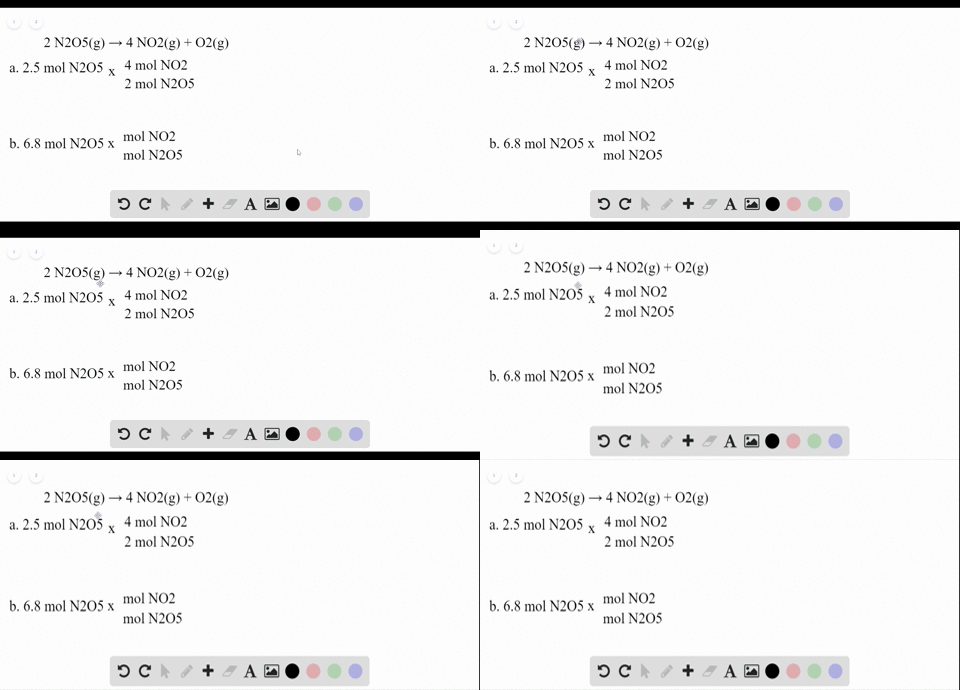
Calculate how many moles of NO2 form when each quantity of reactant completely reacts.2 N2O5(g)-4 NO2(g) + O2(g)a. 2.5 mol N2O5 b. 6.8 mol N2O5c. 15.2 g N2O5 d. 2.87 kg N2O5
Describe the roles of oxidizing agents and reducing agents in a redox reaction.How is each changed in the reaction?
Make and Use Graphs Alkali metals are strong reducing agents. Make agraph showing how the reducing abilities of the alkali metals wouls increase ordecrease as you move down the family from sodium to francium.
Use the oxidation-number method to balance these redox equations.$$\text {Challenge} \quad \mathrm{SO}_{2}+\mathrm{Br}_{2}+\mathrm{H}_{2} \mathrm{O} \rightarrow \mathrm{HBr}+\mathrm{H}_{2} \mathrm{SO}_{4}$$
Use the oxidation-number method to balance the following net ionic redox equations.$$\mathrm{Cr}_{2} \mathrm{O}_{7}^{2-}(\mathrm{aq})+\mathrm{I}^{-}(\mathrm{aq}) \rightarrow \mathrm{Cr}^{3+}(\mathrm{aq})+\mathrm{I}_{2}(\mathrm{s}) \quad \text {(in acid solution)}$$
Use the oxidation-number method to balance the following net ionic redox equations.$$\mathrm{Zn}+\mathrm{NO}_{3}^{-} \rightarrow \mathrm{Zn}^{2+}+\mathrm{NO}_{2} \quad \text {(in acid solution)}$$