Bethany Campbell

The University of West Florida
Teaching Assistant

Biography

I have bachelor's degrees in environmental science and physics, and am almost done with my master's degree in physics. I am passionate about education and have demonstrated interest in STEM education through involvement with Science Olympiad as a Coach and Event Supervisor/Test Writer and with the Science Fair as a category judge. I taught introductory physics labs as a Teaching Assistant at San Diego State University. In addition, I have completed various internships with government labs, one of which specifically focused on developing STEM lessons for children. I initially struggled with physics, so I am familiar with some of the common pitfalls and am confident in my ability to explain topics clearly.

Education

BS Environmental Science
The University of West Florida
BS Physics
The University of West Florida
MS Physics
San Diego State University

Educator Statistics

Numerade tutor for 6 years
7 Students Helped

Topics Covered

Explore the Fascinating Dynamics of Rotational Motion
Discover the Power of Gravitation: Exploring the Science Behind It
Mastering the Rotation of Rigid Bodies: Tips & Techniques
Understanding Electromagnetic Waves: A Comprehensive Guide
Understanding Reflection and Refraction of Light: A Comprehensive Guide
Explore the Fascinating World of Wave Optics - Unleash Its Potential

Bethany's Textbook Answer Videos

02:26
Physics: Principles with Applications

(II) For each of the cases described below, sketch and label the total acceleration vector, the radial acceleration vector, and the tangential acceleration vector. ($a$) A car is accelerating from 55 km/h to 70 km/h as it rounds a curve of constant radius. ($b$) A car is going a constant as it rounds a curve of constant radius. ($c$) A car slows down while rounding a curve of constant radius.

Chapter 5: CIRCULAR MOTION; GRAVITATION
Section 4: Nonuniform Circular Motion
Bethany Campbell
03:59
Physics for Scientists and Engineers with Modern Physics

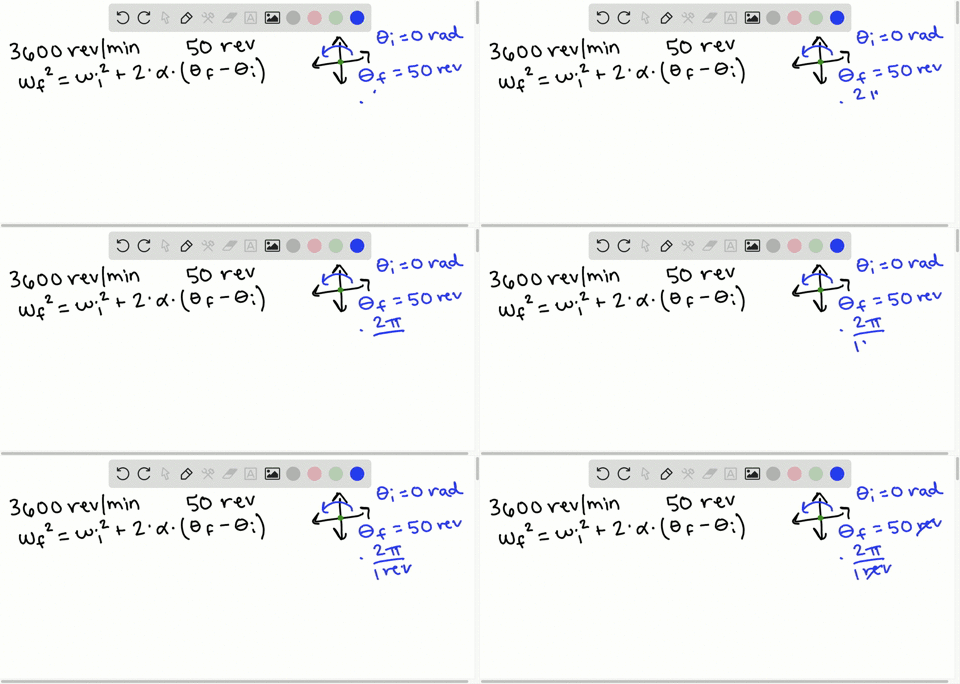
A centrifuge in a medical laboratory rotates at an angular speed of 3600 rev/min. When switched off, it rotates through 50.0 revolutions before coming to rest. Find the constant angular acceleration of the centrifuge.

Chapter 10: Rotation of a Rigid Object About a Fixed Axis
Bethany Campbell
06:11
Physics for Scientists and Engineers with Modern Physics

A machine part rotates at an angular speed of $0.060 \mathrm{rad} / \mathrm{s} ;$ its speed is then increased to 2.2 $\mathrm{rad} / \mathrm{s}$ at an angular acceleration of $0.70 \mathrm{rad} / \mathrm{s}^{2} .$ (a) Find the angle through which the part rotates before reaching this final speed. (b) If both the initial and final angular speeds are doubled and the angular acceleration remains the same, by what factor is the angular displacement changed? Why?

Chapter 10: Rotation of a Rigid Object About a Fixed Axis
Bethany Campbell
06:58
Physics for Scientists and Engineers with Modern Physics

A rotating wheel requires 3.00 s to rotate through 37.0 revolutions. Its angular speed at the end of the 3.00 -s interval is 98.0 $\mathrm{rad} / \mathrm{s}$ . What is the constant angular acceleration of the wheel?

Chapter 10: Rotation of a Rigid Object About a Fixed Axis
Bethany Campbell
05:38
University Physics with Modern Physics

A photographer takes a photograph of a Boeing 747 airliner (length 70.7 $\mathrm{m} )$ when it is flying directly overbead an altitude of 9.50 $\mathrm{km}$ . The lens has a focal length of 5.00 $\mathrm{m}$ . How long is the image of the airliner on the film?

Chapter 34: Geometric Optics and Optical Instruments
Bethany Campbell
08:38
Principles of Physics a Calculus Based Text

A submarine is $300 \mathrm{m}$ horizontally from the shore of a freshwater lake and $100 \mathrm{m}$ beneath the surface of the water. A laser beam is sent from the submarine so that the beam strikes the surface of the water $210 \mathrm{m}$ from the shore. A building stands on the shore, and the laser beam hits a target at the top of the building. The goal is to find the height of the target above sea level. (a) Draw a diagram of the situation, identifying the two triangles that are important in finding the solution. (b) Find the angle of incidence of the beam striking the water-air interface. (c) Find the angle of refraction. (d) What angle does the refracted beam make with the horizontal? (e) Find the height of the target above sea level.

Chapter 25: Reflection and Refraction of Light
Bethany Campbell
1 2