Bianca Gualtieri

Temple University
Teaching Assistant/Lab instructor

Biography

Hello! I am a 2nd year physics PhD student at Temple University in Philadelphia PA. My research focus is in experimental high energy particle physics. I received my undergraduate degree in physics (B.S.) from a small liberal arts school, Ursinus College. After graduate school I hope to pursue a career as a professor. I have always been interested in research and have been doing research since my sophomore year of undergrad. While in undergrad my research focus was on quantum controlling Rydberg atoms using a genetic algorithm. However I changed from this atomic physics research to particle physics in graduate school after I had a summer research internship at Michigan State University's Facility for Rare Isotope Beams lab. Here I learned a whole new field of physics that I completely fell in love with. I have been a teaching assistant from the time I was a junior in my undergrad and throughout graduate school currently. I always enjoy explaining my passion of physics to students who are just learning physics. I find that my very first physics professors made the biggest impact on my decision to pursue physics as a career. While being a TA I have also learned that there are many, many, different ways students learn. Physics is generally a hard concept for students to grasp at first and I believe every year I am a teaching assistant I become more developed as an educator, with new tools on how to present the material that is being covered so that it makes sense to all types of learners in my class.

Education

Phd Physics
Temple University
BS Physics
Ursinus College

Educator Statistics

Numerade tutor for 6 years
13 Students Helped

Topics Covered

Mastering the Rotation of Rigid Bodies: Tips & Techniques
Calculating Electrical Power: Resistance and EMF
Discovering the Fundamentals: Newton's Laws of Motion Explained
Exploring the Fascinating World of Quantum Physics

Bianca's Textbook Answer Videos

09:12
Physics for Scientists and Engineers

A teapot with a surface area of $700 \mathrm{cm}^{2}$ is to be silver plated. It is attached to the negative electrode of an electrolytic cell containing silver nitrate $\left(\mathrm{Ag}^{+} \mathrm{NO}_{3}^{-}\right) .$ If the cell is powered by a $12.0-\mathrm{V}$ battery and has a resistance of $1.80 \Omega,$ how long does it take for a 0.133 -mm layer of silver to build up on the teapot? (The density of silver is $\left.10.5 \times 10^{3} \mathrm{kg} / \mathrm{m}^{3} .\right)$

Chapter 27: Current and Resistance
Bianca Gualtieri
0:00
Physics for Scientists and Engineers

Suppose that the current through a conductor decreases exponentially with time according to the equation $I(t)=I_{0} e^{-t / \tau}$ where $I_{0}$ is the initial current (at $t=0),$ and $\tau$ is a constant having dimensions of time. Consider a fixed observation point within the conductor. (a) How much charge passes this point between $t=0$ and $i=\pi^{2}$ (b) How much charge passes this point between $t=0$ and $t=10 \tau ?$ (c) What If? How much charge passes this point between $t=0$ and $t=\infty ?$

Chapter 27: Current and Resistance
Bianca Gualtieri
08:38
University Physics with Modern Physics

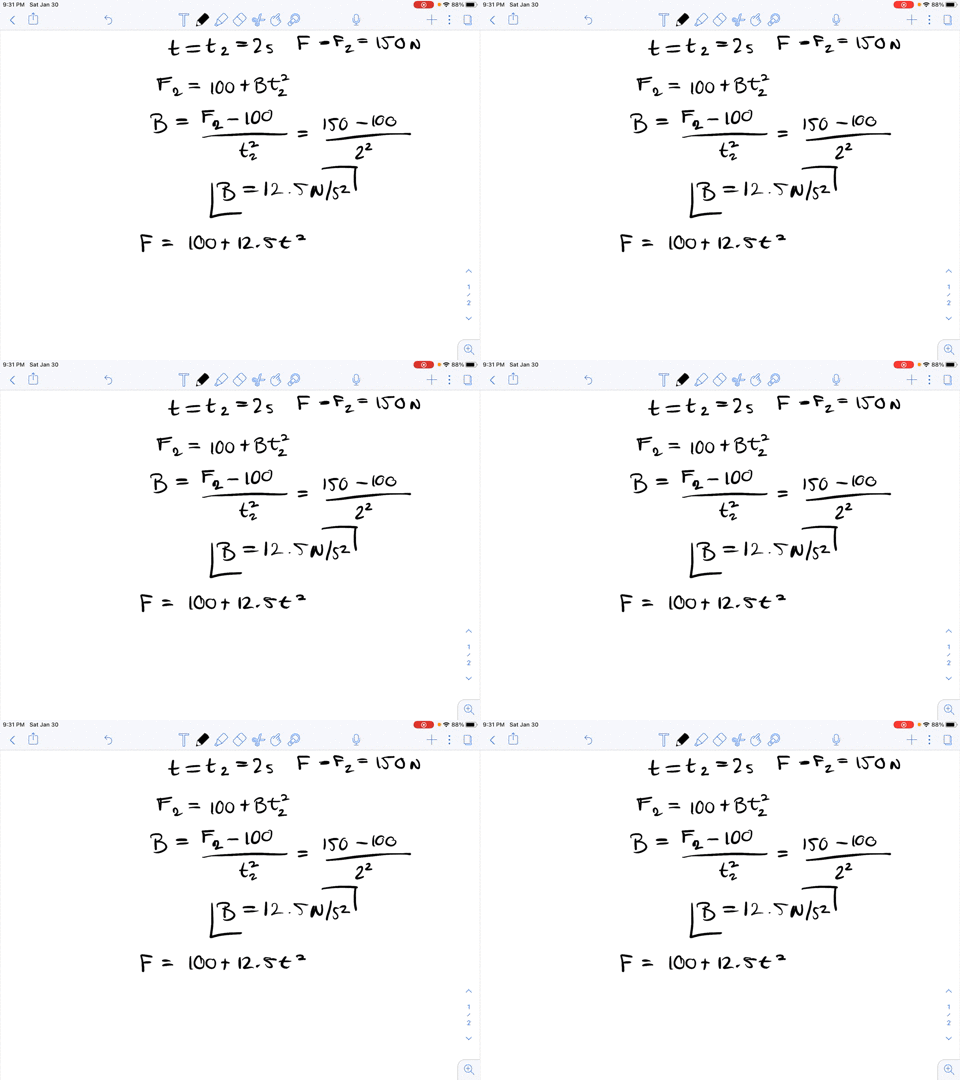
A small $8.00 \mathrm{~kg}$ rocket burn fuel that exerts a time-varying upward force on the rocket (assume constant mass) as the rocket moves upward from the launch pad. This force obeys the equation $F=A+B t^{2} .$ Measurements show that at $t=0,$ the force is $100.0 \mathrm{~N}$ and at the end of the first $2.00 \mathrm{~s}$, it is $150.0 \mathrm{~N}$. (a) Find the constants $A$ and $B$, including their SI units. (b) Find the net force on this rocket and its acceleration (i) the instant after the fuel ignites and (ii) $3.00 \mathrm{~s}$ after the fuel ignites. (c) Suppose that you were using this rocket in outer space, far from all gravity. What would its acceleration be 3.00 s after fuel ignition?

Chapter 4: Newton's Laws of Motion
Bianca Gualtieri
03:44
University Physics with Modern Physics

Estimate the mass in kilograms and the weight in pounds of a typical sumo wrestler. How do your estimates for the wrestler compare to your estimates of the average mass and weight of the students in your physics class? Do a web search if necessary to help make the estimates. In your solution list what values you assume for the quantities you use in making your estimates.

Chapter 4: Newton's Laws of Motion
Bianca Gualtieri
02:15
University Physics with Modern Physics

World-class sprinters can accelerate out of the starting blocks with an acceleration that is nearly horizontal and has magnitude $15 \mathrm{~m} / \mathrm{s}^{2} .$ How much horizontal force must a $55 \mathrm{~kg}$ sprinter exert on the starting blocks to produce this acceleration? Which object exerts the force that propels the sprinter: the blocks or the sprinter herself?

Chapter 4: Newton's Laws of Motion
Bianca Gualtieri
1 2 3