I have been a high school teacher for 9 years with experience teaching physics, chemistry and astronomy. I also have experience creating videos of problem solutions as I run my physics classes as a flipped classroom.
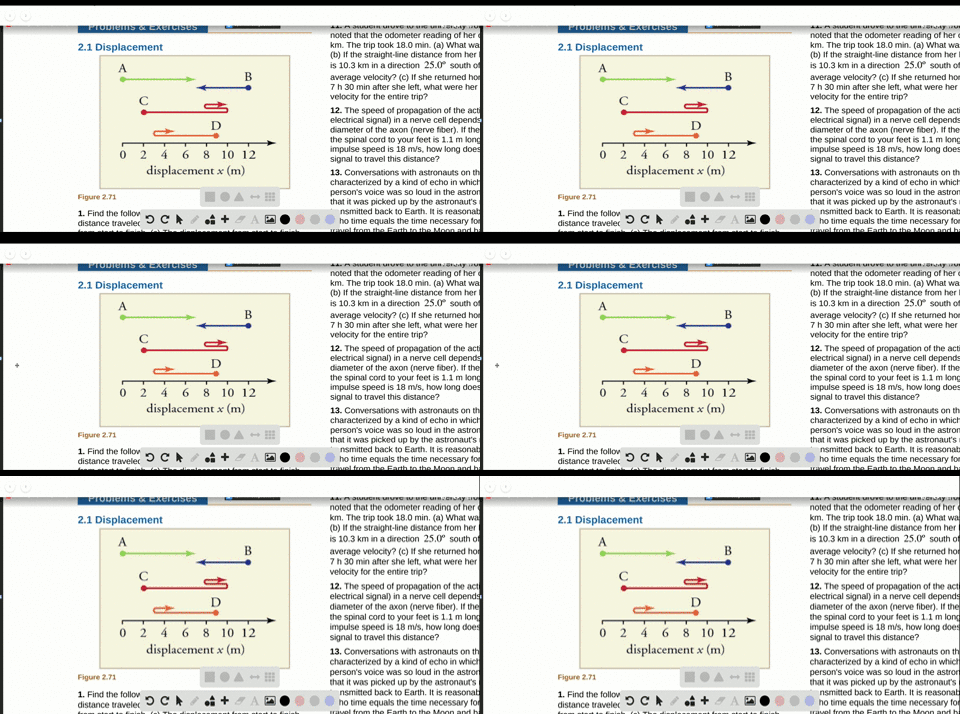
Find the following for path A in Figure 2.71: (a) The distance traveled. (b) The magnitude of the displacement from start to finish. (c) The displacement from start to finish.
Find the following for path C in Figure 2.71: (a) The distance traveled. (b) The magnitude of the displacement from start to finish. (c) The displacement from start to finish.
(a) Calculate Earth's average speed relative to the Sun. (b) What is its average velocity over a period of one year?
The North American and European continents are moving apart at a rate of about 3 cm/y. At this rate how long will it take them to drift 500 km farther apart than they are at present?
On May 26, 1934, a streamlined, stainless steel diesel train called the Zephyr set the world's nonstop long-distance speed record for trains. Its run from Denver to Chicago took 13 hours, 4 minutes, 58 seconds, and was witnessed by more than a million people along the route. The total distance traveled was 1633.8 km. What was its average speed in km/h and m/s?
A student drove to the university from her home and noted that the odometer reading of her car increased by 12.0 km. The trip took 18.0 min. (a) What was her average speed? (b) If the straight-line distance from her home to the university is 10.3 km in a direction $25.0^{\circ}$ south of east, what was her average velocity? (c) If she returned home by the same path 7 h 30 min after she left, what were her average speed and velocity for the entire trip?