Elizabeth Clark

University of Massachusetts Amherst
Lecturere in Calc for engineers

Biography

My MS is in Physics, I have been teaching high school including AP Physics and Math for 15 yrs. I have worked on textbooks before. Me and another grad student input all the chapter questions for a Physics txbk with variable inputs for each question for online homework.

Education

MA Physics
University of Massachusetts Amherst

Educator Statistics

Numerade tutor for 6 years
7 Students Helped

Topics Covered

Understanding Moment Impulse and Collisions for Better Physics
Understanding Electromagnetic Waves: A Comprehensive Guide
Understanding Reflection and Refraction of Light: A Comprehensive Guide

Elizabeth's Textbook Answer Videos

08:42
Physics for Scientists and Engineers with Modern Physics

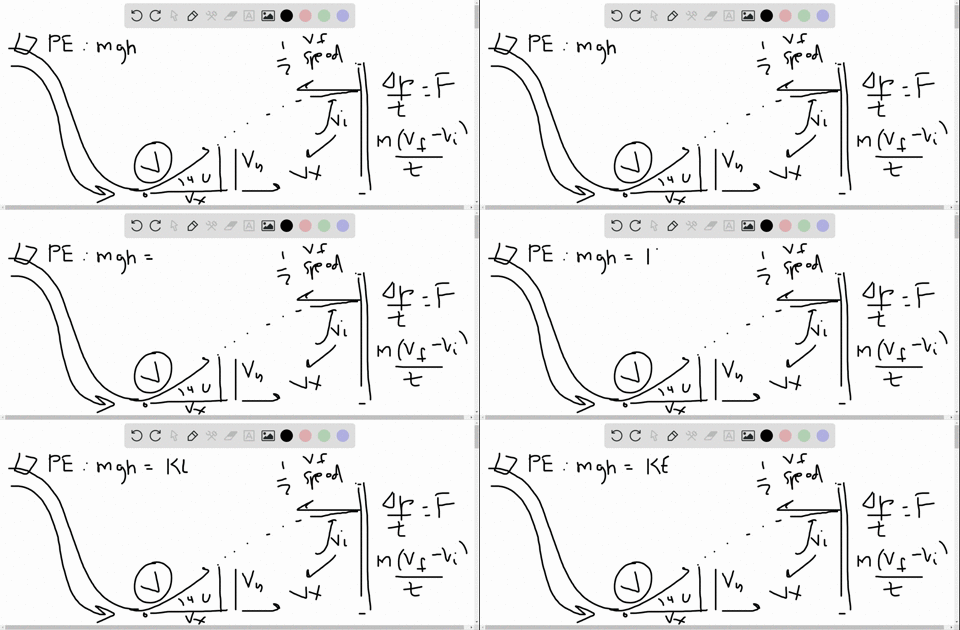
Small ice cubes, each of mass 5.00 g, slide down a friction-less track in a steady stream, as shown in Figure P9.66. Starting from rest, each cube moves down through a net vertical distance of 1.50 $\mathrm{m}$ and leaves the bottom end of the track at an angle of $40.0^{\circ}$ above the horizontal. At the highest point of its subsequent trajectory, the cube strikes a vertical wall and rebounds with half the speed it had upon impact. If 10.0 cubes strike the wall per second, what average force is exerted on the wall?

Chapter 9: Linear Momentum and Collisions
Elizabeth Clark
05:08
Physics

An object is placed $12.0 \mathrm{cm}$ in front of a lens of focal length $5.0 \mathrm{cm} .$ Another lens of focal length $4.0 \mathrm{cm}$ is placed $2.0 \mathrm{cm}$ past the first lens. (a) Where is the final image? Is it real or virtual? (b) What is the overall magnification?(www.interactive: virtual optics lab)

Chapter 24: Optical Instruments
Elizabeth Clark
05:23
Physics

A converging lens and a diverging lens, separated by a distance of $30.0 \mathrm{cm},$ are used in combination. The converging lens has a focal length of $15.0 \mathrm{cm} .$ The diverging lens is of unknown focal length. An object is placed $20.0 \mathrm{cm}$ in front of the converging lens; the final image is virtual and is formed $12.0 \mathrm{cm}$ before the diverging lens. What is the focal length of the diverging lens?

Chapter 24: Optical Instruments
Elizabeth Clark
04:08
Physics

Two converging lenses are placed $88.0 \mathrm{cm}$ apart. An object is placed $1.100 \mathrm{m}$ to the left of the first lens, which has a focal length of $25.0 \mathrm{cm} .$ The final image is located $15.0 \mathrm{cm}$ to the right of the second lens. (a) What is the focal length of the second lens? (b) What is the total magnification?

Chapter 24: Optical Instruments
Elizabeth Clark
04:12
Physics

An object is located $16.0 \mathrm{cm}$ in front of a converging lens with focal length $12.0 \mathrm{cm} .$ To the right of the converging lens, separated by a distance of $20.0 \mathrm{cm},$ is a diverging lens of focal length $-10.0 \mathrm{cm} .$ Find the location of the final image by ray tracing and verify using the lens equations.

Chapter 24: Optical Instruments
Elizabeth Clark
09:49
Physics

An object is located $10.0 \mathrm{cm}$ in front of a converging lens with focal length $12.0 \mathrm{cm} .$ To the right of the converging lens is a second converging lens, $30.0 \mathrm{cm}$ from the first lens, of focal length $10.0 \mathrm{cm} .$ Find the location of the final image by ray tracing and verify by using the lens equations.

Chapter 24: Optical Instruments
Elizabeth Clark
1