I am currently the Science and Mathematics tutor for an online blended 1-12 school within the Harrisburg City School District. I have a Bachelor's Degree in General Science as well as a Minor in Mathematics from the Pennsylvania State University where I also tutored in subjects including, but not limited to, multivariable calculus, differential equations, probability, statistics and algebra. I come from a family of educators and I love not only teaching about math and science but trying to inspire excitement and enthusiasm towards both subjects.
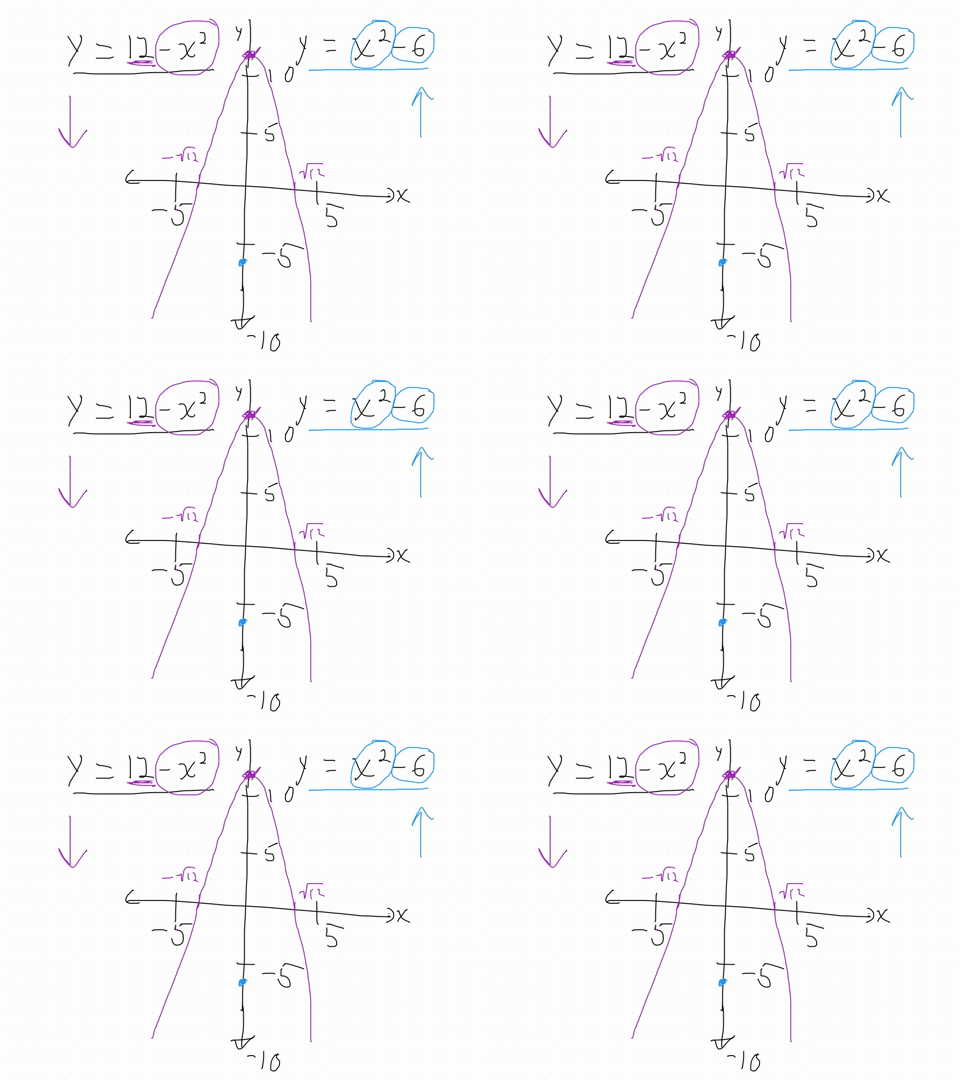
Sketch the region enclosed by the given curves and find its area.$y=12-x^{2}, \quad y=x^{2}-6$
The Force Exerted on the Moon In FIGURE $5-37$ we show the Earth,Moon, and Sun (not to scale) in their relative positions at thetime when the Moon is in its third-quarter phase. Though fewpeople realize it, the force exerted on the Moon by the Sun isactually greater than the force exerted on the Moon by theEarth. In fact, the force exerted on the Moon by the Sun has a magnitude of $F_{\mathrm{sM}}=4.34 \times 10^{20} \mathrm{N},$ whereas the force exerted bythe Earth has a magnitude of only $F_{\mathrm{EM}}=1.98 \times 10^{20} \mathrm{N}$ . Theseforces are indicated to scale in Figure $5-37 .$ Find (a) the directionand (b) the magnitude of the net force acting on the Moon.(c) Given that the mass of the Moon is $M_{M}=7.35 \times 10^{22} \mathrm{kg}$ ,find the magnitude of its acceleration at the time of the third-quarter phase.
You pull upward on a stuffed suitcase with a force of 105 $\mathrm{N}$ , and itaccelerates upward at 0.725 $\mathrm{m} / \mathrm{s}^{2} .$ What are (a) the mass and (b) the weight of the suitcase?
BIO Brain Growth A newborn baby's brain grows rapidly. In fact,it has been found to increase in mass by about 1.6 mg per minute.(a) How much does the brain's weight increase in one day? (b) Howmuch time does it take for the brain's weight to increase by 0.15 $\mathrm{N} ?$
Suppose a rocket launches with an acceleration of 30.5 $\mathrm{m} / \mathrm{s}^{2}$ .What is the apparent weight of a 92 -kg astronaut aboard this rocket?
During an episode of turbulence in an airplane you feel 190 $\mathrm{N}$heavier than usual. If your mass is $78 \mathrm{kg},$ what are the magnitudeand direction of the airplane's acceleration?