I have taught calculus and statistics to college undergraduate and graduate students. I guide students through thinking and use drawings to illustrate concepts.
The system of differential equations$ \frac {dx}{dt} = 0.5x - 0.004x^2 - 0.001xy $$ \frac {dy}{dt} = 0.4y - 0.001y^2 - 0.002xy $is a model for the populations of two species.(a) Does the model describe cooperation, or competition, or a predator-prey relationship?(b) Find the equilibrium solutions and explain their significance.
Lynx eat snowshoe hares and snowshoe hares eat woody plants like willows. Suppose that, in the absence of hares, the willow population will grow exponentially and the lynx population will decay exponentially. In the absence of lynx and willow, the hare population will decay exponentially. If $ L(t), H(t), $ and $ W(t) $ represent the populations of these three species at time $ t, $ write a system of differential equations as a model for their dynamics. If the constants in your equation are all positive, explain why you have used plus or minus signs.
A phase trajectory is shown for population of rabbits $ (R) $ and foxe $ (F). $(a) Describe how each populations changes as time goes by.(b) Use your description to make a rough sketch of the graphs of $ R $ and $ F $ as functions of time.
Graphs of populations of two species are shown. Use them to sketch the corresponding phase trajectory.
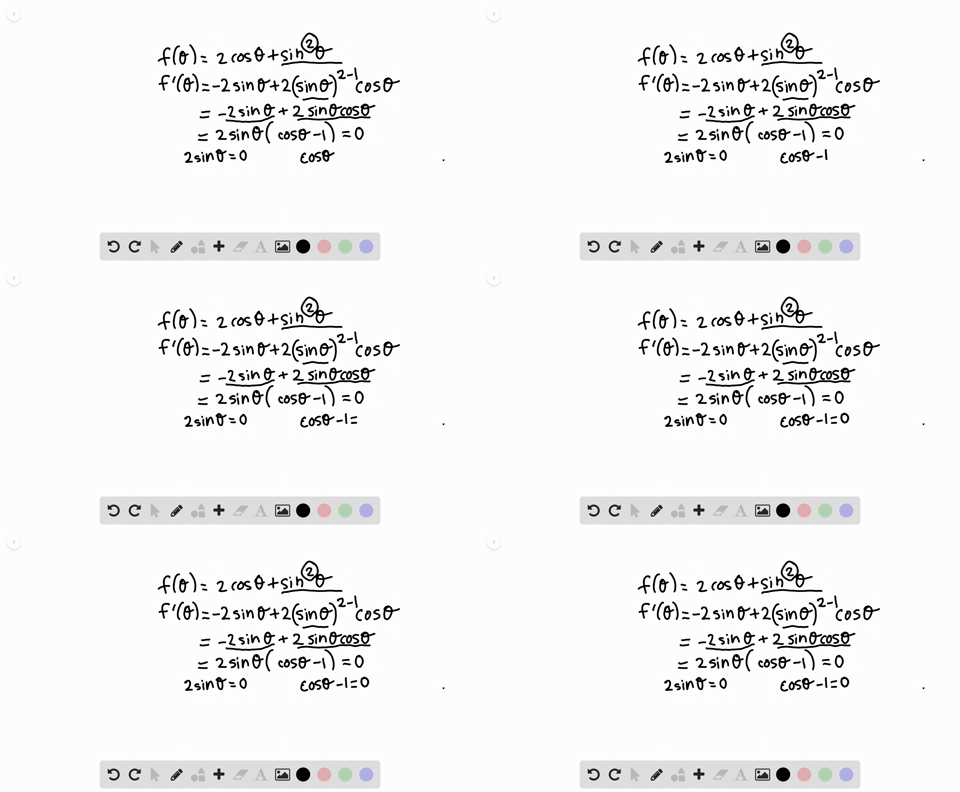
$23-36=$ Find the critical numbers of the function.$$f(\theta)=2 \cos \theta+\sin ^{2} \theta$$
On average, a clothing store gets 120 customers per day.
What is the probability of getting 150 customers in one day? (Round your answer to four decimal places.)
An airline flies the same route at the same time each day. The flight time varies according to a Normal distribution with unknown mean and standard deviation. On 15% of days, the flight takes more than an hour. On 3% of days, the flight lasts 75 minutes or more. Use this information to determine the mean and standard deviation of the flight time distribution.
Ann and Bev have each applied for several jobs at a local university. Let $A$ be the event that Ann is hired and let $B$ be the event that Bev is hired. Express in terms of $A$ and $B$ the events(a) Ann is hired but not Bev.(b) At least one of them is hired.(c) Exactly one of them is hired.
Consider randomly selecting a student at a certain university, and let $A$ denote the event that theselected individual has a Visa credit card and $B$ be the analogous event for a MasterCard. Suppose that $P(A)=.5, P(B)=.4,$ and $P(A \cap B)=.25 .$(a) Compute the probability that the selected individual has at least one of the two types of cards (i.e., the probability of the event $A \cup B )$ .(b) What is the probability that the selected individual has neither type of card?(c) Describe, in terms of $A$ and $B$ , the event that the selected student has a Visa card but not a MasterCard, and then calculate the probability of this event.
Recall that the cigarette industry requires that models incigarette ads must appear to be at least 25 years old. Also recallthat a sample of 50 people is randomly selected at a shopping mall.Each person in the sample is shown a "typical cigarette ad" and isasked to estimate the age of the model in the ad.The p-value fortesting H0 versus Ha canbe calculated to be 0.0038.Determine whether H0 would berejected at each of α =.10, α = .05, α = .01,and α = .001. (Round youranswer to 4 decimal places.)p-value= Reject H0 at α =
Assume that a simple random sample has been selected from a normally distributed population and test the given claim. Identify the null and alternative hypotheses, test statistic, P-value, and state the final conclusion that addresses the original claim. A simple random sample of 25 filtered 100 mm cigarettes is obtained, and the tar content of each cigarette is measured. The sample has a mean of 19.2 mg and a standard deviation of 3.22 mg. Use a 0.05 significance level to test the claim that the mean tar content of filtered 100 mm cigarettes is less than 21.1 mg, which is the mean for unfiltered king-size cigarettes. What do the results suggest, if anything, about the effectiveness of the filters?