Kaylee Rushlau

University of Nebraska at Omaha
Tutor

Biography

I believe obtaining my bachelor’s degree in Neuroscience helps give me a well diverse background to be able to help tutor neuroscience to other students. I did help many of the students in my neuroscience classes with homework and understanding the material that we were covering in class. Many of the topics I helped students learn were brain imaging techniques, neuronal staining, brain regions and their functions, neurogenesis, different types of cells that make up neuronal matter, as well as the behavioral aspects of neuroscience. Many of the classes I took at the University of Nebraska were on the genetics and hormone side of the neuroscience curriculum. During my junior and senior year as an undergraduate I also worked in a research laboratory that was inquiring the neural and genetic differences in zebrafish stress coping styles. Working in this laboratory allowed me to use the different behavioral and genetic based techniques I had learned in my classes applied in an academic setting. With working in the laboratory, we were required to help other students in the lab with their projects and troubleshooting when a student’s project was not going as planned. I believe my class time experience as well and my hands-on training would help me when helping students in tutoring sessions. When it comes to tutoring making concepts and techniques make sense in a bigger picture to the student is very critical and I believe my past experiences would help me excel in tutoring this subject to students. When I was a junior and senior in high school, I tutored geometry to sophomores in my school. I would set up a time with students usually in the evening to go over homework problems or any questions they had regarding the material they covered in class. I and the students would meet on a regular basis, on average during the school week of 1-2 sessions on the weekend if needed. During college, I would help tutor students that needed help with subjects that I have already completed. I would answer any questions they had either about homework or concepts they didn’t feel confident about. When I tutor someone my first objective is to understand their learning style so I can be effective while tutoring them. Then I let the student explain what they feel like they aren’t understanding or grasping, and from there I start to help the student on the journey to understand the concepts and applying helping them apply it. I believe that what makes a great tutor is the understanding of how individual students learn so I can better help them understand the concepts they are having problems with. When I first start to tutor a student I want to know what concepts they do understand and then figure out where the disconnect is so I can help them connect the dots of what they do not yet understand. I have tutored Biology, Chemistry, and Neuroscience while attending the University of Nebraska at Omaha. I have also tutored geometry in my senior year of high school. Everyone has a different style/way of learning, I personally learn by reading the material then writing out the concepts that I do and do not understand using diagrams. I believe to be a great tutor you must be able to explain subjects or concepts in multiple ways so that way if the student does not understand one you can explain it differently. At the end of the lesson, I want to make sure that they can explain what was covered back to me so I know they are making progress.

Education

BS Neuroscience
University of Nebraska at Omaha

Educator Statistics

Numerade tutor for 6 years
62 Students Helped

Topics Covered

Advancements in Genomics and Biotechnology: Revolutionizing Science
Ecosystems and Restoration Ecology: Restoring Balance and Biodiversity
Conservation Biology and Global Change: Protecting Our Planet
Discover the Power of Gases: Benefits and Applications
Unlocking the Power of Thermodynamics: A Comprehensive Guide
Exploring the Fascinating World of Thermochemistry | Learn More Today

Kaylee's Textbook Answer Videos

04:14
Chemistry: The Molecular Nature of Matter and Change

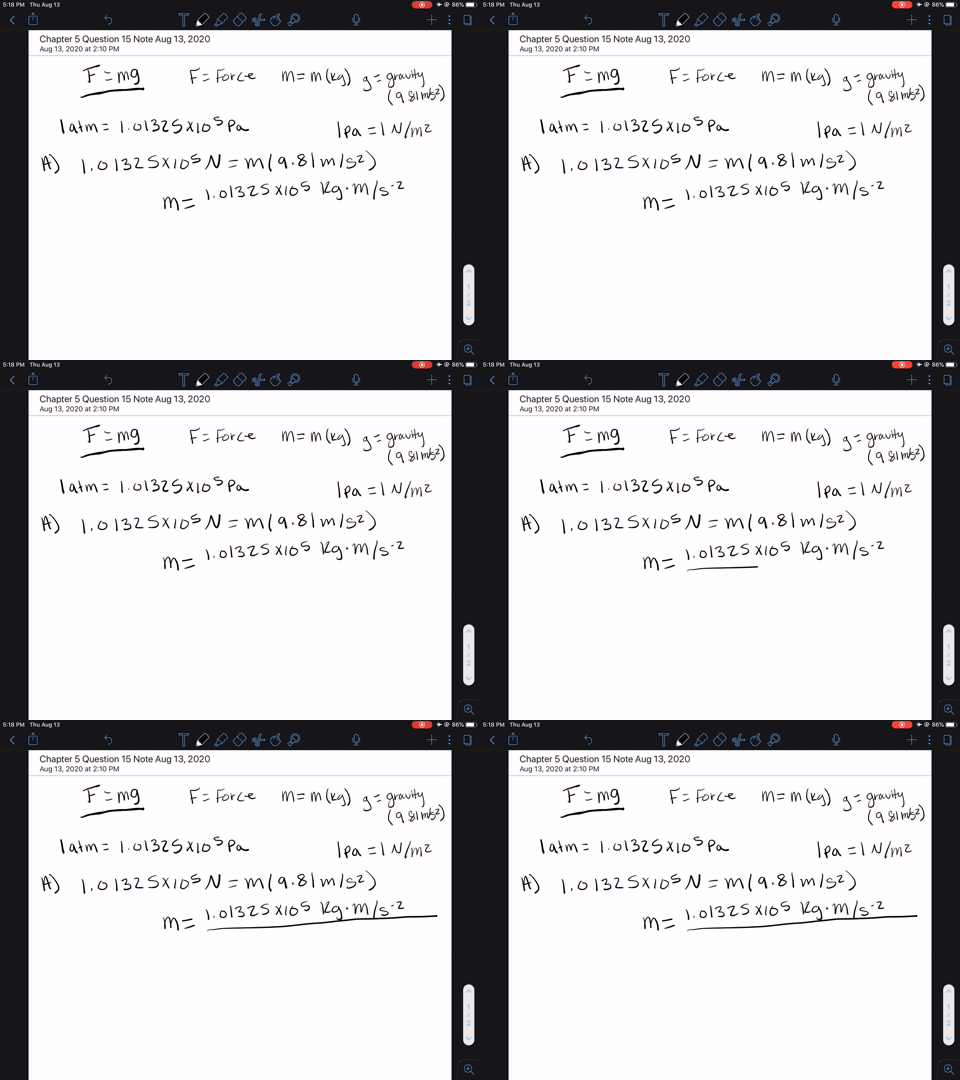
The gravitational force exerted by an object is given by $F=m g,$ where $F$ is the force in newtons, $m$ is the mass in kilograms, and $g$ is the acceleration due to gravity $\left(9.81 \mathrm{m} / \mathrm{s}^{2}\right) .$
(a) Use the definition of the pascal to calculate the mass (in $\mathrm{kg}$ ) of the atmosphere above 1 $\mathrm{m}^{2}$ of ocean.
(b) Osmium $(Z=76)$ is a transition metal in Group 8 $\mathrm{B}(8)$ and has the highest density of any element $(22.6 \mathrm{g} / \mathrm{mL})$ . If an osmium column is 1 $\mathrm{m}^{2}$ in area, how high must it be for its pressure to equal atmospheric pressure? [Use the answer from part (a) in your calculation. $]$

Chapter 5: Gases and the Kinetic-Molecular Theory
Kaylee Rushlau
05:00
Chemistry: The Molecular Nature of Matter and Change

A sample of air contains 78.08$\%$ nitrogen, 20.94$\%$ oxygen, 0.05$\%$ carbon dioxide, and 0.93$\%$ argon, by volume. How many molecules of each gas are present in 1.00 $\mathrm{L}$ of the sample at $25^{\circ} \mathrm{C}$ and 1.00 $\mathrm{atm}$ ?

Chapter 5: Gases and the Kinetic-Molecular Theory
Kaylee Rushlau
01:52
Chemistry: The Molecular Nature of Matter and Change

In the four piston-cylinder assemblies below, the reactant in the left cylinder is about to undergo a reaction at constant $T$ and $P :$
Which of the other three depictions best represents the products of the reaction?

Chapter 5: Gases and the Kinetic-Molecular Theory
Kaylee Rushlau
05:51
Chemistry: The Molecular Nature of Matter and Change

Roasting galena [lead(II) sulfide] is a step in the industrial isolation of lead. How many liters of sulfur dioxide, measured at STP, are produced by the reaction of 3.75 $\mathrm{kg}$ of galena with 228 $\mathrm{L}$ of oxygen gas at $220^{\circ} \mathrm{C}$ and 2.0 atm? Lead(II) oxide also forms.

Chapter 5: Gases and the Kinetic-Molecular Theory
Kaylee Rushlau
05:08
Chemistry: The Molecular Nature of Matter and Change

Hemoglobin is the protein that transports $\mathrm{O}_{2}$ through the blood from the lungs to the rest of the body. To do so, each molecule of hemoglobin combines with four molecules of $\mathrm{O}_{2}$ . If 1.00 $\mathrm{g}$ of hemoglobin combines with 1.53 $\mathrm{mL}$ of $\mathrm{O}_{2}$ at $37^{\circ} \mathrm{C}$ and 743 torr, what is the molar mass of hemoglobin?

Chapter 5: Gases and the Kinetic-Molecular Theory
Kaylee Rushlau
06:52
Chemistry: The Molecular Nature of Matter and Change

A baker uses sodium hydrogen carbonate (baking soda) as the leavening agent in a banana-nut quickbread. The baking soda decomposes in either of two possible reactions:
$$
\begin{array}{l}{\text { (1) } 2 \mathrm{NaHCO}_{3}(s) \longrightarrow \mathrm{Na}_{2} \mathrm{CO}_{3}(s)+\mathrm{H}_{2} \mathrm{O}(l)+\mathrm{CO}_{2}(g)} \\ {\text { (2) } \mathrm{NaHCO}_{3}(s)+\mathrm{H}^{+}(a q) \longrightarrow \mathrm{H}_{2} \mathrm{O}(l)+\mathrm{CO}_{2}(g)+\mathrm{Na}^{+}(a q)}\end{array}
$$
Calculate the volume (in mL) of $\mathrm{CO}_{2}$ that forms at $200 .^{\circ} \mathrm{C}$ and 0.975 atm per gram of $\mathrm{NaHCO}_{3}$ by each of the reaction processes.

Chapter 5: Gases and the Kinetic-Molecular Theory
Kaylee Rushlau
1 2 3 4 5 ... 11