Working as Physics Teacher and Lecturer in well reputed private sector school and college. Expert in theoretical and applied Physics.
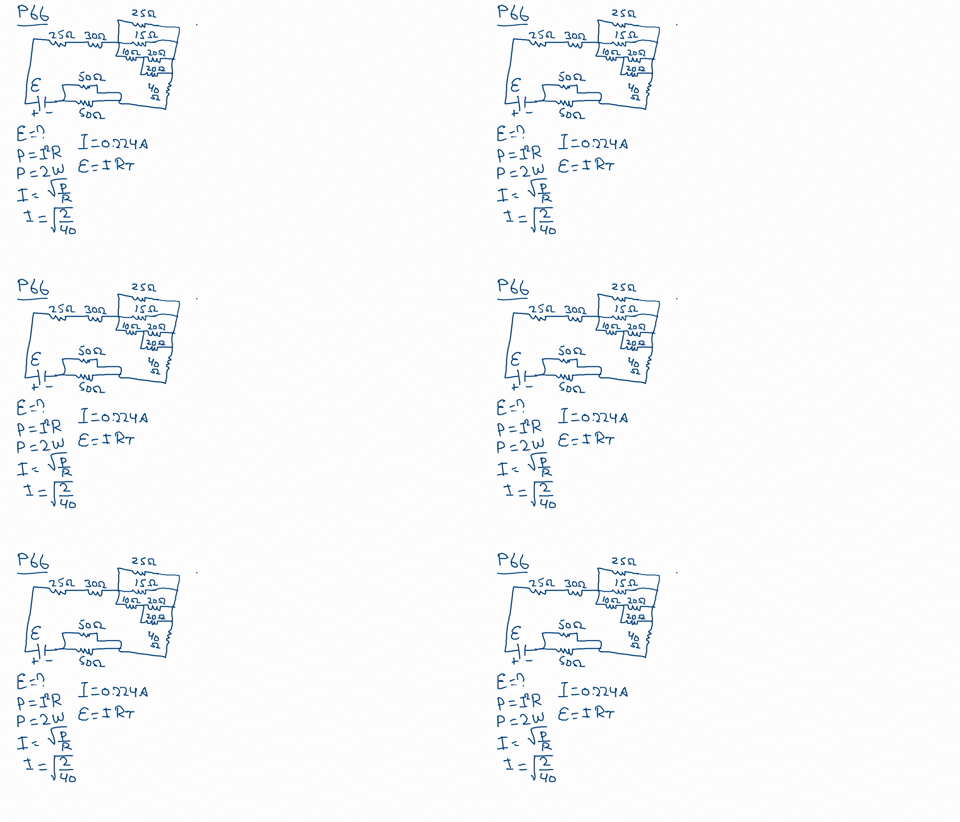
In the circuit shown in Fig. P26.66 all the resistors are rated at a maximum power of 2.00 W. What is the maximum emf $\varepsilon$ that the battery can have without burning up any of the resistors?
The capacitor in $\textbf{Fig. P26.70}$ is initially uncharged. The switch $S$ is closed at $t =$ 0. (a) Immediatelyafter the switch is closed, what is the current through each resistor? (b) What is the final charge on the capacitor?
The circuit shown in $\textbf{Fig. P26.74}$, called a $Wheatstone$ $bridge$, is used to determine the value of an unknown resistor $X$ by comparison with three resistors $M$, $N$, and $P$ whose resistances can be varied. For each setting, the resistance of each resistor is precisely known. With switches $S_1$ and $S_2$ closed, these resistors are varied until the current in the galvanometer G is zero; the bridge is then said to be $balanced$. (a) Show that under this condition the unknown resistance is given by $X = MP/N$. (This method permits very high precision in comparing resistors.) (b) If galvanometer G shows zero deflection when $M =$ 850.0 $\Omega$, $N =$ 15.00 $\Omega$, and $P =$ 33.48 $\Omega$, what is the unknown resistance $X$?
$\because$ A finch rides on the back of a Galapagos tortoise, which walksat the stately pace of 0.060 $\mathrm{m} / \mathrm{s}$ . After 1.5 minutes the finch tires ofthe tortoise's slow pace, and takes flight in the same direction foranother 1.5 minutes at 11 $\mathrm{m} / \mathrm{s} .$ What was the average speed of thefinch for this 3.0 -minute interval?
To tighten a spark plug, it is recommended that a torque of 15 $\mathrm{N} \cdot \mathrm{m}$ be applied. If a mechanic tightens the spark plug with awrench that is 25 $\mathrm{cm}$ long, what is the minimum force necessaryto create the desired torque?
Pulling a Weed The gardening tool shown in FIGURE $11-37$ is used to pull weeds. If a $1.23-\mathrm{N} \cdot \mathrm{m}$ torque is required to pull a given weed,what force did the weed exert on the tool?