Hey there! I’m teacher James. I have a bachelor’s degree in Secondary Education Major in Biological Science, I love tutoring science subjects like Biology, Chemistry, and Physics because I get the chance to discuss how applicable science is to everyday life. I am passionate about sharing my knowledge with others and I love helping students like you. In my free time, I like to complete projects around the house, take my wife and dine at new local restaurants.
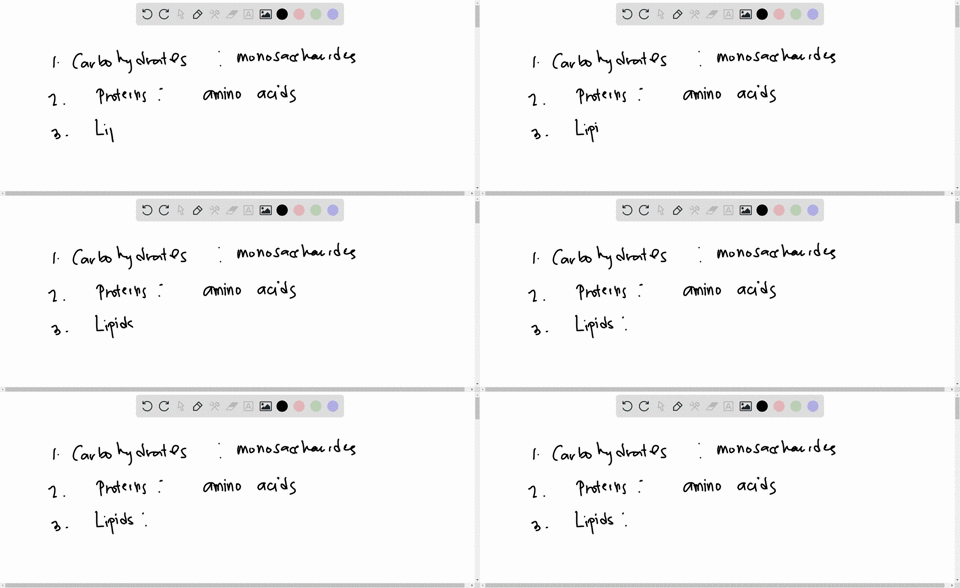
List the four biological molecules commonly found in living organisms.
List the structural features in a prokaryotic cell.
Water _________A. is a good solute; B. facilitates chemical reactions; C. serves as an enzyme; D. makes strong covalent bonds with other molecules; E. consists of two oxygen and one hydrogen atoms.
Ions are _______ A. the smallest particles; B. held together by covalent bonds; $\mathrm{C}$. always charged; D. found in the nucleus of an atom along with neutrons; E. the main building blocks of water.
Which of the following is the odd one out?A. amino acid; B. monosaccharide; C. guanine; D. protein; E. tryptophan
In a SINGLE turn of the Calvin cycle, how many CO2 molecules arebrought in?Question 5 options:1236
You have a diploid cell with an n=11. How many differentcombinations of the maternal and paternal chromosomes are possiblefor the two diploid cells at the end of MITOSIS? A. 11 B. 22 C. 1D. 2,048
The principal energy molecule used on the inside the cells ofliving organisms isGroup of answer choicessugarDNARNAATP
1) Which of the following events does not directly require ATPor GTP to occur?a) Import of a protein into the ERb) Import of a protein into the mitochondriac) Vesicle tethering by Rab proteinsd) Membrane fusion mediated by SNARE proteinse) Import of a protein into the nucleus2. One day in the lab, your super-nice roommate injects acell with excess of alpha and beta tubulin dimers bound to a"nonhydrolyzable" form of GTP. This prevent the phosphoanhydridebond from breaking in the GTP molecule. How will this affectmicrotubules in the cell? Select ALL correct answers!a) Microtubules would stop growing because new dimers couldnot be added to the microtubules.b) Microtubules would grow longer at the plus end.c) No change, as addition of monomers bindingnonhydrolyzable GTP would not affect microtubule length.d) Microtubules would show less frequent "catastrophic"shrinking.e) Microtubules would show more frequent "catastrophic"shrinking.
Which of the following characteristics determine a virus's host range? - Whether its nucleic acid is DNA or RNA - The enzymes carried by the virus - The presence or absence of an envelope - The enzymatic activity of the host cell - The proteins on the virus's surface and those of the host
Which of the following statements about the channels that generate transient A-type potassium currents is NOT true?A. They reduce the amplitude of EPSPs.B. In mammals, they are represented by Kv2.1 and Kv2.2 channels, which closely resemble the Drosophila channels encoded by the Shaw gene.C. They have an inactivation gate.D. Their density in dendrites increases with distance from the soma.E. Under physiological conditions, they generate outward currents.F. They oppose depolarization and delay firing.